
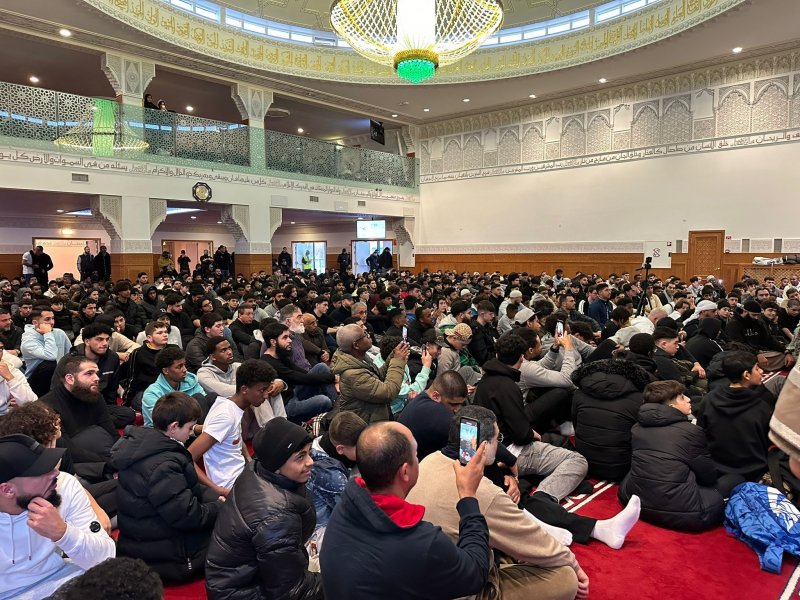
Source: The Copenhagen Post
Denmark’s immigration minister has announced plans to ban the Islamic call to prayer, arguing that some parts of the country increasingly resemble “a suburb of Islamabad,” News.Az reports, citing The Telegraph.
Morten Bødskov, a member of the center-left Social Democrats party, said the government intends to resume an investigation into whether such a ban could be legally implemented.
“The call to prayer should not be heard over Danish rooftops,” Bødskov told news agency Ritzau. “It has no place in Denmark, and you shouldn’t be in any doubt whether you’ve ended up in a suburb of Islamabad when you walk around Denmark.”
In some areas of the country, including parts of Copenhagen, local regulations already prevent the broadcasting of the call to prayer from mosque minarets because of strict noise restrictions.
Bødskov also argued that what he described as a gradual “Islamisation” of Denmark was occupying too much public space.
The Adhan, the Islamic call to prayer, is traditionally performed five times a day to summon worshippers to mosques, often using loudspeakers mounted on minarets.
This marks the third attempt by a Danish immigration minister to establish a legal basis for banning the public call to prayer, following similar efforts by Social Democratic governments in 2020 and 2025.
Denmark has adopted some of Europe’s toughest immigration policies under Prime Minister Mette Frederiksen, who began her third term earlier this month.
Under the country’s so-called “ghetto” legislation, authorities can require migrants to relocate from neighborhoods deemed to have excessively high concentrations of foreign residents.
In certain cases, asylum seekers must surrender jewelry and other valuable possessions to help cover accommodation costs, and applicants whose asylum claims are rejected are not entitled to financial assistance.
During the 2015 refugee crisis, when more than one million people fled the Middle East and sought refuge in Europe, Denmark accepted significantly fewer asylum seekers than many neighboring countries.
Any attempt to ban the Islamic call to prayer could face legal challenges, as the government’s review is expected to examine the balance between religious freedom and the rights of residents living near mosques.
Denmark’s constitution guarantees the right to public worship, although exceptions exist, including restrictions on anti-democratic preaching and financial contributions to prohibited organizations.
Countries such as Germany and the United Kingdom also impose regulations on mosque broadcasts, including limits on operating hours and sound levels to minimize disturbance to nearby residents.
Denmark has a population of approximately six million people, including around 270,000 Muslims. The country is home to an estimated 100 mosques, among them the Grand Mosque of Copenhagen, which does not broadcast the call to prayer outdoors under an agreement with local authorities.