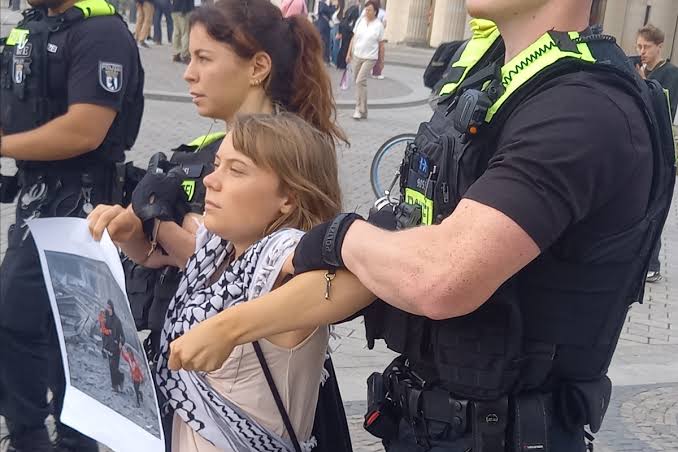
Swedish climate activist Greta Thunberg joined pro-Palestinian protesters outside a Rheinmetall weapons factory in Berlin, adding her voice to growing demonstrations against arms supplies to Israel.
The protest, organized by the activist group Peacefully Against Genocide, focused on the German defense company’s alleged role in supplying military equipment used during Israel’s ongoing military campaign in Gaza, News.Az reports.
The demonstration comes amid increasing activism across Europe targeting governments and defense manufacturers over arms exports to Israel, as the humanitarian situation in Gaza continues to fuel international debate.
What happened in Berlin?
More than 30 activists gathered outside Rheinmetall’s manufacturing facility in Berlin’s Wedding district on Tuesday as part of a coordinated protest against the company’s alleged military supplies to Israel.
Demonstrators employed a range of non-violent civil disobedience tactics. Several protesters staged a sit-in at the entrance to the factory, while others glued themselves to the road leading to the facility in an attempt to block vehicle access and disrupt operations. Throughout the demonstration, participants carried Palestinian flags and banners while chanting slogans including “Free Palestine,” “Free Gaza,” and “Your weapons, your money murder around the world.”
The protest formed part of a broader week-long campaign organized by Peacefully Against Genocide, which has held multiple demonstrations across Berlin between July 8 and July 15.
Why was Greta Thunberg participating?
Greta Thunberg has become one of the most recognizable international figures supporting calls for a ceasefire in Gaza. Although she rose to global prominence through climate activism, particularly the Fridays for Future movement, she has increasingly linked environmental justice with broader human rights and social justice issues.
Since the outbreak of the Israel-Hamas war in October 2023, Thunberg has repeatedly expressed support for Palestinian civilians, participated in demonstrations across Europe, and criticized governments that continue to support Israel’s military campaign. Her appearance at the Rheinmetall protest reflects her broader view that activism should address interconnected global issues, including armed conflict, humanitarian crises, and human rights.
Her participation also brought significant international attention to what otherwise might have remained a relatively local protest outside a defense manufacturing facility.
Who organized the protest?
The demonstration was organized by Peacefully Against Genocide, an activist group that has coordinated a series of protests in Berlin aimed at opposing Germany’s political and military support for Israel.
According to the organizers, the week-long campaign seeks to draw attention to what they describe as Germany’s complicity in the war in Gaza. Their principal demands include an immediate end to German arms exports to Israel, greater political pressure for a ceasefire, and the closure of Rheinmetall’s Berlin production site.
Organizers say they intend to continue using peaceful civil disobedience to pressure both government institutions and private defense companies.
Why are protesters targeting Rheinmetall?
Rheinmetall is Germany’s largest defense contractor and one of Europe’s leading manufacturers of military equipment. The company produces a wide range of defense systems, including armored vehicles, artillery ammunition, air defense systems, military electronics, and ammunition for various weapons platforms.
Activists argue that companies manufacturing weapons used in ongoing conflicts should bear responsibility for the humanitarian consequences of those conflicts. They allege that Rheinmetall manufactures components that ultimately become part of ammunition supplied to Israel.
The Berlin factory, which previously focused primarily on automotive components, now manufactures parts used in the production of large-caliber artillery ammunition. Protesters claim that some of this ammunition reaches the Israeli military and is used during operations in Gaza and southern Lebanon.
Rheinmetall has not publicly commented on the allegations made during Tuesday’s protest.
Does Rheinmetall directly supply weapons to Israel?
Rheinmetall has acknowledged in the past that it conducts international defense business, including exports approved under German law. However, the specific supply chains involving ammunition components can be complex and often involve multiple manufacturers, subcontractors, and government export approvals.
Germany maintains one of Europe’s strictest arms export control systems, requiring government authorization before military equipment can be exported to foreign countries. Export licenses are evaluated based on German legislation, European Union regulations, and international obligations.
While activists argue that Rheinmetall products ultimately support Israeli military operations, the company has not publicly confirmed the specific allegations raised during Tuesday’s demonstration.
How did German police respond?
Police intervened after protesters blocked roads leading to the Rheinmetall facility. Officers removed demonstrators from the roadway and carried out identity checks, during which several activists were detained.
According to police procedures, individuals who obstruct public roads or refuse to comply with lawful orders may be temporarily detained while authorities verify their identities or restore public access.
Protest organizers accused police of using disproportionate force during the operation. They alleged that some activists were handcuffed with their hands behind their backs while being removed from the protest site. Authorities had not publicly responded to those allegations immediately following the demonstration.
Despite the police operation, protesters continued chanting slogans after many of the roadblocks had been cleared.
Why are activists using civil disobedience?
Civil disobedience has long been a common tactic among environmental, peace, and human rights movements. Rather than relying solely on marches or rallies, activists deliberately disrupt normal activities to draw public attention to issues they believe require urgent action.
Methods such as sit-ins, road blockades, and gluing themselves to roads are intended to create media coverage while remaining non-violent. Participants generally accept the possibility of arrest or detention as part of their protest strategy.
Supporters argue that peaceful disruption is justified when governments fail to respond to major humanitarian or environmental crises. Critics, however, contend that such tactics inconvenience the public, disrupt businesses, and sometimes violate the law without advancing constructive dialogue.
Why has Gaza become a major focus of international protests?
The humanitarian situation in Gaza has generated widespread international concern since the conflict between Israel and Hamas escalated following the Hamas attacks on Israel in October 2023.
Military operations have resulted in extensive destruction, large-scale displacement, and significant civilian casualties, prompting repeated calls from humanitarian organizations and many governments for increased protection of civilians, humanitarian access, and ceasefire negotiations.
These developments have sparked demonstrations across Europe, North America, Latin America, and parts of Asia. Protesters have demanded various measures, including immediate ceasefires, expanded humanitarian aid, sanctions, recognition of Palestinian statehood, and restrictions on arms exports to Israel.
At the same time, other demonstrations have expressed support for Israel’s right to self-defense and emphasized the need to secure the release of hostages taken by Hamas, highlighting the deep divisions surrounding the conflict.
Why are defense companies increasingly becoming protest targets?
Traditionally, demonstrations related to armed conflicts focused primarily on governments and embassies. Increasingly, however, activists are directing attention toward defense manufacturers, arguing that companies producing military equipment also bear ethical responsibilities regarding how their products are ultimately used.
Major defense firms across Europe and North America have faced protests over contracts involving conflicts in Ukraine, Gaza, Yemen, and elsewhere. Demonstrators seek to influence corporate decision-making by raising public awareness, generating media attention, and encouraging political scrutiny of defense procurement and export policies.
Companies generally respond that they operate within national laws, fulfill government-approved contracts, and support the legitimate defense needs of sovereign states.
How has Greta Thunberg’s activism evolved?
Greta Thunberg first gained international recognition in 2018 after beginning her school climate strikes outside the Swedish parliament. Her Fridays for Future movement quickly expanded into a global youth campaign demanding stronger action against climate change.
In recent years, however, Thunberg has increasingly addressed issues beyond environmental policy, including indigenous rights, social justice, economic inequality, and international conflicts. She argues that many global crises are interconnected and cannot be separated from questions of justice and human rights.
Her decision to participate in pro-Palestinian demonstrations has generated mixed reactions. Supporters praise her willingness to engage with humanitarian issues beyond climate change, while critics argue that such involvement risks politicizing her environmental activism and dividing public opinion.
What broader debate does this protest reflect?
The Berlin demonstration highlights a broader international debate over the relationship between defense industries, government policy, and humanitarian responsibility. As conflicts continue in multiple regions, questions surrounding arms exports have become increasingly prominent in public discourse.
Supporters of continued military cooperation with Israel argue that states have the right to defend themselves against armed attacks and that defense exports strengthen international security partnerships. Opponents contend that countries and companies should suspend military transfers if there is a risk that exported weapons could contribute to civilian harm or violations of international humanitarian law.
This debate extends beyond Germany and Israel, reflecting wider discussions about arms exports, accountability, corporate responsibility, and the legal and ethical standards governing international military trade.
What happens next?
Peacefully Against Genocide has indicated that it intends to continue demonstrations throughout its planned campaign in Berlin and may organize further actions targeting defense companies and government institutions.
Whether the protests influence government policy or Rheinmetall’s business operations remains uncertain. Germany’s arms export decisions ultimately rest with the federal government, while companies such as Rheinmetall operate under licenses and regulations established by national authorities.
For now, the protest underscores how the conflict in Gaza continues to shape political activism far beyond the Middle East, drawing international figures such as Greta Thunberg into broader debates over war, humanitarian law, and the responsibilities of governments and defense industries.