A partial solar eclipse will be visible across Finland on Wednesday 12 August, with more than 80 per cent of the Sun’s diameter covered at the deepest stage. The Astronomical Association Ursa said the eclipse will reach about 85 per cent in Kilpisjärvi and 83 per cent in Helsinki.
The event will begin shortly before 8pm, depending on location, and will reach its maximum before 9pm across the country.
Ursa said the eclipse will appear at a similar depth throughout Finland. The largest coverage will occur in Kilpisjärvi in the north-west, where 85 per cent of the Sun’s diameter will disappear behind the Moon. In Helsinki, the figure will reach 83 per cent.
Lappeenranta and the eastern parts of Finland will see the smallest coverage, though the difference between regions will remain limited.
The eclipse will begin when the Sun is already low above the west-northwestern horizon. This will make viewing more dependent on local weather and the position of buildings, trees and hills.
Ursa said the best viewing prospects will be in western and northern Finland.
In southern and eastern parts of the country, the Sun will set before the eclipse has ended. The deepest stage will still take place while the Sun remains above the horizon everywhere in Finland.
The Sun will remain above the horizon for the entire event north of a line running roughly from Kaskinen to Kuusamo.
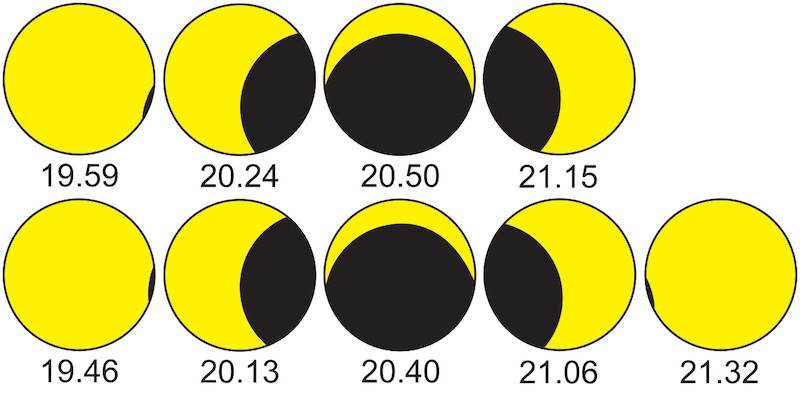
The progression of the eclipse in Lappeenranta (above) and Kilpisjärvi (below). Photo: Ursa / Veikko Mäkelä
In Helsinki, the eclipse begins shortly after 8pm and reaches its maximum at around 8.52pm, before sunset at about 9.23pm.
Ursa said the event will be the deepest solar eclipse visible in Finland for more than a decade.
Finland last saw a partial solar eclipse on 29 March 2025. The next one will occur on 2 August 2027, but only southern Finland will see it and the Moon will cover about 20 per cent of the Sun’s diameter.
The most recent total solar eclipse visible from Finland occurred in July 1990. The next total eclipse visible from the country is due in October 2126.
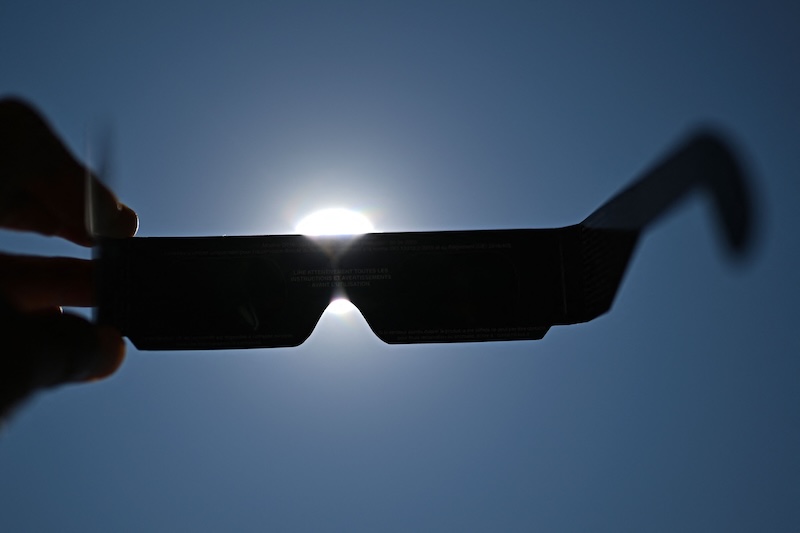
Ursa also warned viewers not to look directly at the Sun without proper protection.
Solar radiation can damage the retina within seconds, and ordinary sunglasses do not provide enough protection. Purpose-made eclipse glasses are suitable for direct observation if they remain undamaged.
Cameras, binoculars and telescopes also require approved solar filters. Looking through optical equipment without a proper filter creates a risk of eye damage because the lenses concentrate sunlight.
Ursa plans to observe the eclipse from its Kaivopuisto observatory in Helsinki if weather conditions permit and intends to stream images online where possible.
HT