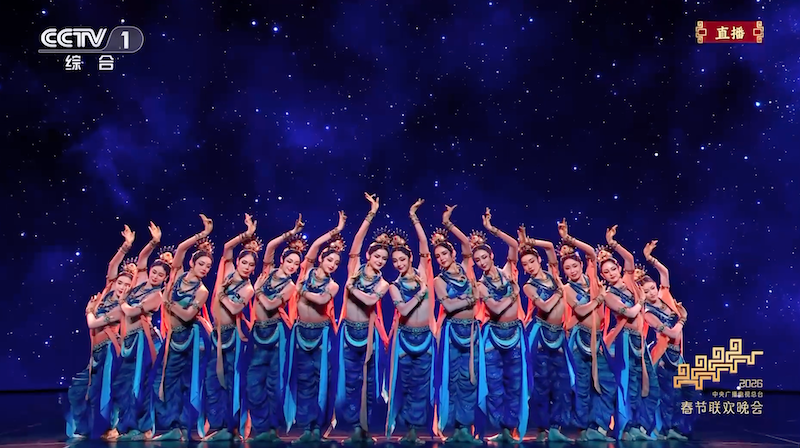
China Media Group broadcast its 2026 Spring Festival Gala on Monday evening, drawing audiences across China and abroad for the annual Lunar New Year’s Eve programme known as Chunwan. The live show began at 8 p.m. Beijing time on 16 February and continued past midnight, linking family gatherings with a national television ritual that has run for more than four decades.
CMG had outlined its plans at a press conference in Beijing on 4 February, where executives confirmed the theme, host line-up and technical features.
This year’s edition carried the theme “joy, auspiciousness and jubilance”, with organisers stating that the programme would draw on traditional culture while integrating digital production systems.
Ren Luyu, Sa Beining, Neghmet, Long Yang, Ma Fanshu and Liu Xinyue hosted the main venue in the capital. The six presenters guided viewers through a sequence of music, dance, comedy, opera, martial arts, acrobatics and magic, maintaining a format that has defined the gala since its launch in 1983.
The 2026 show unfolded against a large-scale stage built around LED screens, projection systems and a central installation titled “Galloping Horses”. Designers combined layered lighting and colour diffusion to create the image of horses moving across the backdrop and floor. The set merged mechanical structures with digital imagery, extending the visual field beyond the physical stage.
Martial arts formed a central segment of the evening. Performers presented coordinated routines rooted in traditional forms, including fist techniques and weapon displays. Groups moved in symmetrical formations while cameras alternated between overhead shots and close views, linking choreography with broadcast direction. In one sequence, humanoid robots joined dancers to perform Kung Fu movements, including vaults and backflips programmed in time with the music.
The appearance of robots reflected wider developments in China’s robotics sector. Industry data shows that the country now hosts more than 150 humanoid robot companies. The sector expands at an annual rate of over 50 percent, with projections placing market scale at 100 billion yuan by 2030. During the gala, engineers monitored the machines from off-stage control stations as they executed synchronised routines.
Technology shaped multiple aspects of the production. CMG integrated artificial intelligence, augmented reality and extended reality tools into stage design and live broadcasting. Digital landscapes unfolded behind performers through interactive projections. Some segments incorporated drones and positioning systems linked to Beidou navigation. Visual effects teams used AI-generated imagery to support transitions between acts, merging performers with animated backdrops in real time.
The gala also included cross-cultural collaborations. A joint acrobatic performance blended Chinese techniques with international choreography, presenting artists from different countries on the same stage. Another segment combined ballet with street dance, bringing classical training and urban movement into a single routine. Organisers described these exchanges as part of an effort to present dialogue between civilisations through performance.
Comedy sketches addressed scenes from daily life, focusing on family relations and social change. Opera excerpts and folk songs linked the programme to regional traditions. Magic and acrobatic acts added spectacle to the line-up. Together, the performances presented a survey of established and contemporary forms within a single broadcast.
For many viewers, the Spring Festival Gala remains part of the New Year ritual. Families gather before television screens in the hours leading to midnight, when the Lunar New Year begins. The programme provides a shared schedule of performances that accompany reunion dinners and the countdown to the New Year bell.
CMG expanded global distribution for the 2026 edition. CGTN partnered with multilingual platforms in 85 languages and worked with more than 3,500 media outlets in over 200 countries and regions to broadcast and report on the gala. English, Spanish, French, Arabic and Russian channels carried the event live. Overseas Chinese communities watched through satellite television and digital platforms, aligning their celebrations with those in China despite time differences.
The gala aired domestically on 4K and 8K Ultra HD channels, alongside online streaming via CCTV News and related applications. For the first time, an accessible version broadcast live on CCTV-15 with sign language interpretation and AI-generated captions to support viewers with hearing loss.
CMG executives stated before the broadcast that the programme would continue to serve as “the People’s Gala”. They linked the 2026 edition to the wider trajectory of China’s technological development, noting that artificial intelligence and robotics now move from research settings into consumer markets and public events.
The Year of the Horse edition stands as the 43rd instalment of the Spring Festival Gala. Since the early 1980s, the programme has tracked shifts in media production, from studio-bound performances to multi-platform global transmission. On Monday night, as families in China and viewers overseas followed the same broadcast, the gala once again combined heritage, mass entertainment and digital systems within a single New Year event.
HT