
Although U.S. President Donald Trump’s interest in taking over Greenland appears to have faded — at least publicly — Canada’s Governor General says concern remains that the fight over the semi-autonomous territory isn’t over yet.
“Even though the threat has kind of gone to the wayside … People are still very worried it could come back,” Gov. Gen. Mary Simon said in an interview airing Sunday morning on Rosemary Barton Live.
“It creates a lot of anxiety. It creates a lot of turmoil,” she added.
Simon, Canada’s first ambassador for Circumpolar Affairs and a former ambassador to Denmark, said she’s told Greenlanders that Canada supports them and the Danes, who control the territory’s foreign policy and defence.
“The way forward is to continue this dialogue between Greenland and Denmark because it’s them that has to decide what the future is for Greenland,” Simon told host Rosemary Barton.
For a few weeks in January, Trump said the U.S. should take over the Arctic island as a matter of national security.
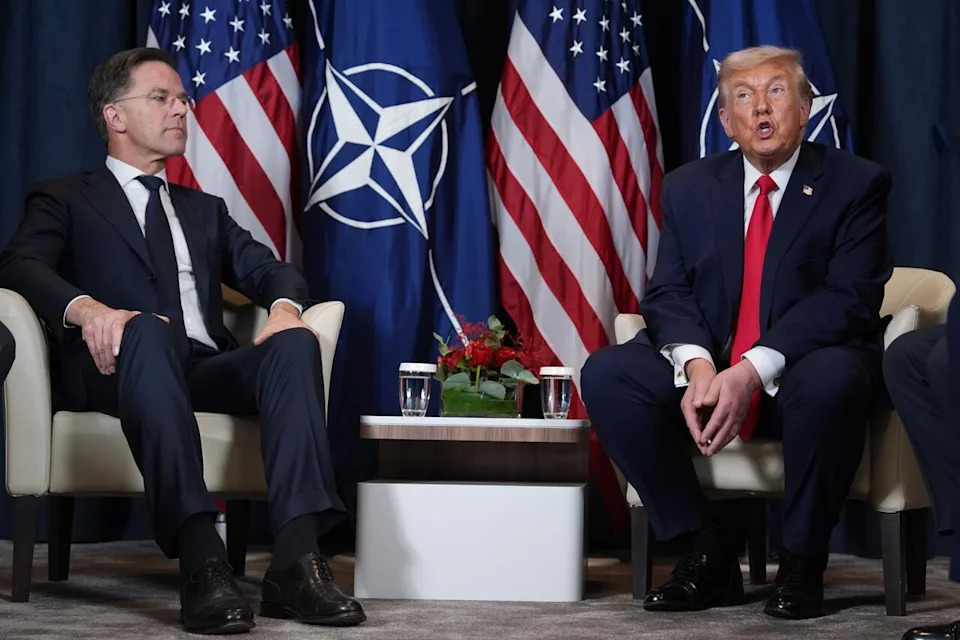
NATO Secretary General Mark Rutte, left, and U.S. President Donald Trump during a meeting on the sidelines of the World Economic Forum in Davos, Switzerland, on Jan. 21, after which Trump backed down from his plans to take control of Greenland. (Evan Vucci/The Associated Press)
Then, after a Jan. 21 meeting with NATO Secretary General Mark Rutte on the sidelines of the World Economic Forum in Davos, Switzerland, Trump suddenly announced he had forged the “framework of a future deal.”
While few specifics have emerged about the framework, it’s clear it does not include Denmark handing Greenland over to the U.S.
Trump has mostly dropped mention of Greenland since, barring one brief flare-up.
On Feb. 21, Trump floated the idea of sending a hospital ship to Greenland after Denmark’s Joint Arctic Command said it had evacuated a crew member from a U.S. submarine in Greenlandic waters who needed urgent medical treatment.
In a social media post, the president said he would send a “great hospital boat” to “take care of the many people who are sick, and not being taken care of there.”
Greenland Prime Minister Jens-Frederik Nielsen rejected Trump’s offer, adding, “we have a public health-care system where treatment is free for citizens.”
It’s unclear whether plans for sending a U.S. hospital ship ever materialized beyond Trump’s statement.
But Simon said it’s clear the U.S. president still wants Greenland because of its “geopolitical location” and, if she were in Greenland’s position, she would “continue to be very concerned” about the threat.
At the end of February, Danish Prime Minister Mette Frederiksen announced early elections, telling parliament that security is critical and the country must “secure the future of the Danish Commonwealth,” which includes Greenland.
Trump’s threats against Canada
Simon said she also remains worried about Trump’s threats against Canada. The U.S. president’s interest in Canada ebbs and flows, with his most recent threats involving his Canada’s trade agreement with China and the Gordie Howe Bridge.
However, the Governor General says those threats have also brought Canadians closer together than ever before — and it’s prompted Canadian officials to look at ways to strengthen the country’s sovereignty and self-reliance, including removing interprovincial trade barriers.
“That’s my role, to bring stability in terms of our relationships across the country,” Simon said.
Earlier this week in Australia, Prime Minister Mark Carney spoke candidly about dealing with Trump and said you can’t speak about the president off the cuff.
“You’ve got to choose your words — one chooses language for the audience, that’s true in any circumstance — and so [be] careful in terms of the language you use with him,” Carney said.
He said things are quite different with Trump in private, and the U.S. president is open to hearing ideas and solicits opinions from those he speaks with.
But still, the prime minister noted, “it’s not easy, let’s be clear.”