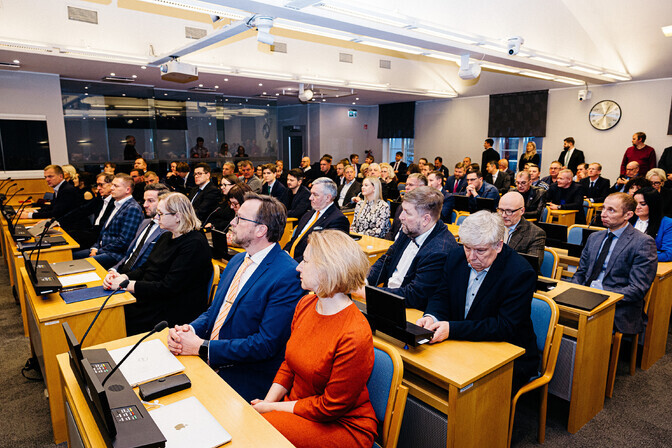
Tallinn’s 2026 budget passed a vote at the city council on Thursday
The total volume of the city’s 2026 budget revenues and expenditures amounts to €1.32 billion.
City council chair and Center Party leader Mihhail Kõlvart said that by adopting the city budget after the second reading, the council formalized decisions the coalition has made for this year.
“Among other things, this means that all benefits that increased at the start of the year can now be paid out at the new rates. And retroactively as well – all Tallinn residents who have received the childbirth allowance or the seniors’ birthday allowance since the beginning of the year under the old calculation will receive the corresponding additional payment,” Kõlvart said.
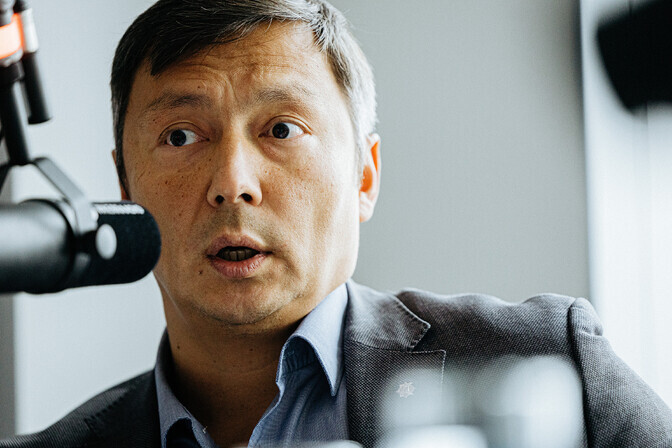 Mihhail Kõlvart. Source: Priit Mürk/ERR
Center is in office in Tallinn with Isamaa, and the latter party’s chair, Sven Sester, called the budget “honest and responsible.”
Sester, a former finance minister, also said Tallinn is setting an example for the state with the budget, in that its revenues exceed its expenditures. “As for the city’s continued development, under the leadership of Mayor Peeter Raudsepp, the current coalition has set a clear goal that we will not be building castles in the air. Only those investments that can realistically be implemented this year – amounting to €195.6 million – have been included in the budget. This is responsible budget policy,” Sester said.
Sester also highlighted the coalition’s efforts to boost entrepreneurship by easing restrictions and speeding up planning. “Nearly €800 million of the city’s revenues come from personal income tax. The better entrepreneurship performs, the higher salaries residents receive,” he said. This, in turn, supports both the budget and residents’ ability to cope with tax hikes from the national government.
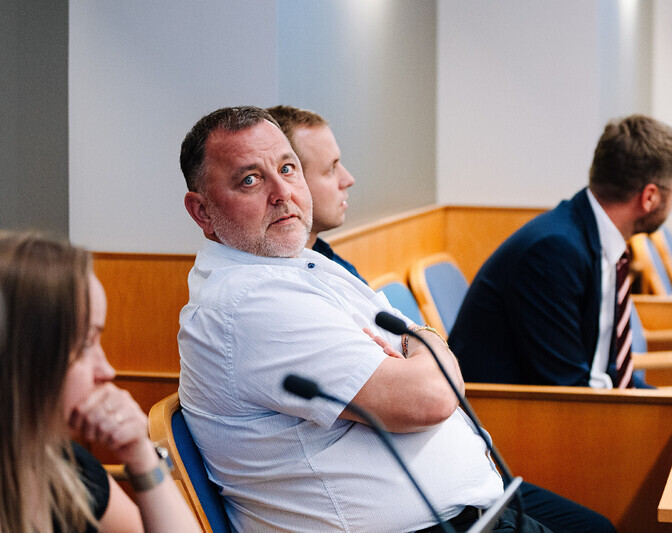 Sven Sester (Isamaa) at a Tallinn City Council session last July. Source: Ken Mürk/ERR
Total revenues for 2026 are planned at €1.2 billion. The city’s main sources of income will be personal income tax (which brings in €781.2 million), grants from the state and other institutions (totaling €188.3 million), revenue from the sale of goods and services by city institutions (€112.4 million), land tax (€36.4 million) and external funding (€9.5 million).
Operating expenses are planned at €1.1 billion. The largest share is allocated to education (which makes up 42 per cent), followed by mobility (18 per cent) and social welfare and healthcare (15 per cent), which together account for 75 per cent of total expenditures.
€195.6 million has been allocated for investment activities in the 2026 budget. By sector, the largest shares go to education (45.7 per cent), mobility (15.2 per cent), social welfare and healthcare (9.2 per cent) and sport and physical activity (6.8 per cent), which together account for over 75 per cent of total investments. None of the 71 amendment proposals submitted to the city’s 2026 budget received council support.
The Tallinn budget would normally pass by the end of the year preceding it. However, the process was held up by lengthy coalition negotiations following the October 2025 local elections. The Center-Isamaa coalition took office in December, with part of the agreement seeing non-politico Raudsepp, who had not run in the elections, being Isamaa’s mayor for the first two years, while a Center nominee is due to hold the position for the second two of the four-year term.
Last year’s Tallinn budget stood at €1.29 billion. 2022’s figure was €1.032 billion.
—