
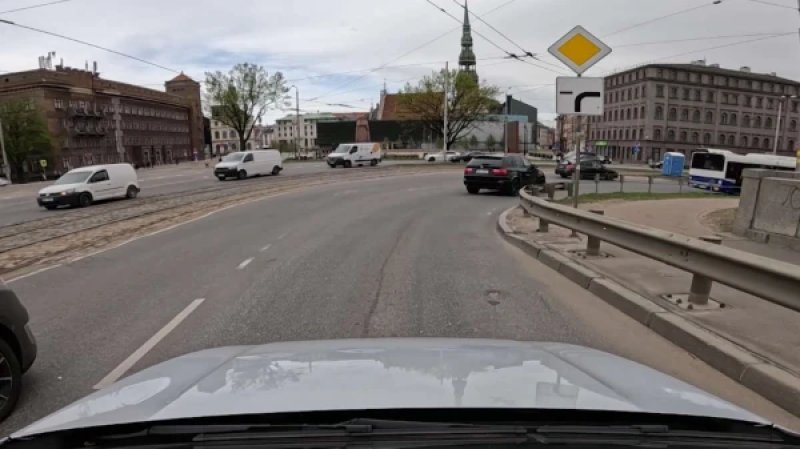
Поворот на Каменном мосту в Риге
A viewer of the Bez Tabu program ([TV3](https://tv3.lv/beztabu/transports/bistama-vieta-noslogota-likuma-nodzisusas-linijas/)), Girts, who crosses the Stone Bridge at least twice a day, noticed a dangerous situation at the exit towards the city center.
According to him, the problem arises immediately after the turn: the lane markings practically disappear and become visible again only after 15–25 meters.
While the road markings on the bridge itself are clearly visible, drivers have to literally guess the trajectory of their movement at the exit.
The situation is complicated by the fact that the traffic scheme in this area has changed in recent years. Until the fall of 2023, there were two lanes at the turn, then an additional lane appeared on the left, and after the changes in 2024, a new lane unexpectedly appears on the right.
Photos of the urban environment show that the markings began to gradually wear away about a year ago.
Traffic safety expert Oskars Irbitis notes that this place has long been considered problematic.
> “This is the place where the markings should be monitored especially closely. At the moment when the lines have worn away, it is quite difficult to understand what position to take to go straight or turn towards the Cable Bridge,” he stated.
According to Irbitis, the police and insurers’ accident map shows that accidents occur here regularly.
The expert explained that in the absence of clearly visible markings, the right-hand rule begins to apply.
> “If there are any ambiguities, insurers will take this principle into account,” he warned.
This means that when trajectories intersect, the vehicle approaching from the right has the advantage, even if drivers interpret lane movements differently.
The Riga City Council acknowledges the problem and states that the updating of the markings is already included in the work plan.
Municipality representative Ieva Grīsle explained that the application of road markings depends on weather conditions.
> “At night, the temperature must be no lower than +10 degrees, as the work is carried out at night. Currently, the nighttime temperature is too low,” she noted.
Additionally, dry weather is required for the work to be carried out.
The council also explained that it is on such sections—with intense traffic and a large number of maneuvers—that the markings wear away particularly quickly.
The Stone Bridge remains one of the busiest transport arteries in Riga, so even minor issues with traffic organization here quickly become a risk factor for thousands of drivers daily.
Until the markings at the exit from the Stone Bridge are updated, drivers have to navigate almost blindly—in one of the busiest places in Riga.