
Volodymyr Zelensky’s decree renaming a Ukrainian unit after a group from the Second World War has sparked a bitter row between Kyiv and Warsaw.
The unit, called the Separate Special Operations Center North, would become the “Heroes of the UPA” after the Ukrainian Insurgent Army (UPA) that fought in the Second World War, the Ukrainian president announced on Wednesday.
On May 19, Kyiv also repatriated the corpse of Andriy Melnyk, a leader of the Organisation of Ukrainian Nationalists (OUN), the umbrella group that established the UPA military unit.
However, these moves have caused a dispute rooted in the history of the bloodlands of Europe, darkening Polish-Ukrainian relations and playing into Russia’s hands.
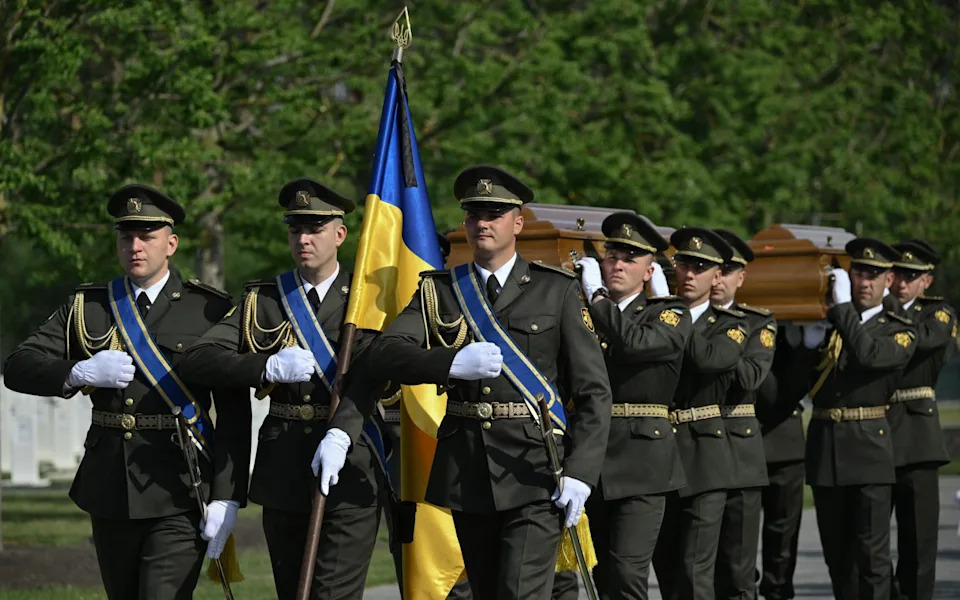
In May, Kyiv exhumed the remains of Andriy Melnyk, the leader of the group that formed the UPA – Genya Savilov/AFP
To Ukrainians, members of the UPA were heroes who fought for independence against Soviet forces.
But to those in Poland – a key ally of Ukraine as it fights off Russia’s invasion – it is known for briefly allying with Nazi Germany against the Soviets and committing massacres against ethnic Poles in the Volhynia and Galicia regions in eastern Ukraine.
The partisans killed up to 100,000 Polish civilians and exhumations were only recently allowed.
Karol Nawrocki, the Polish president, said he would ask for Mr Zelensky to be stripped of Poland’s highest honour, the Order of the White Eagle, for repatriating Melnyk’s remains and posing by his grave.
Donald Tusk, Poland’s prime minister, said Mr Zelensky’s move “wounds our historical sensitivity” and is “worrying from the point of view of our relations”.

Donald Tusk has called for Ukrainians to think of what ‘the grim legacy of the UPA means from the perspective of every Pole’ – Radek Pietruszka/Shutterstock
Lech Walesa, a Polish Nobel Peace Prize-winner who was instrumental in the fall of communism in Poland in 1989, said he had decided to stop wearing a Ukrainian flag lapel pin.
“By honouring the bandits of the UPA, the president of Ukraine has insulted me and all our massacred compatriots,” Walesa said on Facebook.
Mr Zelensky received the Order of the White Eagle in 2023 from Andrzej Duda, Mr Nawrocki’s predecessor. The honour was seen as a sign of reconciliation in the face of a shared threat from Vladimir Putin after the invasion in 2022.
But Mr Nawrocki, a nationalist historian who headed Poland’s Institute of National Remembrance before winning the presidency last year, said the move showed that the Ukrainian mentality towards history meant the country “is not ready to be part of the European family”.
“You cannot glorify bandits who murdered women and children,” he added.
“Glorifying the UPA has provided Russian propaganda with ample oxygen for disinformation,” he told reporters in Warsaw on Friday, as Russian propaganda frequently refers to the UPA to portray Ukraine as a Nazi state.
Ukrainian nationalists, though, revere the UPA for fighting for an independent Ukrainian state against Soviet forces.
In Lviv, a heartland of Ukrainian nationalism, the red and black flag frequently flies, with the face of Stepan Bandera, an ultranationalist militia leader during the 20th century, for sale on scarves in flea markets and referred to as “Daddy Bandera” in design shops.

Ukrainian nationlists still revere far-Right figures from the 20th century, such as Stepan Bandera
Mr Zelensky said he had renamed the unit “in order to restore the historical traditions of the national army” as well as to “take into account the exemplary performance of the tasks entrusted during the defence of Ukraine’s territorial sovereignty”.
There is a strong nationalist element within the armed forces, with semi-official militia groups such as the Azov Battalion and Right Sector often using far-Right nationalist symbolism as they fight against Russia.
Putin and his propagandists have been able to harness this, stating that one of his war goals was to “demilitarise and denazify Ukraine” as he launched the invasion.
While Ukraine does have fringe far-Right nationalist factions, historians note that they have little political sway. Mr Zelensky himself is Jewish, and hard-Right parties won 2 per cent of the popular vote in Ukraine’s last general election in 2019.
The House of Commons Library, along with the US state department, classifies Russia’s denazification as disinformation intended to justify the invasion.
And while Melnyk worked with the Germans, he was later imprisoned at the Sachsenhausen concentration camp after the Third Reich decided it did not want Ukraine to be an independent state.
Melnyk’s faction split from the more radical, anti-Semitic faction around Bandera.
Mr Tusk, whose government regularly clashes with Mr Nawrocki, has attempted to soothe tensions with a warning that Russia could profit from division between the formerly staunch allies.
“If we quarrel about the past, someone else will win the future,” he wrote on X, saying that both the Poles and the Ukrainian president should understand this “before it’s too late!”
“I would expect both presidents to be able to rise above these emotions … or the Kremlin will truly have reason to rejoice.”
He also called on Ukrainians to show greater awareness of “what this grim legacy of the UPA means from the perspective of every Pole”.