
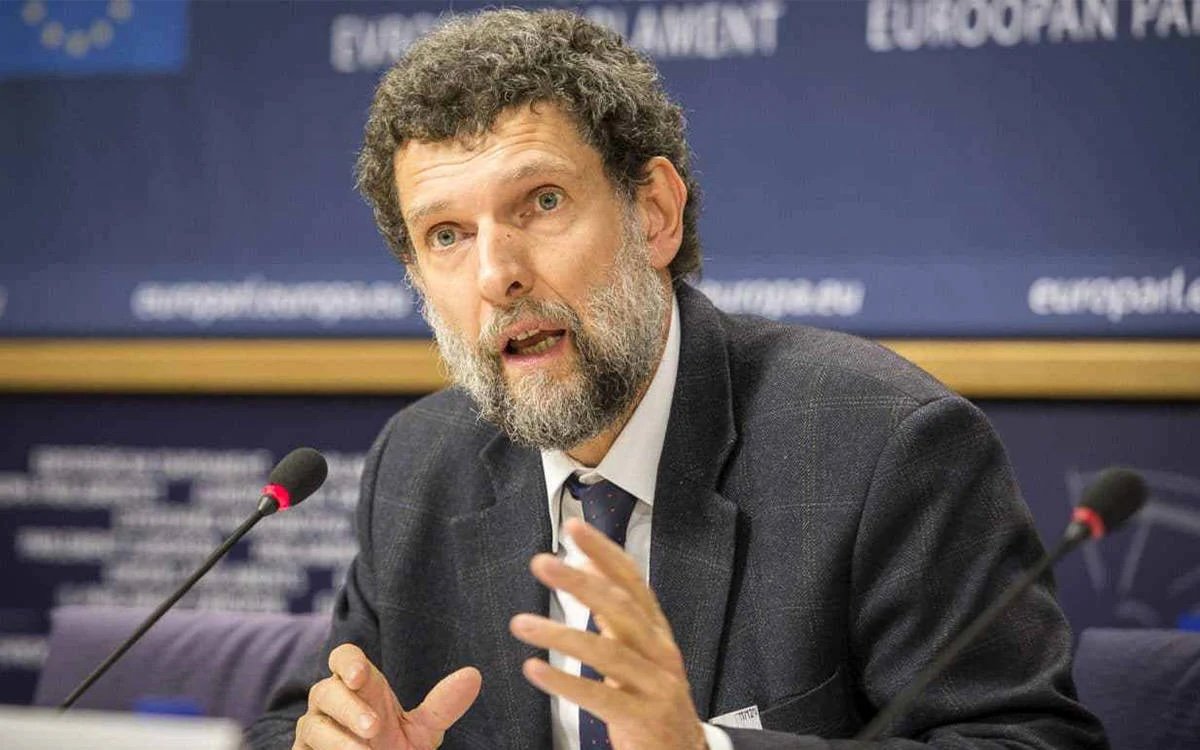
The European Court of Human Rights (ECtHR) on Tuesday ordered Turkey to release imprisoned philanthropist Osman Kavala without delay and said his criminal conviction should be treated as null and void, delivering a sweeping judgment in a case that has strained Ankara’s relations with European institutions for years.
The court’s 17-judge Grand Chamber found that the criminal proceedings against Kavala were used predominantly to punish and silence him over activities connected to the 2013 Gezi Park protests and his work as a human rights defender. It also said his case reflected a wider systemic problem in Turkey involving the prosecution and detention of political opponents, human rights defenders and journalists as well as structural weaknesses in judicial independence.
The Strasbourg-based court found violations of Kavala’s rights to liberty, a fair trial, freedom of expression and freedom of assembly and association. It also found that Turkey had improperly restricted those rights for purposes not permitted under the European Convention on Human Rights and that Kavala’s life sentence without the possibility of parole violated the prohibition on inhuman or degrading punishment.
The court said Turkish authorities had failed to establish that Kavala personally committed, encouraged or directed acts of violence during the Gezi protests. Instead, activities protected under the convention — including his civil society work, participation in public debate and contacts with academics, journalists, diplomats and international organizations — were used as evidence against him.
It concluded that the flaws in the proceedings were so serious that Kavala’s conviction amounted to a “flagrant denial of justice,” meaning the conviction could not provide a lawful basis for keeping him imprisoned. The court said his detention since its first ruling in his favor in December 2019 had therefore violated his right to liberty.
Kavala, 68, has been imprisoned since 2017. A Turkish court sentenced him in April 2022 to aggravated life imprisonment — effectively life without parole — after convicting him of attempting to overthrow the government by allegedly financing and organizing the Gezi Park protests.
The demonstrations began in Istanbul in May 2013 as a small environmental protest against plans to redevelop Gezi Park and quickly grew into nationwide anti-government demonstrations. Kavala has denied organizing or financing the unrest.
Tuesday’s ruling also questioned whether the courts handling Kavala’s case were sufficiently independent and impartial. The ECtHR pointed to a disciplinary investigation opened against three judges shortly after they acquitted Kavala in 2020, repeated transfers and mergers of his cases, statements by senior government officials portraying him as guilty before his conviction and broader problems involving the appointment, transfer and discipline of judges.
The court stopped short of saying Turkey’s judiciary as a whole acts on government orders. But it said the structural shortcomings it identified could facilitate direct or indirect executive influence over judicial decisions, particularly in politically sensitive cases.
The Turkish government has repeatedly denied accusations of political interference in the judiciary and maintains that the country’s courts operate independently. President Recep Tayyip Erdoğan has also rejected previous European court rulings in Kavala’s case.
The judgment marks the latest stage in a prolonged confrontation between Turkey and the Council of Europe over Kavala’s imprisonment.
The European court first ruled in December 2019 that Kavala’s detention lacked sufficient evidence and was intended to silence him as a human rights defender, ordering his release. Kavala was acquitted of the Gezi-related charges in February 2020 but was taken back into custody before he could leave prison on a separate charge linked to a failed 2016 coup.
His acquittal was later overturned and the cases were reconfigured. He was ultimately convicted in April 2022 over the Gezi protests, with Turkey’s highest appeals court upholding his life sentence the following year.
Turkey’s refusal to release Kavala after the 2019 judgment prompted the Council of Europe’s Committee of Ministers to launch infringement proceedings, a rarely used mechanism against member states that refuse to comply with ECtHR judgments. In 2022 the Grand Chamber ruled that Turkey had failed to carry out the original judgment.
Tuesday’s ruling went substantially further by examining the conviction itself, the fairness and independence of the proceedings that produced it and Kavala’s imprisonment after his 2022 conviction. The court said his continued imprisonment following the new judgment would perpetuate the violation of his right to liberty.
It said Turkey must release Kavala at the earliest possible date and eliminate the legal and practical consequences of his conviction. Under European human rights law, the conviction is to be regarded as null and void.
The court also awarded Kavala 70,000 euros ($82,000) in damages and 43,300 euros in legal costs.
Grand Chamber judgments are final and legally binding on Turkey as a member of the Council of Europe. Their implementation is supervised by the Council of Europe’s Committee of Ministers.