
Prime Minister Mark Carney says Canada is working to become an “associate member” as he hosts European Union leaders in Montreal, although it remains unclear what that would look like and how viable the pitch really is.
“We share a common mission. We’re in the process of forging a new alliance — alliance for the future — with Canada as an associate member,” Carney said ahead of a roundtable with Canadian and European business leaders on Thursday afternoon, wading into an ongoing back and forth about how to describe the new partnership both sides are seeking.
Carney has, until Thursday, largely stayed away from using the associate member title, instead arguing the nomenclature doesn’t matter.
CBC News has requested clarity from his office about his associate member comment.
Making Canada the first associate member of the EU is something European Commission President Ursula von der Leyen first championed last month, but the move faces some objection within the 27-member bloc. The status currently does not exist.
WATCH | EU chief floats ‘association without accession’: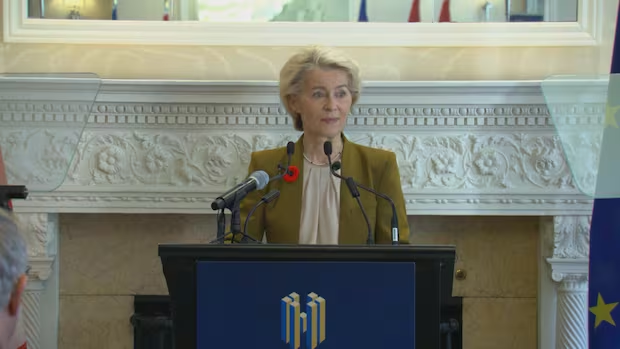
EU chief floats ‘association without accession’ for Canada
After Canada’s ‘associate membership’ of the EU was reportedly removed from a proposed joint statement on Wednesday, European Commission President Ursula von der Leyen mentioned the idea again on Thursday, suggesting a partnership ‘that comes closer to membership than anything we’ve done before.’
Von der Leyen renewed her calls to carve out a special place for Canada within the union during a keynote speech hours earlier in Montreal, where she told a crowd she wants a partnership with Canada “that comes closer to membership than anything we’ve done before.”
Von der Leyen and other European Union delegates are in Montreal for a two-day summit aimed at forging a new phase in the Canada-EU relationship, as they both seek to lessen dependence on the United States under an unpredictable and protectionist President Donald Trump.
“In a world of growing rivalries, sovereignty and independence are no longer just the freedom to act alone — it is the capacity to act together. And this is why we will build an alliance for the future,” she said.
“And we start with Canada.”
What to call that alliance has overshadowed the gathering and caused confusion.
The day before von der Leyen’s speech, it was revealed the words “associate membership” were removed from the draft of a joint statement expected to be published on Friday and replaced with a commitment to an “ever closer association,” as objections within the bloc persist.
However, von der Leyen marched on with her vision in her Thursday speech.
“It is an association without accession,” she said.
The leader said becoming an associate member would see a close alignment on policies, including AI, climate, energy, security and governance.
“It means more work shared by the European Commission and the Canadian government,” von der Leyen said, suggesting that could mean “parliament to parliament” and “court to court” co-operation.
As European Commission president, von der Leyen can advocate for policies but it’s up to the bloc to decide what happens next.
Sources speaking to CBC News said Germany in particular opposes the “associate member” term, calling it a red line.
WATCH | Carney mentions ‘associate membership’ alongside European Commission president:
Canada forging ‘alliance for the future’ with EU as an ‘associate member,’ Carney says
On the margins of the Canada-EU summit on Thursday, Prime Minister Mark Carney told a roundtable meeting that Canada and the European Union are in the process of forging a new ‘alliance for the future, with Canada as an associate member.’ Carney earlier told reporters the proposed partnership’s ‘name doesn’t matter.’
Earlier in the day, Carney said the name of the alliance “doesn’t matter.”
“This new alliance is not a marketing exercise,” he told reporters during a news conference.
“What matters to Canadians ultimately from this new alliance is going to be affordability, it’s going to be opportunity. Opportunity for young Canadians, to live, travel, study. Opportunities for our researchers to plug into one of the most advanced research networks across a wide range of domains.”
Former ambo calls debate a ‘distraction’
David Plunkett, the former Canadian ambassador to the European Union, said the title is a tricky issue for the Europeans — pointing to their relations with other countries who also want to join.
“Since this thing first came up, I have thought it was an unnecessary distraction to spend a lot of time on this empty label,” Plunkett said.
WATCH | EU agreement ‘names or nomenclature’ don’t matter, says Carney: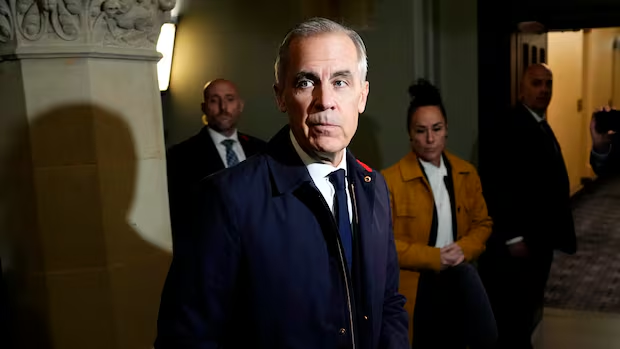
EU agreement ‘names or nomenclature’ don’t matter, says Carney
Prime Minister Mark Carney says what ‘matters’ at the EU summit set to take place later this week in Montreal is ‘Canada as a whole becoming a more independent, more sovereign nation so we can live our lives as we choose.’
“I think it’s far more important that the two sides continue to work on developing the broadest and deepest package of substance that they can get and at the end, once they’ve got everything put together, they figure out what they want to call it.”
Trump has threatened retaliation
Talk of making Canada an associate member has irked Trump, who previously said if he interpreted the move as a “hostile act,” he might stop trading with Europe “on many things.”
It raises the question of whether the president will look unkindly at this week’s gathering in Montreal.
Asked Wednesday about the possibility of retaliation from Trump, a senior Canadian government official, speaking on background, told reporters the summit isn’t directed against anyone but reflected deep interests between Canada and the EU.
Carney government invests $1.6B in AI company
Over the course of the summit, the two sides are expected to continue talks on deepening trade, investment and security partnerships.
In their Thursday speeches both von der Leyen and Carney stressed the importance of collaborating on artificial intelligence. On the sidelines of the summit, the prime minister announced plans to invest up to $1.6 billion in Cohere, the Toronto-based company specializing in generative AI.
“We’re not waiting for the future of AI to be decided somewhere else by those we don’t know or by whom we don’t trust,” said Carney.
The version of the EU-Canada statement seen by CBC News also commits to reinforcing “a predictable trade environment, deepening collaboration in the Arctic, countering foreign information manipulation and interference and continued support for Ukraine.”
LISTEN | More from the summit:
The Current15:11Inside the New Canada-EU alliance
Delegates from the EU are in Montreal for a summit to launch negotiations to deepen trade and other partnerships between Canada and the European Union. We hear from former leader of the federal Liberals and former Special Envoy to Europe, Stéphane Dion, and from Teresa Ribera, Executive Vice President for the European Commission, on what this new alliance means for Canada and the EU.
Both sides are also promising to launch negotiations toward deeper participation in Erasmus, the European Union’s student and youth exchange program.
A source speaking to CBC News on the condition they not be named says this statement is now finalized by EU member countries, but Canada could still ask for changes before the summit wraps on Friday.
Canada’s Opposition Leader Pierre Poilievre called the summit a “grand theatrical meeting to sign a bunch of meaningless declarations filled with big words.”
“No one’s mortgage or grocery bill will come down,” he posted on social media.
“Get EU countries to let our beef into the continent and cancel their planned carbon tariff on Canada. Otherwise stop wasting your time and our money. Both are running out.”