//php echo do_shortcode(‘[responsivevoice_button voice=”US English Male” buttontext=”Listen to Post”]’) ?>
Quantum computing is rapidly evolving from an academic pursuit into an industrial imperative. Amid intensifying global competition, worldwide investments have exceeded $66 billion. In this context, Spain has aggressively repositioned itself, moving from a theoretical contributor to a sovereign developer of quantum infrastructure.
Anchoring this transition is the Spanish government’s “Quantum Technologies Strategy 2025-2030.” This ambitious framework allocates about €808 million in public funding. When combined with private venture capital, it aims to mobilize up to €1.5 billion.
Yet, the beating heart of this national architecture lies in Catalonia at the Barcelona Supercomputing Center (BSC-CNS). Here, Europe tackles one of the most complex challenges of the next decade: seamlessly integrating classical exascale supercomputing, AI, and heterogeneous quantum hardware.
Alba Cervera-Lierta, a senior researcher engineer at the BSC and the coordinator of the foundational Quantum Spain initiative, stands at the epicenter of this effort. Her work bridges the gap between theoretical quantum physics and classical high-performance computing (HPC) resource management.

By Harry Foster, Siemens EDA 05.04.2026

By MRPeasy 05.04.2026

By Global Unichip Corp. (GUC) 05.04.2026
Orchestrating supercomputers and qubits
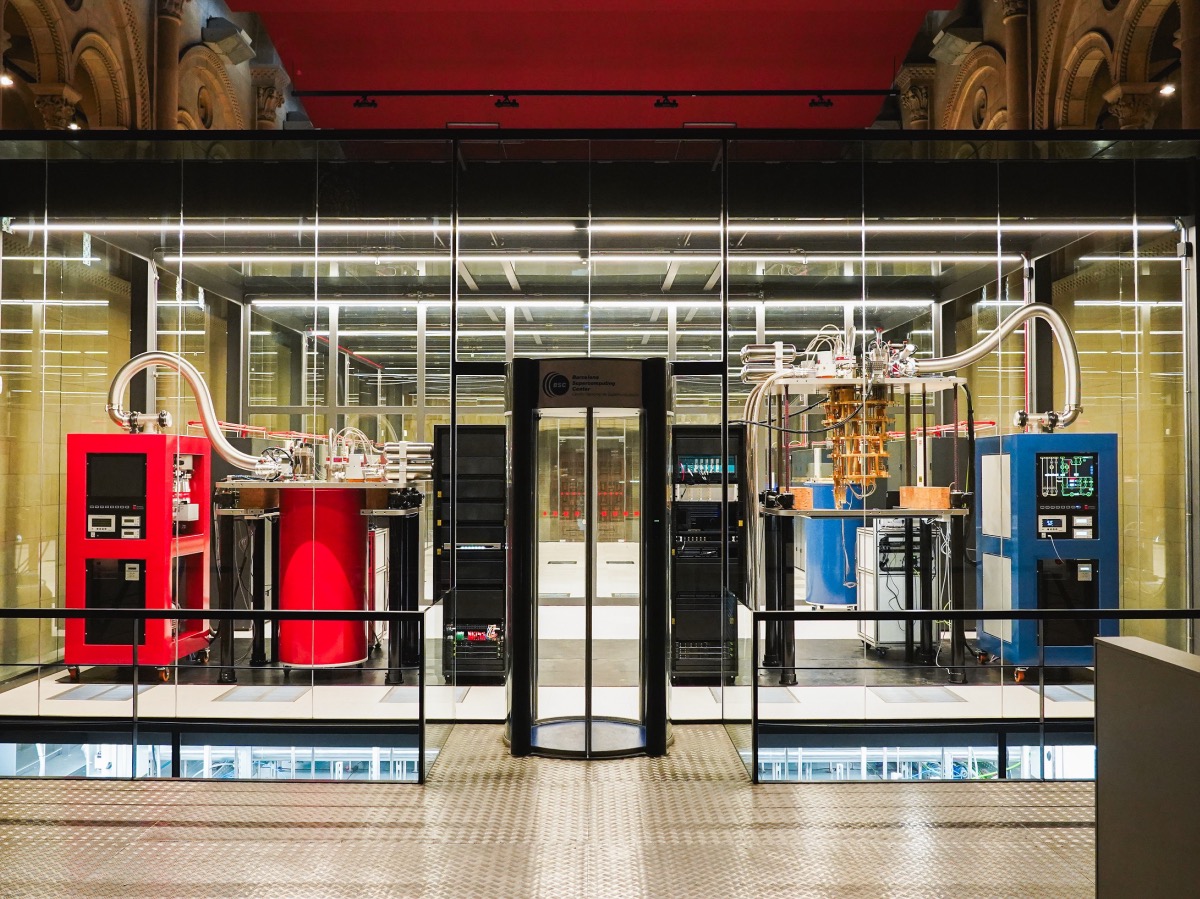
Rather than developing quantum systems in isolated laboratories, Spain integrates them into the Spanish Supercomputing Network (RES). At the BSC, quantum processing units are not seen as independent monoliths. Instead, they act as highly specialized accelerators for classical supercomputers, specifically the exascale MareNostrum 5 supercomputer.
“At the BSC, we have the quantum computing partition called MareNostrum ONA,” Cervera told EE Times in an interview. “It now includes the digital quantum computers and an analog one in the coming month.” The system is designed to give researchers and industry access to both classical and quantum computing resources. “The idea is that any user can ask for computing time for both the MareNostrum classical supercomputer and MareNostrum quantum [resources]. At the moment, it’s the user who decides how to orchestrate and use each partition separately,” she said.
 Alba Cervera-Lierta (Source: BSC)
However, the ultimate goal is seamless, automated integration. The BSC is actively designing quantum HPC workflows to manage these complex computational loads. “We have internal researchers, and we made some proof of concept applications that require the use of the connection of the quantum parts and the HPC parts,” Cervera said. “In particular, for quantum simulation, we are checking that we can send jobs to different machines that act and respond differently at different times. So, in the future, we can use it for applications.”
This orchestration is critical because current quantum hardware remains in the noisy intermediate-scale quantum (NISQ) era, characterized by limited qubit counts and imperfect operations.
To mitigate these hardware limitations, the BSC relies on open-source distributed libraries. One example is Qdislib, which enables “quantum circuit cutting.” This technique mathematically partitions massive quantum circuits into smaller subcircuits. A classical supercomputer then manages the immense probabilistic overhead. This approach illustrates the need for HPC-quantum convergence.
Deploying sovereign hardware
To support this ambitious hybrid vision, the BSC serves as a testing ground by hosting two fundamentally different types of quantum systems.
“We installed two digital quantum computers at the BSC with the Quantum Spain project, [and] Qilimanjaro was the company responsible for that,” Cervera said. She clarified that, while the integrators were local, “the chips were manufactured by QuanWare. Qilimanjaro put together all the pieces and developed the software on top of it.”
After the digital installation, the BSC is deploying an analog quantum computer. It is an adiabatic system procured under the European Union’s EuroHPC Joint Undertaking. “Now Qilimanjaro has finished the installation of the analog quantum computer,” Cervera said. “In this case, they also designed and made the quantum chip. They are now calibrating the device to make sure everything works according to specifications.”
 MareNostrum ONA quantum chip (Source: BSC)
This distinction is strategic. The global industry pursues universal gate-based quantum computers. However, analog systems are well-suited for complex combinatorial optimization problems without the rigid error-correction overhead required by digital models.
Navigating geopolitics, hype, and commercial developments
The push for quantum dominance is not merely scientific. It is fundamentally geopolitical. The European Union has recognized quantum technology as a critical vector for technological sovereignty. It backs this belief with major initiatives such as the €1 billion Quantum Flagship.
Cervera is aware of the global race, especially against well-funded American tech giants. “At the moment, in Europe, the number of qubits is not as high as in IBM or as in Google,” she said. “But I would say two years from now we’ll get there. In the coming years, we will see quantum advantage not only in Google and IBM, but also in European technology. There is still room for breakthroughs, so it’s not like someone in the world has the ideal recipe for quantum computing.”
Cervera continued, “Europe is doing things well. Investing in different types of technology ensures we will cover the spectrum.” However, the influx of billions of dollars globally has generated significant market hype. Publicly traded pure-play quantum companies now face immense pressure to deliver immediate financial returns. As a scientist bridging the gap to commercialization, Cervera views this market exuberance with some caution.
“There is a geopolitical and political component here,” Cervera said. “If someone invests so much in a particular technology, the competitors also want to spend, just to make sure they are not falling behind. Everybody wants to have a winning horse here, right? That’s my fear as a researcher because I want to continue the investment in the long run.”
She added, “At the same time, every year there is a breakthrough. Every year, there are really important papers on this technology.”
Despite the challenges, the timeline for commercial viability is accelerating. “We are now in the pre-fault-tolerant era, and everybody agrees on that,” she said. “We are certainly moving in that direction. I think that in the coming two years or so, we will see a real-world application.” Already, the underlying research is yielding dividends in classical domains.
Classical algorithms mimicking quantum mechanics—so-called ‘quantum-inspired algorithms’—are making financial processes more efficient. “This push is helping a lot now at the moment to improve applications in the real world,” Cervera said.
Imperative of quantum communications
Looking beyond the current generation of processors, the 2025-2030 strategy emphasizes building resilient quantum communication networks. It also focuses on implementing post-quantum cryptography (PQC). This is an acknowledgment that computational dominance directly correlates with state security. Future quantum computers pose a catastrophic risk to classical public-key encryption.
Cervera emphasized the dual purpose of quantum communications. Beyond unbreakable encryption, they are the only physical path to scaling quantum hardware. “Eventually, not all qubits will fit in a single dilution fridge; not all qubits will fit in a single optical tape,” she explained. “We need a quantum connection between different chips to achieve distributed quantum computing and to scale the devices to billions of qubits, not just a few. In that sense, quantum communications is the only way. That’s why there is investment in that.”
By establishing these networks now, Spain and Europe are future-proofing their ecosystems. “Even if the device that you have is still experimental or is still small, at least you know how to use it,” Cervera said. “So once the new generation arrives, you don’t need to prepare all the infrastructure from scratch.”
By combining sovereign hardware development with exascale classical integration, the BSC and its researchers are ensuring that when the quantum advantage finally arrives, Europe will be ready to harness it.
See also:
Looming Quantum Threat as PQC Market Expands
Catalyzing Europe’s Quantum Leap