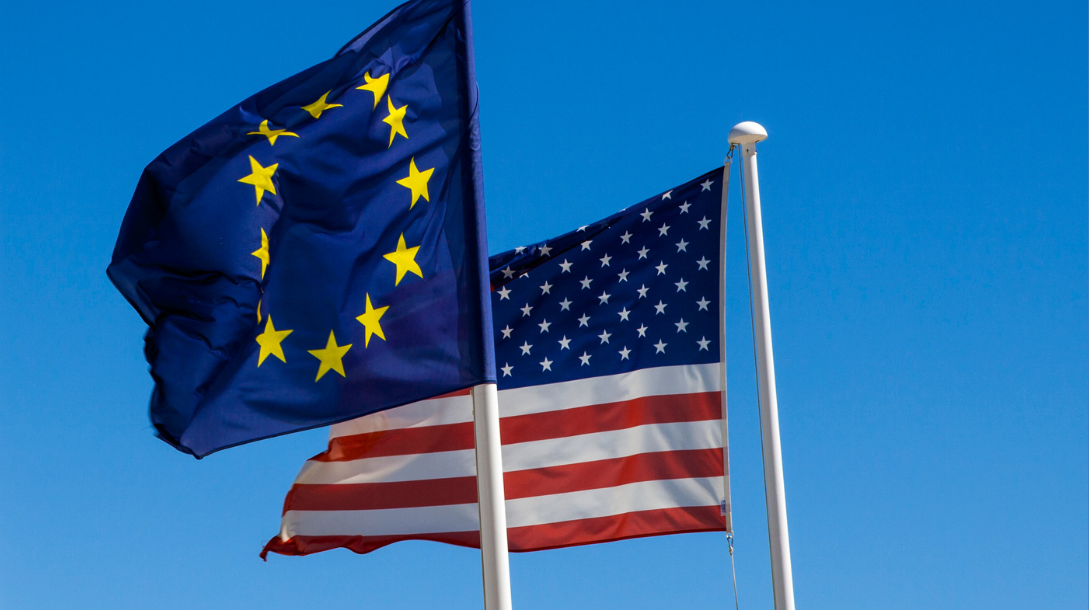
The following is an adapted version of an article written by Laura Nyilas, a research fellow at the Europe Strategy Institute of the University of Public Service, originally published in Hungarian on the Five Minutes Europe blog of Ludovika.hu.
The National Security Strategy of the United States of America, published in November 2025, not only sets out foreign policy objectives but also offers a reinterpretation of the United States’ transatlantic role. The strategy sets out clear objectives and defines specific tools for action to achieve them. Among its primary objectives, the strategy mentions preserving the security and sovereignty of the US, protecting its borders, establishing technological superiority, and creating and maintaining the world’s most advanced and powerful economy and military, equipped with modern nuclear deterrence capabilities and next-generation missile defence.
One of the document’s most significant assertions—which is also of key importance for Europe—is that the United States no longer wishes to play the role of a ‘world government’ that claims sole responsibility for maintaining the world order: ‘The days of the United States propping up the entire world order like Atlas are over.’ The strategy makes clear that the United States’ partners must take responsibility for their own regions and play a more significant role within the transatlantic alliance system.
The United States (for the reasons listed above in part) cannot afford to pay equal attention to all regions and areas of the world and their problems, and this is clearly reflected in the strategy. In the document, Europe is given a prominent role alongside the ‘Western Hemisphere’, Asia, the Middle East, and Africa.
In addition to the goals and priorities, the document also represents a kind of accountability for Europe. The part(s) of the strategy that concern Europe pose an almost irreversible civilizational crisis, in addition to the current economic downturn and insufficient military spending in Europe. This is precisely why, according to the document, Europe needs its own demographic strategy that works well in the long term.
In addition, the European Union institutions are also being targeted as repressive forces within Europe that undermine political freedom and sovereignty. The increased emphasis on bilateral cooperation is also linked to the Trump administration’s expressed dislike for the EU institutions. However, this critical stance stems not from hard security issues, but from the administration’s dissatisfaction with the EU’s protectionist trade policy, which in many areas falls under the exclusive competence of the European Commission. Bilateral agreements are therefore used by the US administration as a means to influence and divide EU policy from within.
Although it is clear that Washington treats Europe as a key strategic area, they also make it clear that the EU must undergo significant changes—favourable to American interests—in order for this statement to continue to be true in Washington. In light of this, we can observe the possibility of a conditional partnership, since the United States is not turning away from Europe, but is simply setting a stricter framework for the strategic partnership.
‘It is clear that Washington treats Europe as a key strategic area’
In a previous Ludovika article, in connection with the MSC conference, it was discussed that Europe’s uncertainty is increasing in the current international environment, while Washington’s support is becoming unpredictable and conditional. However, after the shocking speech of the US Vice President, JD Vance, last year, Marco Rubio struck a significantly different tone. The US is once again extending a hand to the Europeans, but also encouraging its partners to be independent, which is perfectly visible in the strategic document currently being discussed.
Although Washington encourages its European partners to be independent, the settlement of the Russian–Ukrainian war also requires a significant American military, diplomatic, and financial commitment, both to restore the conditions for strategic stability on the Eurasian continent and to mitigate the risk of conflict between Russia and European states.
The experience of recent years shows that the gap in transatlantic relations is deepening, which the parties involved, in addition to wishing to remedy, want to respond to with greater European independence while improving transatlantic relations. The US strategic document also reinforces the uncertainty between the two continents in the short term, but in the long term, it provides an opportunity for European countries to accelerate their preparations for achieving greater strategic autonomy, which, in parallel, can maintain the commitment of the United States. In terms of the US National Security Strategy, strategic autonomy for Europe is therefore no longer just a theoretical issue, but also a security policy necessity.
The strategy can essentially be interpreted as a wake-up call to Europe. The United States is clearly calling on Europeans to take action in order to maintain the partnership, for which it expects financial compensation in return…
Read more:
Click here to read the original article.