No. Geographical location has no impact on political and social stance, and Germany is very firmly a Western country.
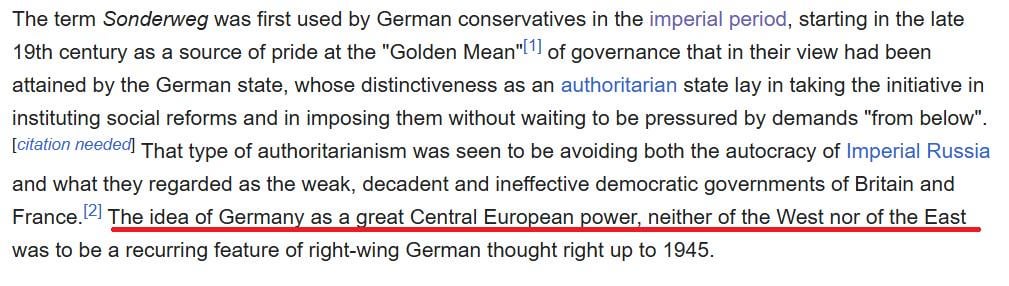
Nah. The German foreign policy paradigm since the foundation of the Federal Republic is the ‘Westbindung’ – the close cooperation with our partners in the western world within the framework of organizations like the EU and NATO.
No, most parties are either firmly bound to the Western alliance and EU. The only parties deviating from this are the AfD (right-wing to extreme right-wing) who come close but are in reality more for an alliance with Russia and the Die Linke (social democrat to left-wing) who are for a more neutral stance but without the central power stance.
Maybe some in ultra-right wing circles. There is a small radical nazi party called III. Weg ([Third Way](https://en.wikipedia.org/wiki/Third_Way)) which was or is a concept of ideological alignment not to either capitalism/democracy nor socialism/communism.
But the vast vast majority sees Germany as part of the Western/European world and even right wing populists argue strongly in favor of a eurocentric (tho maybe less democratic and more nationalistic) approach rather than a distinctive german-only one.
4 comments
No. Geographical location has no impact on political and social stance, and Germany is very firmly a Western country.
Nah. The German foreign policy paradigm since the foundation of the Federal Republic is the ‘Westbindung’ – the close cooperation with our partners in the western world within the framework of organizations like the EU and NATO.
No, most parties are either firmly bound to the Western alliance and EU. The only parties deviating from this are the AfD (right-wing to extreme right-wing) who come close but are in reality more for an alliance with Russia and the Die Linke (social democrat to left-wing) who are for a more neutral stance but without the central power stance.
Maybe some in ultra-right wing circles. There is a small radical nazi party called III. Weg ([Third Way](https://en.wikipedia.org/wiki/Third_Way)) which was or is a concept of ideological alignment not to either capitalism/democracy nor socialism/communism.
But the vast vast majority sees Germany as part of the Western/European world and even right wing populists argue strongly in favor of a eurocentric (tho maybe less democratic and more nationalistic) approach rather than a distinctive german-only one.