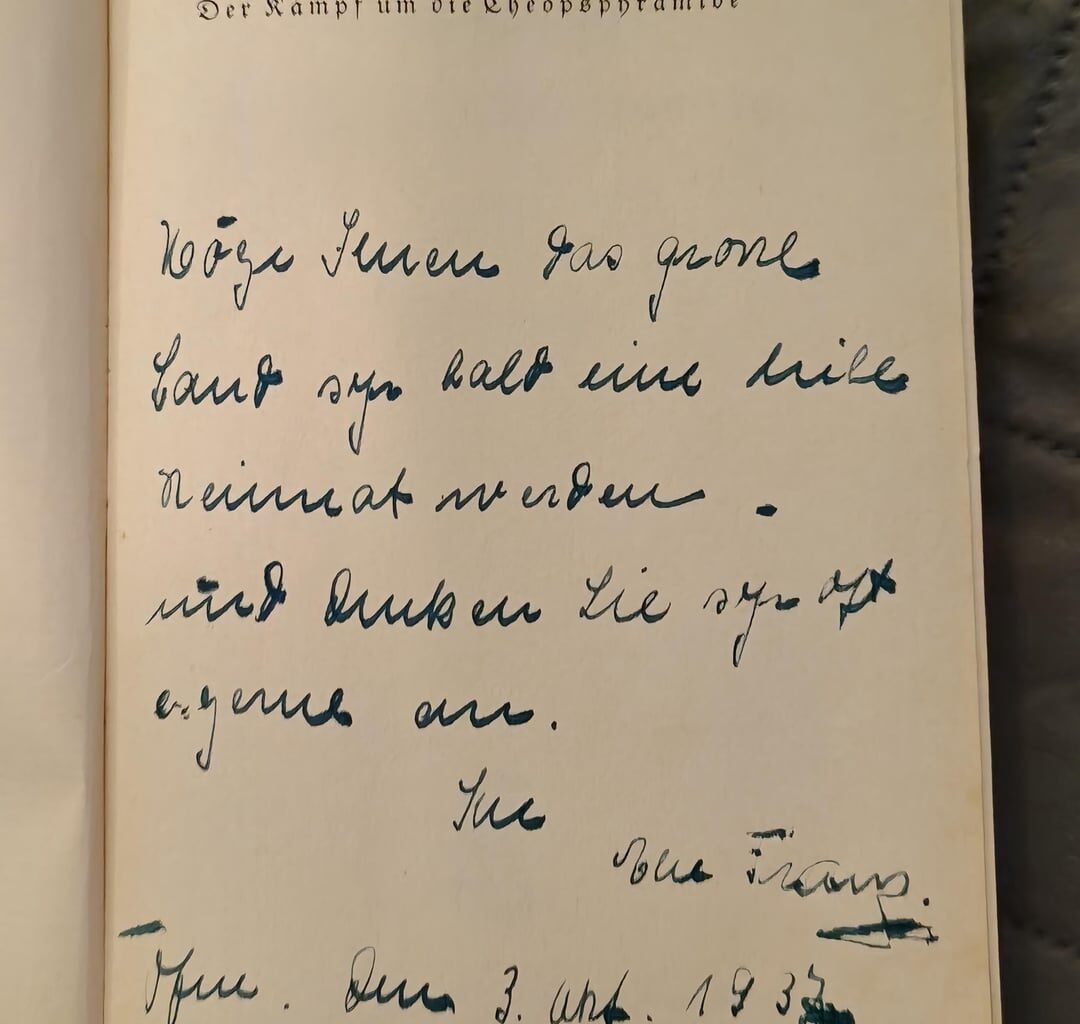
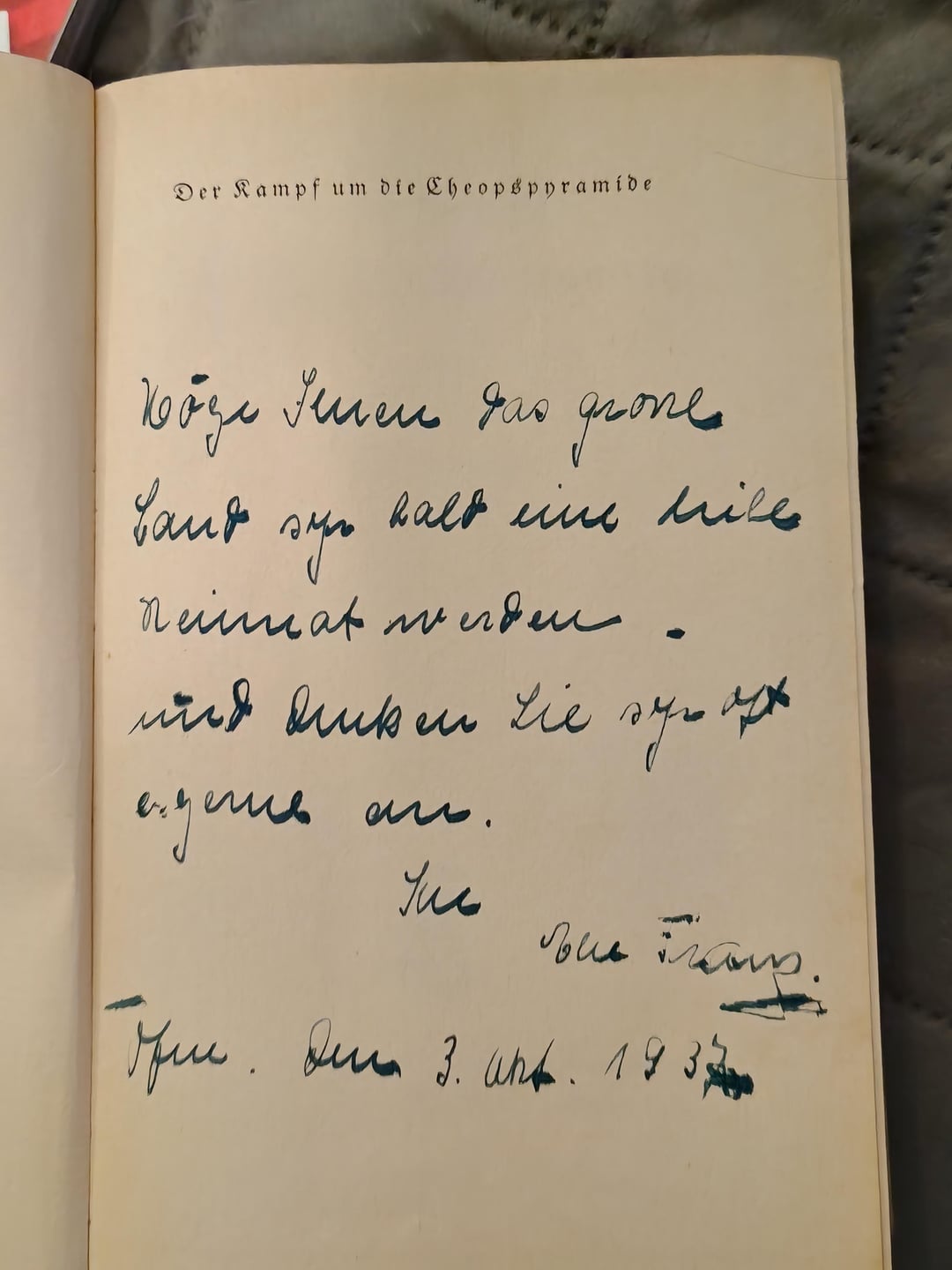
Hello! This was originally found in the USA, I bought it at a local book sale, it's a book from before the 1930s, the note however is from 1937, I don't know the specific region, or if it's from Germany, specifically (maybe Switzerland? who knows) but I'd love help translating it. it seems to be written in an older German dialect/grammar, as none of my friends have been able to fully decode it. If you'd be so kind to help me translate it into English, or even figure out the meaning in German, that would be lovely, thank you!
—
wouldyoulikeadrink
5 comments
Post it in r/kurrent The people there are amazing! It’s just older handwriting, I can only read half of what it says (may… become your new home and may you often fondly think of… is as much as I can read)
The title of the book is The Battle for the Cheops Pyramids
It is prop. Jiddish and says something like:
May the great country soon become a new home for them.
With […] you […] often your own.
Your [name]
Aue (?), 3 October 1937
My inexpert interpretation:
Möge Ihnen das große
Land sehr bald eine liebe
Heimat werden –
und denken Sie oft
an uns.
Ihr
von Franz.
Ulm, den 3. Okt. 1937.
May the great land become a dear home to you very soon – think of us often.
Presumably a leaving gift to someone emigrating to America.
Looks for me like “Möge Ihnen das ganze Land eine zweite Heimat werden, und denken Sie sehr oft u. gerne an, Ihr Franz. (?) den 3.Okt 1937″
May the whole country become a second home to you soon, and rember fondly and often, your Franz. (?) October 3rd 1937”
i am not good at this, and something i think i recodnise does not male sense really… but since maybe someone could take my findings as a starting point:
„Möge Ihnen das ganze
Land —- eine (heile ?)
Heimat werden.
und denken Sie —- oft
(u. gerne?) an
— — —
—-, den 3. Okt 1937“
Roughly:
May the whole land —- become a (wholesome) home(land) to you.
and think —- often (and foundly?) of — —- —-.
—-, on 3rd October 1937