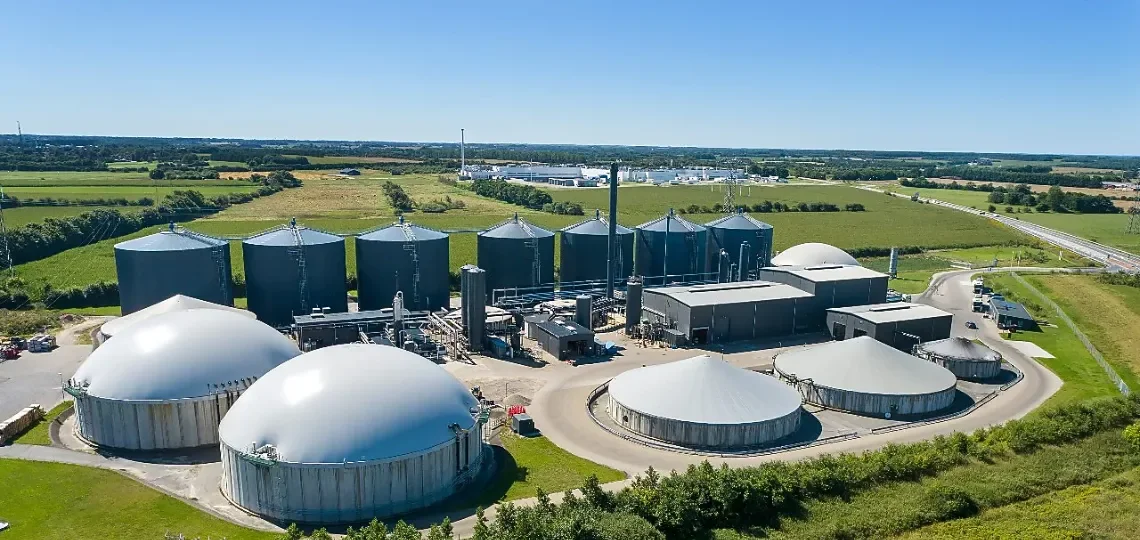
The United Kingdom currently produces a marginal share of its gas as biomethane, produced through anaerobic digestion of organic matter and then purified for injection into the gas grid alongside natural gas. The National Energy System Operator (NESO), the public body responsible for planning the country’s gas and electricity infrastructure, published an analysis in July 2026 on the role this gas could play by 2050, titled « Exploring the Role of Biomethane in the Energy System to 2050. »
A document separate from the gas roadmap
The report is not a component of the Gas Market Roadmap that NESO is due to publish separately, according to the operator. It is a distinct study, released alongside that roadmap and intended to feed into the thinking of the Department for Energy Security and Net Zero (DESNZ), which will have to set the production ambition to pursue. The report’s recommendations are therefore aimed directly at the government decision-making process rather than at the market itself.
The core of NESO’s reasoning rests on the notion of a threshold: below a certain production level, the scale-up of biomethane would not face any significant constraint linked to the availability of land or agricultural feedstock. Beyond that threshold, trade-offs would become necessary between several competing uses of land and agricultural resources. NESO places this tipping point at a level well above current production but far below the most ambitious trajectories considered elsewhere, including in its own long-term energy scenarios. This dynamic is not unique to the United Kingdom: internationally, India and Finland launch Arcistar Bioenergy in compressed biogas, illustrating a comparable value chain trajectory.
Three uses where biomethane would bring particular value
The operator identifies three priority uses. Low carbon dispatchable power, mobilised as backup for the grid when intermittent renewables fall short, ranks first. Decarbonising dispersed industrial sites not connected to future carbon capture and storage networks or to hydrogen constitutes the second identified use, with biomethane representing, according to NESO, the most practicable solution there.
Heavy road transport ranks third, with current use concentrated on heavy goods vehicles and supported by renewable fuel incentive schemes. NESO nonetheless qualifies the long-term strategic value of this use, citing the risk of unburned methane leakage, a gas with high warming potential even in small quantities. International operators are exploring similar combinations of biomethane and low carbon hydrogen for industrial decarbonisation, as illustrated by the partnership in which Pertamina and West Java partner on biomethane and low carbon hydrogen.
Five feedstock pathways with assumptions still to be validated
Scaling up production would depend on five main feedstock pathways: managed grassland, crops integrated into existing agricultural rotations, cover crops sown between main harvests, crop residues and livestock manure. Each of these pathways rests on assumptions that still need to be validated collectively, according to the report. The availability of grassland would notably depend on a reduction in the national livestock herd, an assumption drawn from Climate Change Committee projections, the independent advisory body responsible for advising the UK government on carbon budgets.
Increased use of crops dedicated to anaerobic digestion would also create a risk of competition with food production if price signals were to favour energy crops, a risk NESO specifically associates with certain crops. The biomethane sector is meanwhile undergoing a phase of consolidation in continental Europe, as shown by the acquisition in which Bankinter Investment and Plenium Partners acquire two biomethane plants in Italy. The trade association Anaerobic Digestion and Bioresources Association (ADBA) publicly responded to the report’s publication through its chairman, Chris Huhne.