
PARIS— France will independently finance the Rafale F5 fighter jet program after the United Arab Emirates withdrew from a proposed cost-sharing arrangement.
The breakdown follows a tense diplomatic exchange between French President Emmanuel Macron and UAE leader Sheikh Mohammed bin Zayed over technology-sharing terms.
The split forces France to stretch Rafale F5 funding across its updated Military Programming Law (LPM), delaying deliveries and placing additional strain on an already constrained defense budget, La Tribune reported.
 Photo: Dassault Aviation
UAE Exits Rafale F5 Funding
The UAE had been in discussions to contribute approximately €3.5 billion toward the Rafale F5 program, whose total remaining cost stood at roughly €5 billion as of late December.
Abu Dhabi’s participation was contingent on meaningful involvement in the aircraft’s development, particularly in advanced optronics technology. France refused to share those development secrets, citing sovereignty concerns over sensitive military technology. That refusal proved to be the breaking point.
Macron’s visit to Abu Dhabi, intended to resolve months of deadlock in 2025, instead worsened tensions. Sheikh Mohammed bin Zayed expressed sharp frustration over France’s proposals, and the meeting between the two leaders ended without agreement.
The UAE concluded it would not fund a program from which it received no technological return. Macron subsequently directed his frustration toward the Directorate General of Armaments (DGA) and the Joint Staff (EMA) within the Ministry of the Armed Forces.
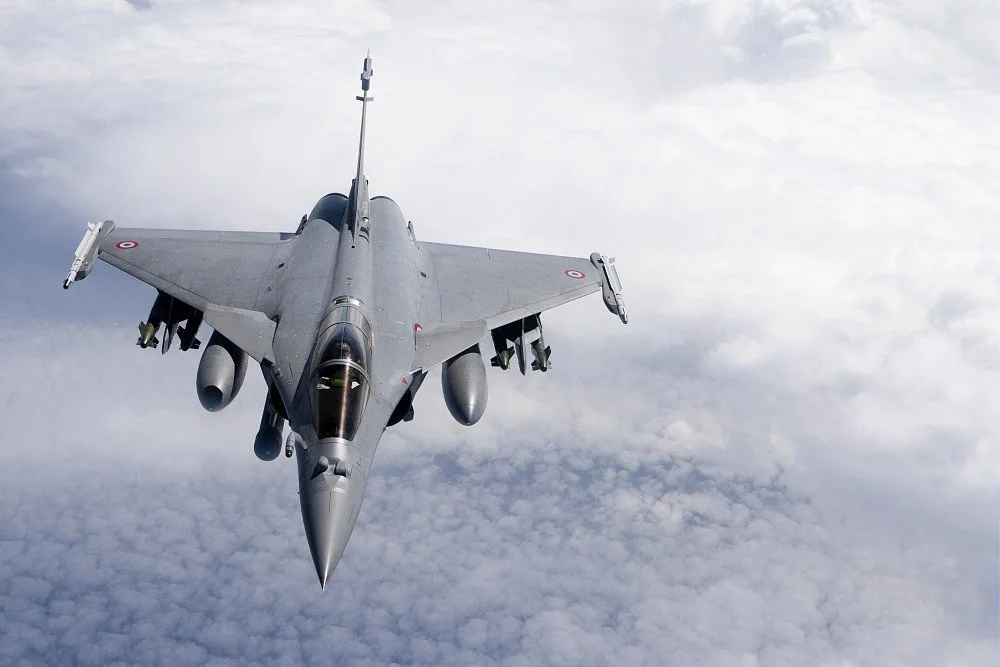 Photo: Dassault Aviation
France Stretches Rafale F5 Budget
With the UAE out of the picture, France must now absorb the full development cost internally. The updated LPM, adding €36 billion to the baseline €413 billion program, will be examined by the Council of Ministers on April 8.
Despite this increase, defense sources describe the funding approach as “spreading the jam on toast,” meaning costs are distributed across a longer timeline to compensate for budget shortfalls. This is a familiar tactic within French defense planning, though it carries real consequences for delivery schedules.
Rafale F5 deliveries will face delays as a direct result. The loss of Emirati funding also weakens France’s ability to manage other programmatic commitments, including SCAF, Eurodrone, and broader cooperative defense initiatives outlined in the 2024–2030 LPM.
Sources familiar with the matter suggest the UAE is unlikely to return to the negotiating table before 2027.
 Representative Photo: Volodymyr Zelenskyy | X
France-UAE Defense Ties Recover Through Operational Support
Despite the financial fallout, the broader France-UAE defense relationship has stabilized. French Air Force pilots operating in Emirati airspace have played an active role in neutralizing Iranian Shahed drones targeting the UAE.
The two countries are separated by just 55 km at the Strait of Hormuz, making the threat from Iran immediate and constant. France’s tangible military support, in contrast to the limited engagement from many European partners, has rebuilt trust between Paris and Abu Dhabi.
France maintains defense agreements with both the UAE and Qatar and has provided concrete assistance to both partners throughout the ongoing regional conflict. This operational credibility has helped repair what diplomatic friction had temporarily damaged.
 Photo: By Tim Felce (Airwolfhound) – Rafale – RIAT 2009, CC BY-SA 2.0, https://commons.wikimedia.org/w/index.php?curid=27816011
French Defense Model Under Pressure
The Rafale F5 funding crisis reflects a deeper structural problem within French defense planning. The current armed forces model, designed in 2013 within the context of stable globalization, is increasingly misaligned with the realities of high-intensity conflict.
The overuse of MICA air-to-air missiles during operations in the UAE illustrates the strain on French military inventory. The updated LPM, despite its additional funding, will not increase force size, according to sources within the Ministry of the Armed Forces.
France’s “sample-based” capability model, built on breadth over depth, faces growing pressure as global security demands intensify.
Stay tuned with us. Further, follow us on social media for the latest updates.
Join us on Telegram Group for the Latest Aviation Updates. Subsequently, follow us on Google News