
🕑7 min read
Back at the Consumer Electronics Show (CES) in 2022, Chrysler pulled the covers off what many people believed was the future of the brand. The Chrysler Airflow Concept was a sleek electric crossover that looked shockingly close to production form. Unlike many concept vehicles filled with unrealistic styling cues and impossible interiors, the Airflow looked like something you could have driven right off a dealer lot the following year.
In this article▾
Chrysler Went Back To The Drawing Board
Investor Day Revealed Chrysler’s New Direction
The New Airflow Will Be Completely Different
Hybrid Power Could Be The Sweet Spot
When Will We See It?
Chrysler followed up the Airflow Concept with the Airflow Graphite Concept in April 2022, giving fans another look at what appeared to be another version of the near-production-ready SUV. Both concepts shared underpinnings from Stellantis’ upcoming STLA Large architecture, the same platform that now underpins vehicles like the Dodge Charger (LB), Jeep® Wagoneer S (KX), and upcoming Jeep Cherokee (KM) models.
At the time, the vehicle was expected to become Chrysler’s first major EV for North America and a critical piece of the brand’s future lineup.
But plans changed.
Chrysler Went Back To The Drawing Board
 Chrysler Airflow Graphite Concept. (Chrysler).
A little over a year later, it became clear the Airflow program was evolving into something very different. During an interview with MotorTrend, Stellantis Chief Design Officer Ralph Gilles explained that former Chrysler CEO Chris Feuell wanted the brand heading in a completely new direction.
Feuell later elaborated on that shift during last year’s Carlisle Chrysler Nationals, explaining that customer feedback played a major role in changing the vehicle’s overall design direction.
“The Airflow, we revealed at the Consumer Electronics Show in January of 2022, gave a glimpse of the crossover future product, although that is going to be a lot edgier, more contemporary, and more modern than what the actual concept looked like,” said Feuell. “That was driven by customer feedback. They looked at the Airflow and said, ‘That’s really nice for today, but if you’re going to launch it three years from now, you can push the design a little edgier.’ And that’s exactly what we did.”
 Chrysler Airflow Concept. (Chrysler).
Internally, the original midsize electric crossover program operated under the C6X (CA) codename. The “C6X” designation referred to the STLA Large-based architecture, while “CA” was widely believed to stand for Chrysler Airflow. Production was originally expected to take place at Windsor Assembly Plant in Windsor, Ontario, alongside the Chrysler Pacifica and Dodge Charger lineup.
However, by January 2025, we broke the news that the C6X program had reportedly been suspended.
That decision immediately raised major questions surrounding Chrysler’s future product plans. For a while, it appeared the Airflow nameplate might disappear altogether.
Investor Day Revealed Chrysler’s New Direction
 Chrysler’s future was laid out at Investor Day. (Chrysler).
At Stellantis Investor Day 2026, it became crystal clear that Chrysler’s future had changed dramatically from the vision originally presented with the all-electric Airflow Concept back in 2022.
Held at the Chrysler Technical Center (CTC) in Auburn Hills, the presentation from Head of American Brands and North America Marketing, Tim Kuniskis outlined a completely new strategy for the Chrysler brand moving forward. Instead of focusing on the STLA Large platform, Chrysler is now pivoting toward a more mainstream, practical, and affordable one.
One of the biggest surprises from Investor Day was the return of the Airflow name itself. In an earlier interview, Gilles had indicated that Chrysler’s next crossover would not wear the Airflow nameplate, leading many to believe the name had been retired altogether. Instead, Stellantis unexpectedly revived the Airflow name for an entirely different crossover program.
 The new STLA One Platform. (Stellantis).
However, this new Airflow will have little in common with the sleek EV concept first shown at CES 2022.
Rather than utilizing the STLA Large architecture, the upcoming Airflow will reportedly ride on Stellantis’ all-new STLA One platform. Unlike STLA Large, which was designed primarily for premium and performance-oriented vehicles, STLA One was engineered for high-volume mainstream vehicles across the B-segment, C-segment, and D-segment categories. More importantly, the platform supports gasoline, hybrid, and fully electric powertrains. That flexibility appears to be key to Chrysler’s new direction.
The New Airflow Will Be Completely Different
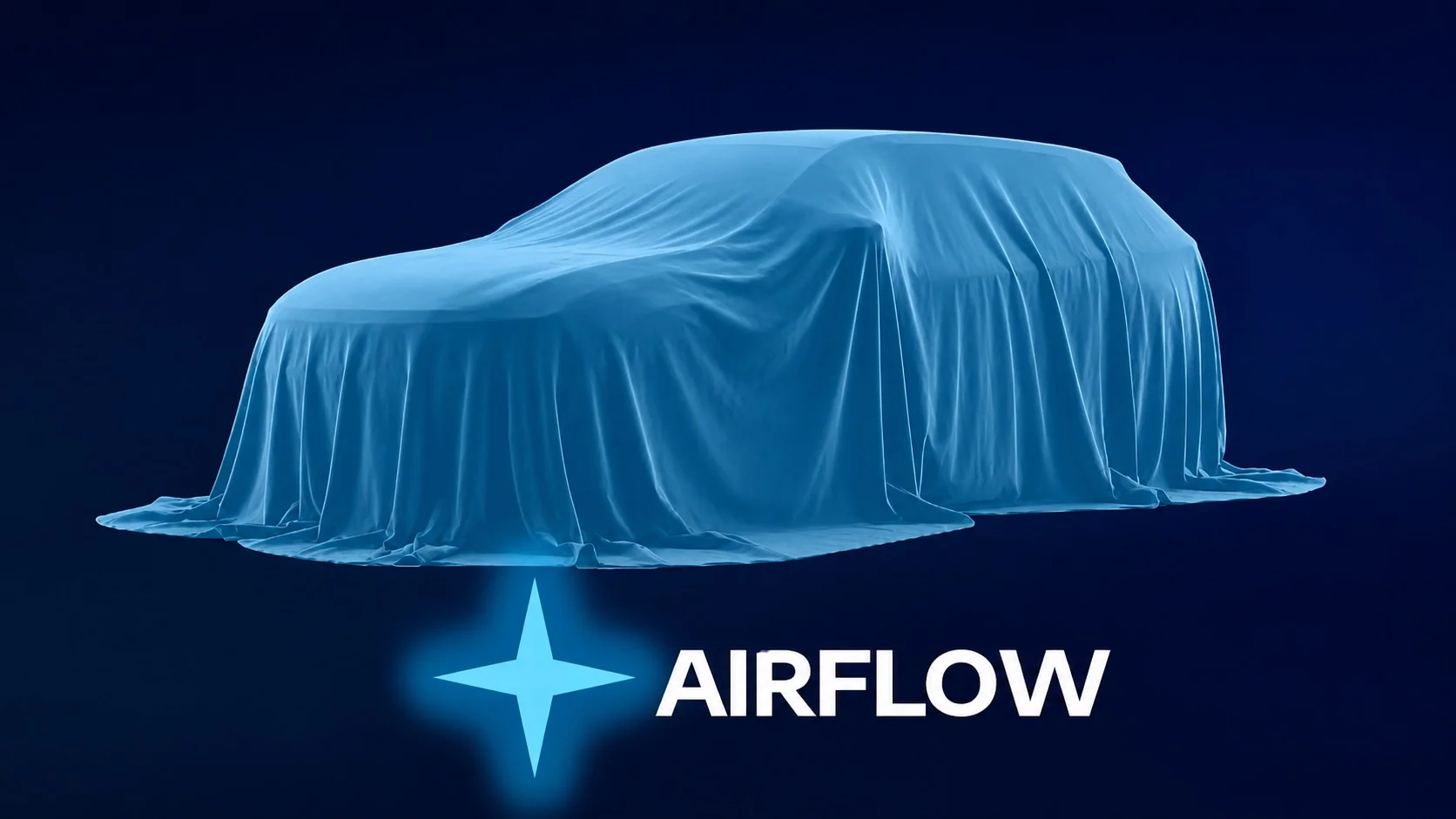 Chrysler Airflow Teaser From Inventor Day. (Chrysler).
During Investor Day, select members of the media were given a very brief preview of Chrysler’s upcoming Airflow crossover behind closed doors. While no photography or detailed specifications were allowed, conversations with those who attended the presentation, along with various industry reports, have started revealing what Chrysler’s next utility vehicle will likely look like.
Unlike the sleek and futuristic Airflow Concept, the upcoming production model reportedly takes a much more realistic and mainstream approach. Sources describe the vehicle as lower, wider, and more planted than most traditional crossovers, while still maintaining a practical SUV shape designed specifically for North American buyers.
The new Airflow delivers interior room comparable to a Toyota RAV4, but with a lower overall stance and improved aerodynamics to help efficiency and driving dynamics. Instead of chasing the ultra-futuristic styling themes of the original concept, Chrysler appears focused on blending practicality with a cleaner and more premium appearance.
 Chrysler Airflow Graphite Concept. (Chrysler).
Design-wise, early details point toward slim horizontal LED lighting connected through an illuminated Chrysler wing badge like the 2027 Pacifica, while vertical lighting signatures positioned at the corners of the fascia are expected to create a unique upscale appearance. Overall, the design reportedly carries a smoother and more refined personality than the upcoming Dodge GLH crossover, despite both vehicles sharing major engineering elements and the same STLA One architecture.
While Dodge’s GLH will reportedly push a more aggressive and performance-oriented character, Chrysler’s version is expected to lean heavily into comfort, refinement, and family-focused practicality.
Hybrid Power Could Be The Sweet Spot
 Turbocharged 1.6-liter EP6 Inline-Four Engine in the Cherokee. (MoparInsiders).
At this point, everything suggests Chrysler is prioritizing hybrid and internal combustion powertrains over fully electric models for the new Airflow. While an EV variant could eventually happen thanks to the flexibility of the STLA One platform, hybrid models appear far more likely at launch.
One of the most likely candidates is Stellantis’ turbocharged 1.6-liter EP6 four-cylinder hybrid system paired with a two-motor electrified transmission. In the upcoming Jeep Cherokee, the setup produces 210 horsepower and 230 lb.-ft. of torque while balancing efficiency, performance, and everyday usability.
The system utilizes two motor-generators and a planetary gearset to seamlessly manage multiple driving modes. It can operate in full EV mode at lower speeds, switch automatically into hybrid operation when additional power is needed, and recover energy through regenerative braking. A liquid-cooled 1.03-kWh lithium-ion battery helps improve fuel economy, reduce emissions, and even powers systems like the air conditioning compressor to reduce engine run time during city driving.
 Engine Production at the Dundee Engine Plant in Michigan. (Stellantis).
Beyond the hybrid setup, the Airflow is also expected to offer Stellantis’ new turbocharged 2.0-liter Hurricane4 inline-four engine, which recently debuted in the 2026 Jeep Grand Cherokee. In that application, the engine delivers 324 horsepower and 332 lb.-ft. of torque while running on regular gasoline.
The Hurricane4 is especially important because it introduces Turbulent Jet Ignition (TJI) technology to a high-volume production engine for the first time. The advanced combustion system improves efficiency, increases power output, and helps reduce emissions by creating a faster and more complete fuel burn inside the cylinders.
Overall, Chrysler’s decision to prioritize hybrid and efficient gasoline powertrains aligns closely with current North American market demand, where many buyers still want improved fuel economy without fully committing to EV ownership.
When Will We See It?
Right now, production details remain unclear, including where the vehicle will ultimately be built. However, all signs point toward a debut sometime in late 2027 as a 2028 model-year vehicle.
If Chrysler delivers the right balance of practicality, affordability, hybrid efficiency, and premium styling, the Airflow could finally give the brand the mainstream utility vehicle lineup it has desperately needed for years.

Robert S. Miller