
In the high-stakes chess game of European defense, France has just upended the board. The recent update to the Military Programming Law (LPM) 2024-2030, unveiled this April 2026, does more than just inject a significant €36 billion in additional funding; it signals a definitive strategic pivot. Paris is reorganizing its priorities for a high-intensity conflict scenario, doubling down on sovereign aerospace capabilities while fundamentally redefining its role in European and NATO multilateral programs.
This shift directly impacts cornerstone projects such as the Eurodrone, the Airbus A400M Atlas, the evolution of the Dassault Rafale to the F5 standard, and the exploration of new European “deep strike” capabilities, consolidating a doctrine centered on conventional deterrence and strategic autonomy.
Rafale F5: The National Pillar Amidst FCAS Uncertainty
The centerpiece of this strategy is the Rafale F5. While the F4 standard focused on connectivity, the F5 represents a generational leap. With a €3.4 billion investment, the F5 moves away from the traditional “multirole fighter” concept to become a collaborative combat coordinator.
What does the update to the 2024–2030 Military Programming Law involve?
It includes an additional €36 billion to prioritize French military autonomy, strengthen aerospace capabilities, accelerate the Rafale F5, withdraw from the Eurodrone, and fund programs such as the A400M, T-REX, and nuclear deterrent.
Why is France withdrawing from the Eurodrone?
To develop a sovereign MALE drone without intellectual property restrictions or external regulations that could limit its operational use or export, while ensuring full integration with the Rafale F5 architecture.
What is the Rafale F5 and why is it important?
It is the evolution of the Rafale fighter, backed by a €3.4 billion investment to transform it into a collaborative combat node with sovereign AI, capable of coordinating UCAVs and operating in A2/AD environments.
What are the objectives of the T-REX program?
To increase the thrust of the M88 engine (from 75 kN to approximately 90 kN), provide greater electrical generation for F5 avionics, and serve as a testbed for future sixth-generation propulsion systems.
What range would the “deep strike” missile under study by France and Germany have?
Approximately 2,500 km, with an operational goal around 2035, based on M51 technology to fill the gap between cruise missiles and nuclear delivery systems.
How does this rearmament affect French public finances?
Contractual “remaining payments” could reach €140 billion by the end of 2026, while defense spending would absorb a large portion of the EU-allowed budget margin, putting pressure on areas such as healthcare and infrastructure.
What is France seeking in terms of European and NATO leadership?
To promote strategic autonomy, exercise technical leadership, and propose a French-led command structure in Europe, positioning itself as a security guarantor — including through advanced nuclear deterrence — even as this generates tensions with partners
This is where the alliance between Dassault and Thales (cortAIx) becomes critical. The integration of a sovereign AI—essential for networked operations without external dependencies—will allow the Rafale F5 to manage a new stealth UCAV (France’s “Loyal Wingman”) in real-time. This drone, an evolution of the Dassault nEUROn, will handle SEAD/DEAD (Suppression/Destruction of Enemy Air Defenses) missions, ensuring the Rafale’s survivability in contested A2/AD environments.
France strengthens its “Plan B” to FCAS: Dassault and Thales advance sovereign AI for the Rafale F5 and combat drones
Power is the lifeblood of this ecosystem. Safran Aircraft Engines’ T-REX (Turbofan Rafale EXperience) program has emerged as the industrial pillar required to push the Rafale beyond its current platform limits. By projecting an increase in M88 engine thrust from 75 kN to 90 kN (9 tons), France aims to compensate for a payload increase of over two tons accumulated through years of airframe evolution. This is a direct response to the need to keep the Rafale competitive against 5th and 6th-generation platforms as the FCAS/SCAF program faces persistent delays.
Safran M88
Beyond kinetic thrust, T-REX is a power generation project. The F5’s avionics suite—including next-gen sensors, upgraded SPECTRA electronic warfare systems, and massive data processing via cortAIx AI—demands electrical power that current M88 engines cannot sustainably provide. By redesigning core engine components and potentially the air intakes, Safran not only ensures the Rafale’s relevance into the 2040s but also uses this development as a technological testbed for the Next-Generation Powerplant (NGP) intended for the future European 6th-gen fighter.
Farewell to Eurodrone
In one of the most significant moves of this update, France has decided to withdraw from the Eurodrone program, a major blow to European industrial cooperation. Despite the system (developed by Airbus, Leonardo, and Dassault under OCCAR management) successfully passing its Critical Design Review (CDR) in October 2025, Paris has executed a sharp U-turn. The new LPM confirms that Paris no longer intends to procure the units originally planned, prioritizing instead the development of a “sovereign MALE UAV capability.”
Eurodrone Completes Critical Design Review, Moves to Production
The move aims to ensure that the successor to the U.S.-made MQ-9 Reaper, slated for 2035, is completely free of external regulations or shared intellectual property that could restrict its operational use or export potential. Budgetary resources will instead be funneled into a Dassault-led national ecosystem, ensuring that the future French MALE drone is natively designed for seamless integration into the Rafale F5’s combat cloud.
Deep Strike
Concurrently, France and Germany have launched feasibility studies for a conventional land-based ballistic missile with a 2,500 km range by 2035. Leveraging ArianeGroup’s M51 technology, this vector seeks to close Europe’s deep-strike gap, filling the critical void between cruise missiles and strategic nuclear assets.
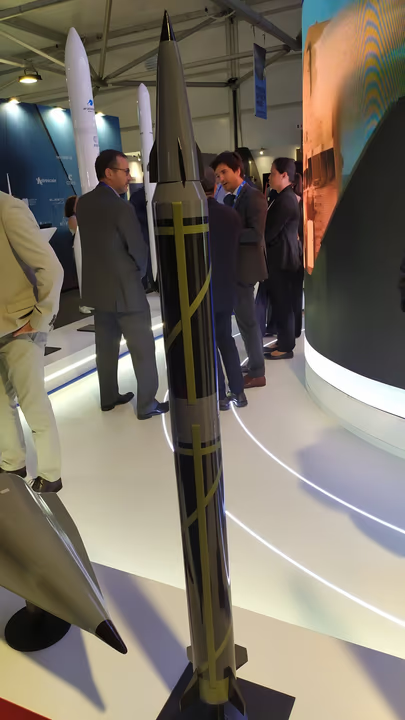
France and Germany are exploring a conventional land-based ballistic missile with ArianeGroup.
This system would provide Europe with a rapid-response, high-penetration capability against critical infrastructure and enemy command centers within minutes. Through this initiative, Paris seeks not only to bolster continental conventional deterrence but also to drastically reduce reliance on U.S. Air Force long-range strike assets within the NATO framework.
Consolidating the A400M Atlas
Unlike the drone sector, the Airbus A400M Atlas program emerges strengthened as an indispensable tool for logistical sovereignty. The LPM update confirms the target of reaching at least 35 aircraft by 2030, prioritizing the rapid replacement of the aging C-130H fleet. The A400M is no longer viewed merely as a transport asset, but as a projection node for special operations.
A400M at FIDAE 2026: From Military Airlifter to Capability Multiplier and Strategic Deterrent
Investment will focus on dedicated mission kits for elite forces and ensuring full aerial refueling capability for helicopters. In a high-intensity scenario, the Atlas is the only platform allowing France to project power independently in distant theaters like the Indo-Pacific, shielding the program from the cuts seen in other cooperative ventures.
Expanding the Nuclear Arsenal
At the highest strategic level, France has decided to reverse the denuclearization trend initiated in 2008. The announced increase in nuclear warheads marks a new phase in Gallic security doctrine. President Emmanuel Macron is proposing an “advanced deterrence” model that, while considering the interests of European allies, remains under strictly sovereign French command.
With an annual budget of €5.6 billion earmarked for stockpile maintenance and modernization (including the SNLE 3G submarines and the ASN4G missile), France aims to position itself as the ultimate guarantor of continental security. This expansion is a direct response to global instability and the surging strategic capabilities of systemic competitors.
France shows nuclear muscle by firing ASMPA-R supersonic missile
The Dilemmas of French Rearmament
This military buildup faces a financial Achilles’ heel. France’s High Council of Public Finances warned that the country’s “remaining payments”—contractual commitments—will reach €140 billion by 2026. Meeting this rearmament pace while respecting EU deficit limits will force difficult trade-offs. By 2027, defense spending could absorb nearly half of the allowable budget growth, putting pressure on sectors such as healthcare and infrastructure.
But the dilemma is not only financial—it is existential. France is balancing the temptation of going it alone with the need for European cooperation under its own terms. The Eurodrone withdrawal and tensions within FCAS indicate Paris will no longer accept programs that dilute technological sovereignty. Instead, France continues backing the A400M and seeks to draw Germany into the deep-strike initiative based on M51 technology. In this framework, France appears willing to cooperate only when it retains technical leadership or direct sovereignty benefits.
Ultimately, Paris seems to be positioning itself to fill the role the United States is gradually vacating in Europe’s security architecture. By offering its nuclear umbrella and proposing European-built strategic capabilities, France aims to convince its partners that NATO’s future in Europe should have a French lead.
The question now is whether Germany, Spain, Italy, and other partners will accept this “leadership by invitation”, or whether internal financial pressure will undermine France’s ambition to lead—while simultaneously funding sixth-generation fighters and preserving its welfare model.