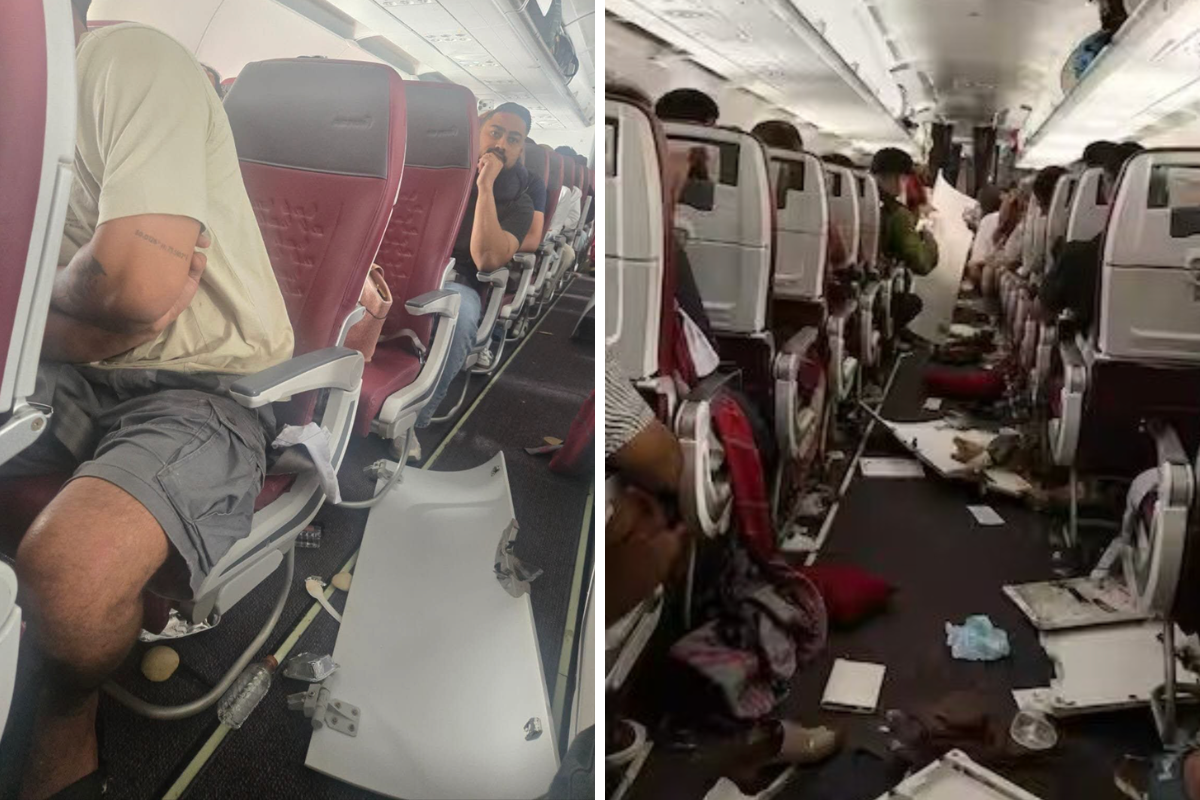
The Captain of an Air India Airbus A320neo narrowbody aircraft that suddenly plunged 300 feet while flying from Phuket, Thailand, to Delhi last week, leaving dozens of passengers and crew injured, has allegedly tested positive for illegal psychoactive drugs for a second time.
Flight AI-2379 on August 4 was flying at a cruising altitude of around 34,000 feet when it unexpectedly dropped. Anyone and anything that wasn’t strapped down was thrown into the air. Multiple passengers and crew were injured after they were slammed into the ceiling of the seven-year-old aircraft.
Around 20 passengers and four cabin crew members were injured in the incident, many of whom had to be transported to the hospital with head, neck, and spinal injuries. The accident is being investigated by India’s Aircraft Accidents Investigation Bureau (AAIB).
A standard part of a serious aviation accident such as this is for all of the crew members involved to undergo drug testing. Both pilots took rapid drug tests shortly after landing in Delhi, with the Captain’s test reportedly coming back as ‘non-negative.’
A follow-up laboratory test was then carried out, and, while the results have not been officially announced, sources cited by Bloomberg claim the test came back as positive for illegal drugs.
That’s not to say that the alleged presence of drugs in the pilot’s system had any correlation with the accident, although it does open up an additional avenue for investigators to probe.
It was initially suspected that clear air turbulence was the cause of the accident, although it didn’t take long for internet rumors to proliferate, suggesting that a mechanical issue or design defect with the aircraft, produced by European aerospace giant Airbus, was to blame.
As is standard in accidents involving Airbus-manufactured aircraft, the French Bureau d’Enquetes et d’Analyses (BEA) is assisting its Indian counterparts in investigating the circumstances of the sudden drop in altitude.
There remains intense debate over the cause of the June 12, 2025, crash of Air India AI-171 to London Gatwick shortly after takeoff from Ahmedabad – the first ever fatal crash of a Boeing 787 Dreamliner.
All but one of the 230 passengers and 12 crew members on board the aircraft died after the plane plunged into a building at the end of the runway when it suddenly lost altitude shortly after takeoff.
In a preliminary report, Indian investigators revealed that both fuel cut-off switches were switched from RUN to CUTOFF within seconds of the plane taking off. A leading theory for the cause of the accident is that one of the pilots deliberately cut off the fuel supply.
Within India, however, there is a growing movement that claims the fuel cutoff switches were faulty.
Late last year, Airbus issued an urgent safety alert for its range of best-selling A320 family single-aisle aircraft following an investigation into an incident aboard a JetBlue aircraft when the plane suddenly pitched down mid-flight without any input from the pilots.
Engineers were able to establish that the unexpected pitch-down input came from a malfunctioning ELAC computer unit. The ELAC stands for Elevator & Aileron Computer, and it is designed to interpret the inputs the pilots are putting into the controls and then smoothly and correctly control the elevators and ailerons.
Airbus believes that the ELAC was corrupted by intense solar radiation, although the issue only affected a software update known as L104. To fix the issue, airlines were ordered to restore all aircraft with the L104 software to the last version before this.
In most cases, this required engineers to plug a Portable Data Loader with the older L103 software into the cockpit computer of affected planes and reinstall the tested software.
Although there are around 11,500 Airbus A320 series aircraft in active commercial service around the world, only 6,000 of these had the L104 software installed.
Stay in the Loop
Want to see more stories like this? Add PYOK as a preferred source on Google, and we’ll show up more often in your searches and Google News.
Add PYOK as a Preferred Source
Related
Subscribe to our newsletter
No spam, just a weekly roundup of the best aviation news that you don’t want to miss

Mateusz Maszczynski honed his skills as an international flight attendant at the most prominent airline in the Middle East and has been flying ever since… most recently for a well known European airline. Matt is passionate about the aviation industry and has become an expert in passenger experience and human-centric stories. Always keeping an ear close to the ground, Matt’s industry insights, analysis and news coverage is frequently relied upon by some of the biggest names in journalism.