


Yayoi Kusama, Getty Images
Yayoi Kusama, Getty Images
Yayoi Kusama, one of the greatest artists of our time, has died at the age of 98. Although her work is most easily recognised by the endless rows of dots that have spread into almost every corner of pop culture, her influence on fashion is far more layered. Decades before the world’s biggest fashion houses began referencing her work, Kusama herself was blurring the boundaries between art, the body and clothing.
August 27, 2026
Boundless rivers of dots into which she would immerse herself to find peace in unity with the universe, endless sequences of mirrors through which she tried to reach eternity, and recurring patterns that flooded every inch of space, turning what inhabited her mind into reality, made Yayoi Kusama’s artistic language one of the most recognisable in the world. For more than half a century, Kusama’s dots transcended the boundaries of art and entered popular culture, turning the Japanese artist into one of the most prominent creative figures of our time. Her art gradually grew into a global phenomenon, while her exhibitions began attracting audiences willing to wait for hours just to step into the infinite world to which she invited us. When the exhibition Yayoi Kusama: Infinity Mirrors opened in Los Angeles in 2017, the gallery was forced by overwhelming demand to introduce a rule allowing visitors only 30 seconds to take photographs inside her installations. All of this was Yayoi Kusama. But she was also so much more.
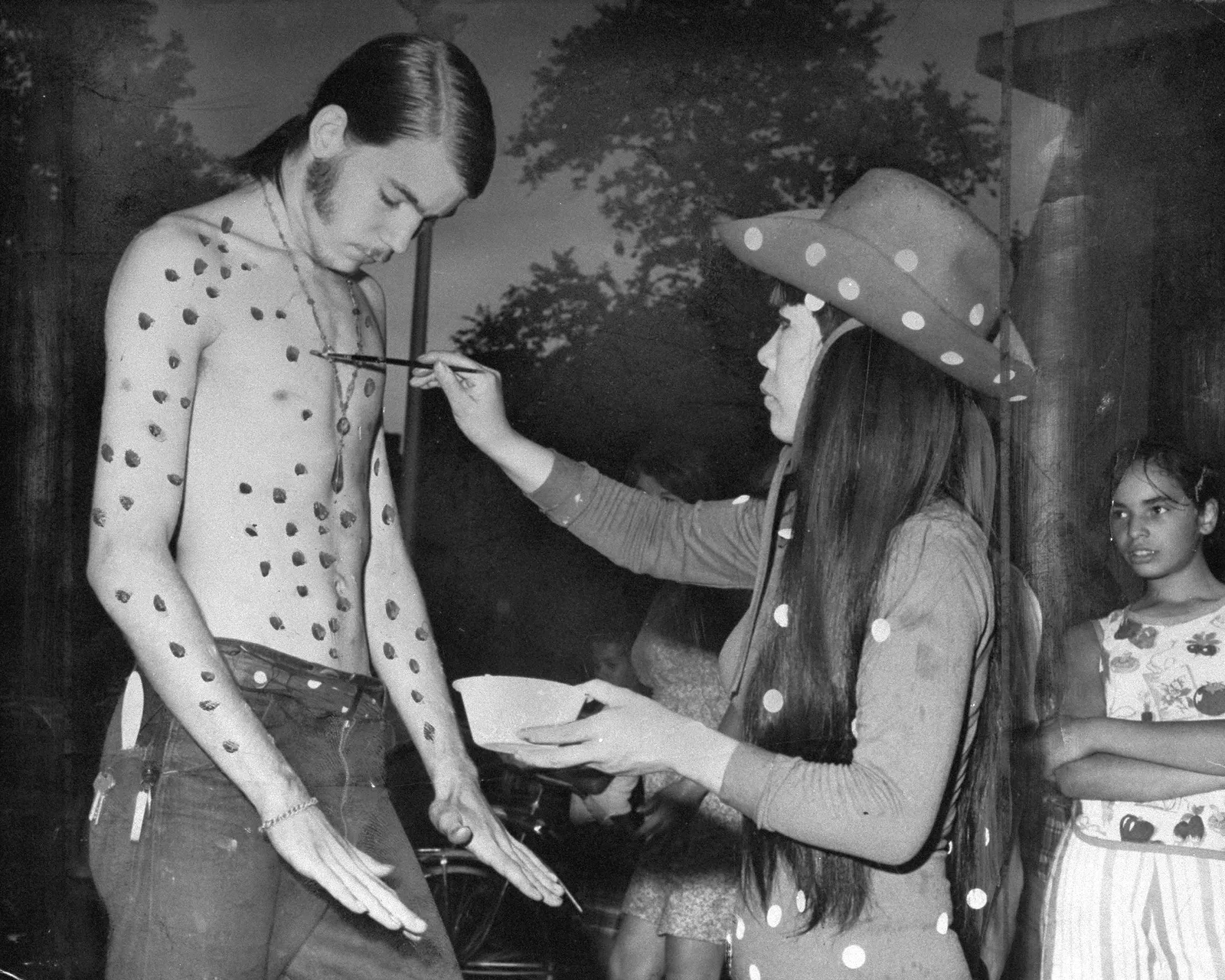
Born in 1929 in Matsumoto, Japan, Kusama began her journey through art by studying Nihonga, a traditional Japanese painting technique, but its rigid framework and strict rules soon proved too restrictive for her. Her early work leaned towards Surrealism, while the organic motifs that initially occupied her gradually evolved into more abstract forms. Somewhere at the very beginning, Kusama started painting networks of dots that would later become synonymous with her artistic practice. After moving to New York in 1957, this motif would develop into one of her best-known artistic series, Infinity Nets. Yet repetition was never merely a visual effect for Kusama. Dots, nets and organic forms gradually moved beyond the surface of the canvas and onto objects, walls, spaces and even bodies. During the 1960s, she began creating Accumulation Sculptures, covering everyday objects with hundreds of hand-sewn phallic forms, while in the controversial public performances she called Happenings, she painted dots across the participants’ naked bodies.
“My nets grew beyond myself and beyond the canvases I covered with them,” she once explained. “They began to cover the walls, the ceiling and, eventually, the entire universe. I always stood at the centre of that obsession, of that passionate accumulation and repetition within me.” In her perpetual pursuit of immersion in infinity, the boundaries between the artwork and its surroundings, as well as those between art and everyday life, gradually disappeared. It is no coincidence, then, that fashion, an often overlooked thread in her work, became another means through which Kusama sought to reach infinity.
Getty Images
Kusama Fashion Company and clothing that brings people together
Long before her dots appeared on clothing by fashion houses such as Louis Vuitton, Kusama ventured into the world of fashion herself. By the mid-1960s, she was already creating costumes for the provocative performances she staged in unexpected locations such as Wall Street, which soon attracted a host of imitators. By the end of the decade, she had decided to extend this experiment beyond her artistic practice. In 1968, she founded Kusama Fashion Company Ltd., and her dot-covered creations soon began selling in hundreds of shops and boutiques across the United States. Bloomingdale’s even opened a dedicated Kusama Corner. But Kusama did not view fashion as a separate commercial venture. For her, clothing was another way of bringing the ideas she had already explored in painting, sculpture and performance onto the body. Her fashion shows were held in her studio, among paintings and sculptures, and she often claimed that she had never perceived a clear boundary between art, design and fashion.
What she created was, of course, far from conventional. Kusama’s fashion was provocative, erotic and often deliberately impractical. Her designs included sheer dresses, garments with openings in intimate areas, clothing covered in dots and the so-called orgy dresses, designed to be worn by several people. One of the better-known examples, the avant-garde Silver Squid Dress, featured two openings at the front through which the breasts were exposed, while the Couples Dress was designed for two people and, according to her vision, the Party Dress could accommodate as many as 25. Sexuality, togetherness and the body were integral to the designs, with clothing becoming a kind of space for interaction.

Getty Images
But her creations were not provocative simply for provocation’s sake. They also carried a clear social message. The clothing Kusama created formed part of both her artistic and personal activism. Through design, she criticised the state of society and advocated for gender equality and sexual freedom. Her work from the 1960s cannot be viewed in isolation from the time in which it was created. Protests against the Vietnam War, resistance to the uniformity of capitalist culture, and connections to psychedelia, the hippie era and the civil rights movement all shaped the political dimension of her work. Although she uncompromisingly embedded her distinctive visual language within it, Kusama’s clothing was never merely a matter of aesthetics. Behind the dots, provocative cut-outs and unusual silhouettes lay the idea of connecting with others, rather than separating from them. Her fashion adventure did not last long, but it raised questions that fashion would continue to explore long after her. She demonstrated not only how art could move onto clothing, but also how clothing could become an artistic medium.
Comme des Garçons Fall 2012, gorunway.com
Comme des Garçons Fall 2012, gorunway.com

Comme des Garçons Fall 2012, gorunway.com
Kusama’s influence on fashion
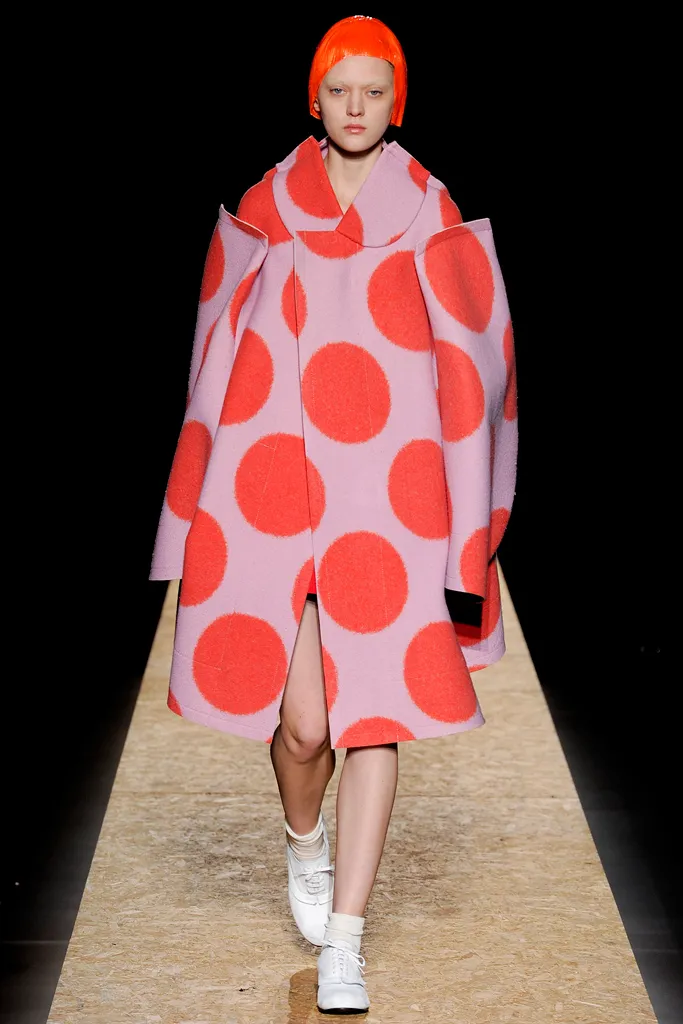
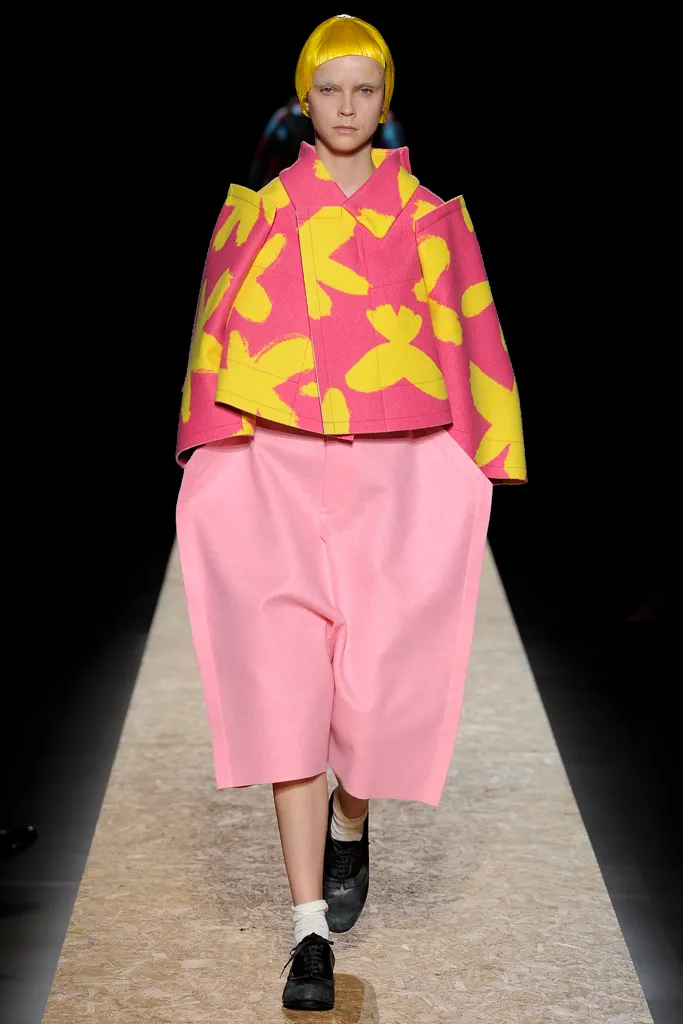
When Kusama’s artistic work returned to the centre of attention, particularly towards the end of the last century, fashion designers began to find inspiration in it. They were drawn to the hallucinatory recurring patterns, the obsessive accumulation and the idea that clothing could transcend the boundaries of a functional object and approach what we call a work of art. One designer whose work is often viewed in this context is Rei Kawakubo. For decades, the founder of Comme des Garçons has transformed clothing into a space for exploring volume and silhouettes that move away from the body, bringing garments closer to sculpture than to traditional clothing. Yet the connection between the two Japanese contemporaries went beyond visual similarities. When the Comme des Garçons space Six, designed by Kawakubo, opened in Osaka in 1996, the occasion was marked by a major solo exhibition of Kusama’s paintings and installations. Although there is no need to declare every similarity between the two artists a direct influence, the connection is difficult to overlook. Each in her own way refused to accept the body and space as fixed forms. Kusama covered, multiplied and extended them into infinity, while Kawakubo spent decades reshaping, expanding and reconstructing them.

David Koma Fall 2011, Getty Images

Louise Gray Fall 2011, Getty Images
The Louis Vuitton collaboration
With some sources of inspiration, however, there was no ambiguity. For his Fall/Winter 2011 collection, London-based Georgian designer David Koma took Yayoi Kusama’s obsession with dots as his starting point. Figure-hugging designs appeared on the runway, their seductive silhouettes enhanced by circles of varying sizes made from leather, felt and patent materials, while cut-outs further emphasised the sensuality of the clothes. Koma translated her most recognisable motif into his own language, transforming the dot from an artistic signature into an element that both constructs the silhouette and accentuates the body.
Related: Louis Vuitton marks 130 years of the Monogram with a year-long celebration
But perhaps the best-known example of Kusama’s entry into contemporary fashion came through Louis Vuitton. Marc Jacobs, then the house’s creative director, met Kusama at her Tokyo studio in 2006, and several years later their encounter developed into one of the most significant art and fashion collaborations of the 21st century. Unveiled in 2012, the collection included bags, jewellery, shoes, clothing and accessories covered in her signature dots and spiral motifs. Jacobs was particularly drawn to the consistency with which Kusama had built her own world over the decades, continually returning to repetition, dots and the idea of infinity. He therefore did not see the collaboration simply as a strategy for transferring her art onto Louis Vuitton products. He believed that Louis Vuitton would bring Kusama’s art to audiences who might never set foot in a gallery or museum. And he was right. It was also one of Louis Vuitton’s largest artistic collaborations to date.

Louis Vuitton x Yayoi Kusama 2012.
Kusama’s personal image and the symbolism of clothing
But perhaps the clearest proof of how thoroughly art and fashion were intertwined in Kusama’s work was the artist herself. Her personal style became almost as recognisable as her art: a neatly cut red bob, which at times became bright pink or orange, dot-covered clothing and often striking accessories turned her appearance into an extension of her artistic identity. During the early years of her career, she frequently appeared at her exhibitions dressed in a kimono and carrying a parasol, playing with the image of the Japanese woman that Western culture had already turned into a stereotype. She always used her appearance as part of her artistic presentation, transforming the act of dressing into a kind of performance.
High heels interested her as more than fashion objects. They appeared in her paintings, prints and sculptures, becoming another motif through which she explored fashion, the body, identity and the ways in which we respond to the expectations society places on women. In the Shoes and High Heels series, shoes densely covered in dots became another means of exploring repetition, infinity and the relationship between an everyday object and art. Even so, it would be wrong to conclude that dots were Kusama’s greatest contribution to fashion, despite being her trademark. Her true legacy lies in the way she understood clothing, as a space for experimentation, political expression, connection… Kusama asked the question countless times: Can clothing be an art object? Her answer was always yes. Decades after she first attempted to push its boundaries, fashion continues to find ways of speaking that same language.

Getty Images