
Sanofi’s SNY stock is trading above its 50-day and 200-day simple moving averages (SMAs).
A stock trading above both its 50-day and 200-day SMAs is generally viewed as technically bullish, as it indicates positive short- and long-term price momentum. That said, bullish technical indicators alone do not guarantee further upside. A stock’s long-term performance ultimately depends on the strength of its underlying fundamentals, including earnings growth, product portfolio, pipeline execution and valuation.
To make an investment decision, it is important to weigh the company’s key strengths against the risks that could influence its future performance. Let’s take a closer look.
Dupixent Sales Hit Record High as Demand Drives Growth
Sanofi and Regeneron’s REGN immunology drug, Dupixent, holds the number one new-to-brand prescription market share across all its approved indications in the United States.
Dupixent is approved in several countries in one or more indications, covering nine distinct diseases, driven partly by type II inflammation, namely severe chronic rhinosinusitis with nasal polyposis, severe asthma, moderate-to-severe atopic dermatitis, eosinophilic esophagitis, prurigo nodularis, chronic obstructive pulmonary disease, chronic spontaneous urticaria, bullous pemphigoid and allergic fungal rhinosinusitis.
Dupixent generated sales of €9.3 billion in the first half of 2026, up 28.6% year over year. Second-quarter sales jumped 37.6% to €5.2 billion, crossing the €5 billion quarterly threshold for the first time. Dupixent’s strong sales growth is being driven by demand across all geographies, newly approved indications and demographics. Sanofi expects Dupixent to achieve around €25 billion in sales in 2030.
However, Sanofi expects Dupixent’s volume growth to moderate in the second half as recent launches annualize and year-over-year comparisons become more challenging.
Sanofi and Regeneron aim to sustain long-term value creation for Dupixent through a three-pronged strategy of defending its patent portfolio, extending the product’s lifecycle via improved dosing options, and innovating with new molecules leveraging its existing alliance infrastructure.
New Medicines Strengthen Sanofi’s Growth Outlook
Sanofi is seeing a good uptake of its new medicines like novel recombinant factor VIII therapy, Altuviiio and cancer drugs, Ayvakit and Sarclisa.
Sales of its new and acquired drugs rose 48.3% to €1.3 billion in the quarter led by Altuviiio, Ayvakit and Sarclisa. Beyfortus [in partnership with AstraZenecaAZN] achieved blockbuster sales in its first full year of sales in 2024 and continues its expansion into new geographies. Altuviiio achieved blockbuster sales in 2025, and Ayvakit, added from the Blueprint Medicines acquisition, is expected to become the next blockbuster drug in 2026.
Key new products approved in 2025 were Wayrilz (rilzabrutinib), for immune thrombocytopenia and Qfitlia (fitusiran) to prevent or reduce the frequency of bleeding episodes in patients with hemophilia A and B. Cenrifki (tolebrutinib) was approved for treating non-relapsing secondary progressive multiple sclerosis in the EU in June 2026 while in the United States, Sanofi’s regulatory application seeking approval of tolebrutinib was issued a complete response letter (CRL) in December 2025. Sanofi’s new drug application (NDA) seeking approval for venglustat for Gaucher Disease is under the FDA’s priority review, with a decision expected in November. Venglustat is also under regulatory review in the EU.
Sanofi expects its new and acquired products to generate approximately €10 billion in sales by 2030.
Sanofi’s Vaccine Business Set for a Weak Second Half
In the first half of 2026, Sanofi’s total vaccine sales declined 1% while influenza vaccine sales declined 42.1% at CER primarily because of unusually strong influenza sales in 2025 and the seasonal nature of the business with the bulk of influenza vaccine sales typically concentrated in the second half of the year. However, sales of new products, AstraZeneca-partnered Beyfortus and Heplisav-B remain strong.
Sanofi expects overall vaccine sales growth to be slightly negative in 2026, with the decline concentrated in the second half due to seasonal trends. In the third quarter, sales are projected to fall low-to-mid teens, In July, Sanofi also lowered its long-term vaccine sales expectations to around €9 billion by 2030 from prior expectations of €10 billion due to currency headwinds and unfavorable market dynamics.
Sanofi’s Pipeline Suffers Several Setbacks in 2026
In 2026, Sanofi announced some notable pipeline setbacks. In July, Sanofi decided not to advance amlitelimab to regulatory submission after determining that its efficacy and safety profile did not offer a meaningful improvement in atopic dermatitis. The company also discontinued itepekimab’s development in chronic obstructive pulmonary disease and chronic rhinosinusitis, along with balinatunfib studies in Crohn’s disease and ulcerative colitis as they failed to meet the company’s internal efficacy expectations. Additionally, Sanofi announced that two phase III Dupixent studies in lichen simplex chronicus failed to meet their primary endpoints.
In June, Sanofi discontinued the phase III MOBILIZE study evaluating riliprubart in treatment-refractory chronic inflammatory demyelinating polyneuropathy.
These setbacks resulted in more than €200 million of wind-down costs and a €952 million impairment related to amlitelimab, which hurt reported earnings in the second quarter.
SNY’s Price, Valuation & Estimate Movement
Sanofi’s stock has declined 7.5% year to date compared with an increase of 16.0% for the industry. The stock has also underperformed the sector and the S&P 500, as seen in the chart below.
SNY Stock Underperforms Industry, Sector and S&P 500
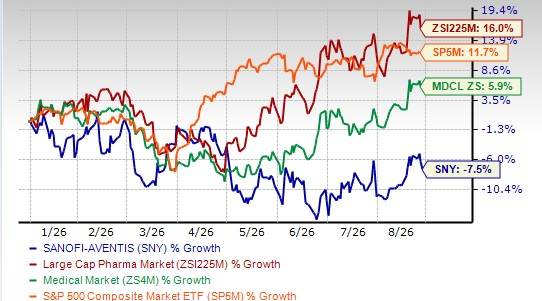 Image Source: Zacks Investment Research
From a valuation standpoint, Sanofi appears attractive relative to the industry. Going by the price/earnings ratio, the company’s shares currently trade at 8.7 forward earnings, lower than 19.09 for the industry. The stock is also trading below the stock’s 5-year mean of 11.16. The stock is much cheaper than other large drugmakers like Lilly, Novo Nordisk, AstraZeneca, J&J, Merck, AbbVie and others.
SNY Stock Valuation
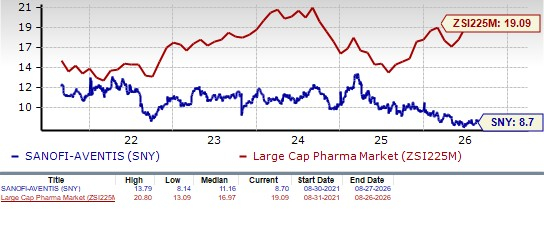 Image Source: Zacks Investment Research
The Zacks Consensus Estimate for 2026 earnings has risen from $4.96 per share to $5.01 per share over the past 30 days.For 2027, earnings estimates have risen from $5.19 per share to $5.23 per share over the same timeframe.
SNY Estimate Movement
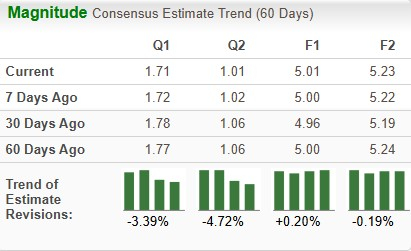 Image Source: Zacks Investment Research
Stay Invested in SNY Stock
Sanofi faces headwinds like heavy reliance on one blockbuster drug, Dupixent, weak influenza vaccine sales and regulatory and pricing pressure. Importantly, Sanofi has discontinued or deprioritized several pipeline programs recently.
However, the biggest reason investors have been willing to look beyond recent pipeline disappointments is Dupixent. Also, along with the second-quarter results, Sanofi raised its sales growth expectations for the year based on a strong performance in the first half and an optimistic outlook for the second half. Sanofi now expects 2026 sales to grow around 10% at CER, up from its previous forecast for high-single-digit growth.
Moreover, Sanofi has increased R&D investments and is achieving significant progress with its pipeline. It has also been active on the business development and M&A front.
The fact that the stock trades above both its 50-day and 200-day SMAs reflects improving investor confidence in the company’s near- and long-term outlook
Investors may continue retaining this Zacks Rank #3 (Hold) stock. You can see the complete list of today’s Zacks #1 Rank (Strong Buy) stocks here.
Beyond Nvidia: AI’s Second Wave Is Here
The AI revolution has already minted millionaires. But the stocks everyone knows about aren’t likely to keep delivering the biggest profits. AI’s second wave is moving from infrastructure to implementation and these companies are at the forefront of this transition, positioned to become what Amazon and Google were to the internet era.
This article originally published on Zacks Investment Research (zacks.com).