
Photo: © Gary Blakeley | Dreamstime.com
By Charlotte Goldstone
23 September 2026
The world’s largest container shipping lines are becoming less-reliant on chartered vessels – most of the top 10 carriers reducing their exposure significantly since the Covid-era freight boom.
New analysis by Alphaliner shows the proportion of chartered capacity in the fleets of most major carriers has fallen since 2021-22, as record profits enabled the lines to invest heavily in newbuildings and second-hand tonnage.
While a decade ago the operated fleets of the top 10 typically comprised 40%-70% chartered capacity, Alphaliner noted that the figure was now 18%-50%. Among the top five, chartered tonnage accounts for just 30% to 40% of deployed capacity.
South Korea’s HMM has made the biggest reduction. Its chartered fleet accounted for 56% of capacity in 2016, but is now less than 20%. Following the collapse of Hanjin, the South Korean government supported HMM’s expansion as the flagship carrier, which included the acquisition of 59 newbuildings to date.
CMA CGM recorded the second-largest decline, its chartered capacity falling from 67% of its fleet in 2016 to about 34% today. Much of the reduction came after the pandemic, when strong profits enabled the French carrier to invest heavily in owned tonnage, acquiring 160 second-hand containerships and delivery of 100 newbuildings.
The carrier nevertheless remains a major user of non-operating owner (NOO) tonnage and continues to play an active role in the charter market.
MSC has reduced its chartered share from 61% in 2016 to 36% today. Compared with the roughly 75% of its fleet on charter during Covid, the Geneva-based carrier has effectively halved its charter exposure over the past five years.
It shifted decisively towards vessel ownership from late 2020, ordering 252 newbuildings and purchasing around 500 second-hand vessels. Its chartering activity subsequently collapsed, with only about 40 fixtures concluded this year, three to four times fewer than previously.
Evergreen has cut its chartered share from 42% in 2016 to 28% today, following an investment programme that included 125 newbuildings ordered since 2021. Yang Ming’s chartered exposure has fallen from 63% in 2016 to 50%.
But Alphaliner flagged that the reductions had been less pronounced at Maersk, ONE, Cosco, and Hapag-Lloyd.
About 38% of Maersk’s operated fleet is now chartered, just seven percentage points below 2016 levels. The Danish carrier remains a major NOO customer and has concluded at least 130 fixtures this year.
ONE and Cosco have both reduced their chartered share by 12%-13%, to approximately 53% and 40%, respectively. Hapag-Lloyd’s ratio has fallen 15% over the past decade, to about 39%.
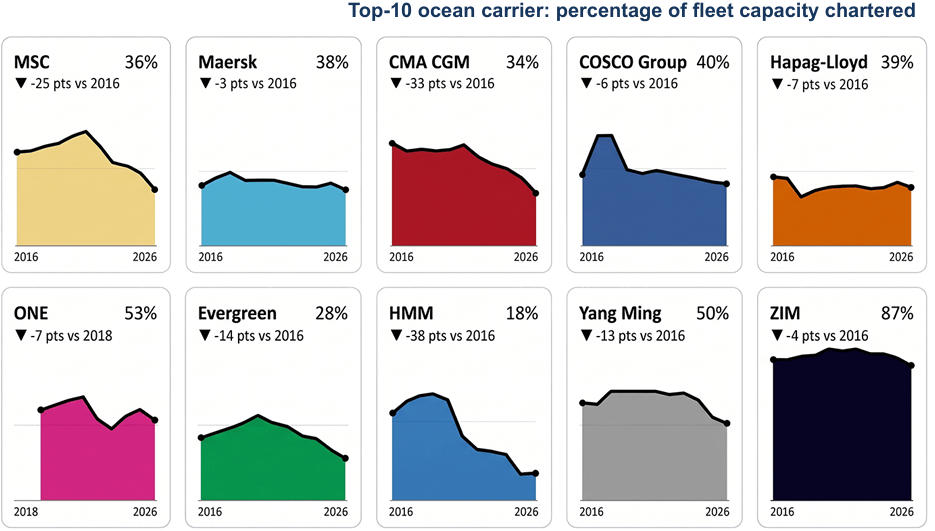
Source: Alphaliner
Zim, however, remains the clear outlier, retaining an asset-light, charter-heavy model.
Chartered vessels have represented between 85% and 98% of its deployed capacity over the past decade, while its 23-vessel orderbook is entirely chartered tonnage. That could change if Hapag-Lloyd’s proposed acquisition goes ahead.
Alphaliner also cautioned that the distinction between owned and chartered tonnage was becoming less clear. Long-term bareboat charters can include purchase options or obligations, meaning some vessels classified as chartered may effectively represent “delayed ownership”.
As a result, the actual proportion of capacity controlled through ownership may be higher than the headline figures suggest.