
Researchers at Chalmers University of Technology, in collaboration with industry partners, have published a study in Nature Communications demonstrating that reconfigurable battery pack architectures can extend electric vehicle battery operational life by more than 20 percent under specific conditions.
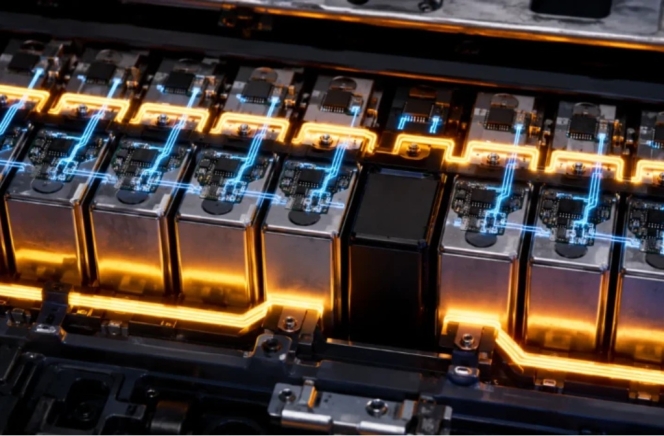
In conventional electric vehicle battery packs, cells are wired in a fixed series configuration, meaning the weakest cell dictates the overall capacity, performance and lifespan of the entire pack. The architecture evaluated by the Chalmers engineering team uses integrated electronic switches and a centralised battery management system to monitor individual cells or cell groups. When a cell experiences accelerated degradation or reduced capacity, the system bypasses the degraded unit while electric current continues to flow through the remaining functional cells.
Albert Skegro, a PhD student at the Department of Electrical Engineering at Chalmers University of Technology, said, “They must all move at the pace of the slowest person and stop when that person stops, regardless of how much energy the others have left. With the architecture we have modelled, the battery can instead bypass the cell that is causing problems and continue using the remaining cells.”
Changfu Zou, Professor at the Department of Electrical Engineering at Chalmers, said, “Reconfiguration is not an on-or-off choice. It is a spectrum. Where a manufacturer chooses to position itself on that spectrum determines how much of the potential benefit can be realised.”
In a representative modelling scenario featuring an 80 kWh battery pack driven 12,000 kilometres annually over an 18.8-year vehicle lifespan, the reconfigurable system deferred battery replacement by approximately 14 months. The researchers noted that the technology yields the highest performance gains in high-voltage vehicles, including 400-volt and 800-volt electric passenger cars and commercial trucks, where higher cell counts in series increase the statistical probability of individual cell variance.
A techno-economic analysis included in the study determined that implementing cell-level switching hardware increases initial pack production costs by approximately nine per cent based on prototype-scale volumes of 1,000 units. The researchers identified an economic break-even threshold at a 12 percent cost increase, noting that volume manufacturing would lower component costs and increase financial viability for fleet operators and private owners. While prototype applications such as Volvo Cars’ SmartCell concept and experimental road vehicles exist, mass-production vehicles using reconfigurable battery packs are yet to enter the commercial market.