
Published
October 13, 2026
Goyard and Moynat are just a stone’s throw away, and the Louis Vuitton flagship on Place Vendôme is anchored only a little further on: on October 12, Fauré Le Page opened its new maison at 352 Rue Saint-Honoré, in the very heart of Paris’s luggage-makers’ district. For this independent French brand, revived in 2009 and relaunched in 2012 by the Liffort de Buffevent family, this opening reads as a clear statement of intent.
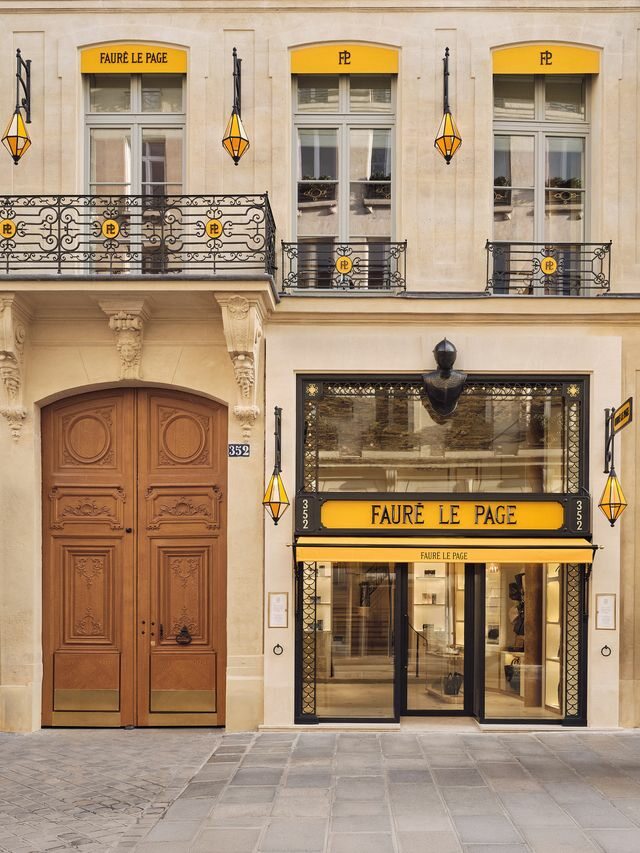 Façade of the boutique at 352 Rue Saint-Honoré – Fauré Le Page/ Matthieu Salvaing
From the moment it was revived, the brand benefited from a prestigious address at number 21 on the famous Rue Cambon. Now, with its yellow glass lighting and its name in black lettering on a gold ground spread across two floors of the façade on this essential Parisian shopping artery, the house is advancing with new ambitions.
Standing like pennants, its large geometric lanterns immediately draw the eye, as does a striking armoured bust, a reminder that the Fauré Le Page brand has its origins in a family who, in 1717, founded a workshop of arquebus makers and armourers to the kings and princes of France. And while the façade, with its interplay of black wrought iron, certainly stands apart, Augustin de Buffevent – who is leading the revival of the house with a focus on luxury leather goods – has opted for an unexpected experience that unfolds over more than 500 square metres within a former private mansion.
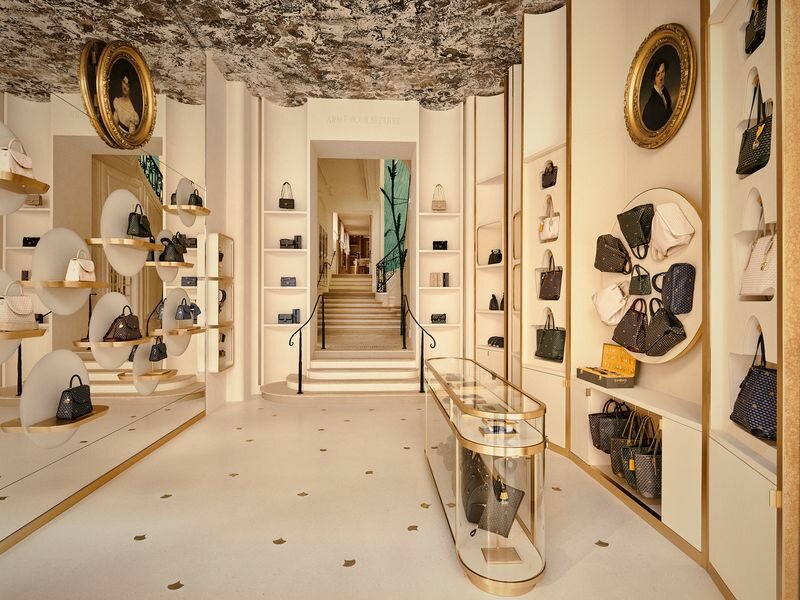 The entrance hall showcases the bags and accessories of the high-end leather goods brand – Matthieu Salvaing
“If it’s just to reproduce what everyone else is doing, there’s no point. I’m very attached to the idea of a family home. Generations must speak to each other here; otherwise, it’s just a hotel. This house is the culmination of a vision spanning 14 years, two years of planning and nine months of building work,” smiles the history-enthused director, who, when designing his collections and shaping the Fauré Le Page universe, draws both on the house’s historical codes and on the military and hunting heritage of French history.
Yet his interpretation is anything but conventional. Crossing the threshold of this boutique is a little like stepping through Alice’s looking-glass or wandering through Gabriel García Márquez’s Macondo: the improbable can occur at any moment.
The first room has been conceived as a vestibule. Vertiginously high, and set between plays of mirrors and wood-and-stone displays, portraits of Marie-Adélaïde and Jean-André Prosper Henry Le Page, dating from the late 19th century, face one another. On the ceiling, just above the motto ‘Armé pour séduire’ engraved in marble, a wallpaper installation nods to the house’s arquebusier roots with a cloud-of-gunpowder effect. Through various installations and display pieces, the house’s emblematic bags, such as the Daily Battle and the Double Battle – which spotlight the brand’s Écailles motif – are presented in a wide range of colours.
“We’ve completely reworked the visual merchandising; the ‘daisy’ concept for the bags allows us to present our products in a totally different way. The scale motif is inlaid in the terrazzo floor and leads you towards the back of the boutique,” explains de Buffevent.
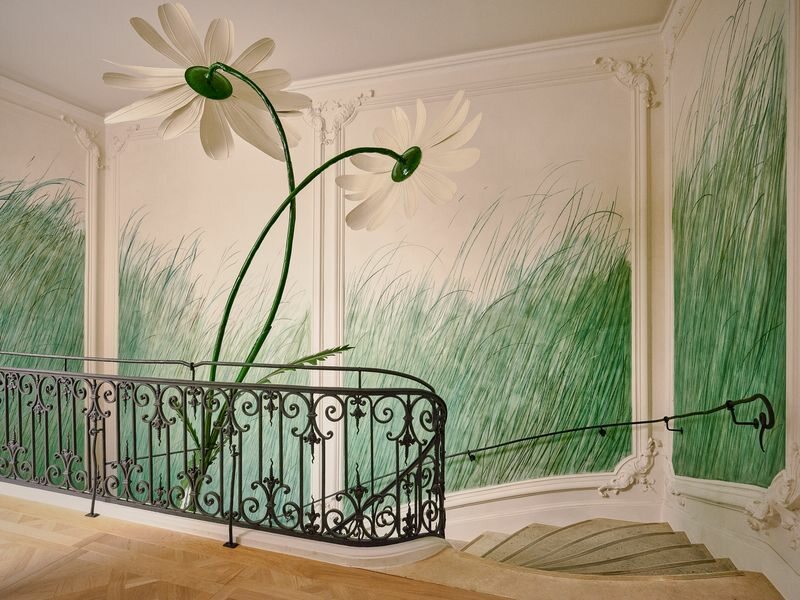 The giant daisies and the botanical sketch pay homage to the house’s Norman origins – Matthieu Salvaing
To succeed in telling this singular story, the director has surrounded himself with artisans and artists. The ceramics reinterpreting the house’s codes are by Agnès Soustiel, Arnaud Le Calvé and Henriette Jansen; the ceiling of the vestibule is the work of decorative painters Dominique and Noé Bouillon; and the staircase railings and balustrades are by metalworker Romain Barré, a graduate of the École Boulle, with whom the brand has also created several exclusive pieces for sale. These railings lead deeper into the hôtel particulier, where the décor shifts: on one side, a huge apothecary cabinet reveals the secrets of the colour blends needed to achieve the shades of the brand’s prints; on the other, a Haussmann-era staircase is overrun with frescoes of wild plants, while the stem of a monumental daisy in raw steel rises all the way to the top of the stairs.
“It’s an explosive element that creates an atypical universe. And it brings me joy,” says de Buffevent, presenting the reimagined rooms of the private mansion, which once belonged to the highly unorthodox Savalette de Lange family.
Conceived as the home of a lineage of eccentrics, the address blurs the boundaries between boutique and family museum. The 18th-century paintings have been preserved, and the furniture has been adapted to showcase the menswear offer here. In the adjoining room, the Ladies First leather bags, made in Italy, are displayed on a Diana the Huntress statue-stand created by the Louvre’s workshops.
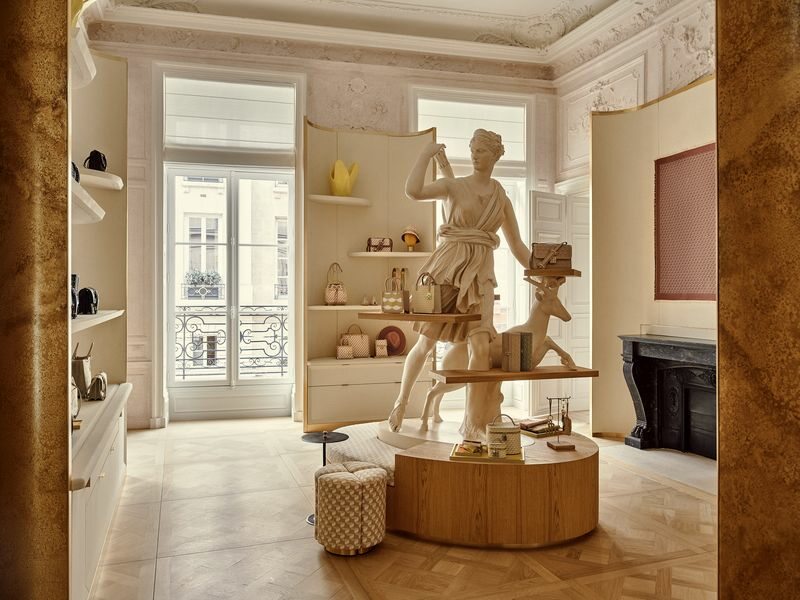 Diana the Huntress – Matthieu Salvaing
A library-cum-boudoir, bringing together works on the Fauré Le Page family and furnished with Louis XV bergères, restored and reupholstered in the house’s signature fabric, serves as a VIP lounge. Another room, another mood: swords and Jérôme Bonaparte’s rifle – a wedding gift from his father-in-law – are displayed under glass.
“I’m keen to foster this dialogue between archival pieces and contemporary creations. It allows us to show where some of our items come from. At Le Page, the weapons are ceremonial arms. These were extraordinarily expensive pieces,” the director enthuses, as he retraces the history of the arquebusier’s craft.
It is to this historical dimension that the house has dedicated an entire room, with the reconstruction of a firing range. Historically, such spaces were used to test weapons. With this feature, dubbed ‘the Challenge of Mars’, Fauré Le Page invites visitors to try their hand on a digital target board in playful four-minute sessions.
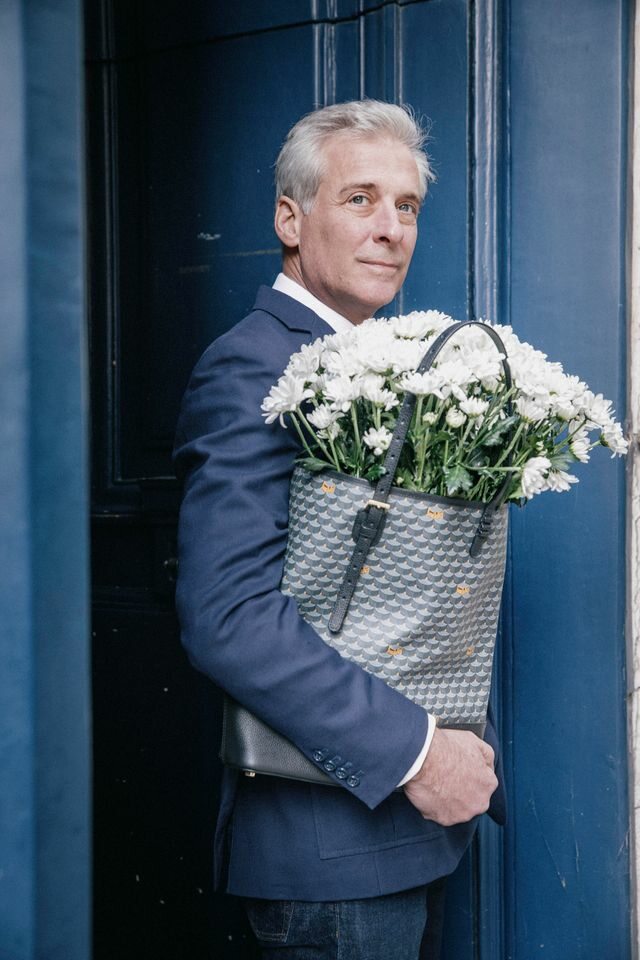 Augustin de Buffevent – Fauré Le Page
In this theatrical mise-en-scène, each room is selling less a product (with prices starting at around 400 euros for small accessories and rising to nearly 4,000 euros for the most elaborate bags) than a fragment of history. The room devoted to payment, for instance, is almost a cabinet of curiosities, with numerous original weapons, manuscripts and family memorabilia, as well as period posters and postcards. A whole world unto itself, whose momentum veers away from the tightly calibrated codes of commercial performance.
“We are not a fashion house. We move at a different pace,” asserts de Buffevent when asked about the rhythm at which products are brought to market.
“For us, creation is a choral process. Just as we are reinventing an old name from French history, we have our own tempo,” he explains.
The house plays with the seasons, but the development of new products emerges from the creative director’s inspirations and encounters.
The maison has a screen-printing workshop in Annecy and, since its relaunch, has worked with the same workshops to produce its leather goods.
“Our philosophy is to grow together. We exchange ideas on techniques and move forward through dialogue. It takes time to build our collections in this way. We take immense pride in the fact that everyone adds their own stone to the edifice. Seduction is the art of surprise, but I believe in striking a balance between management and creation.”
Although neither the level of investment represented by this new house on Rue Saint-Honoré nor the company’s turnover have been disclosed, the brand intends to capitalise on this address as a showcase for its savoir-faire and its ability to serve an international clientele. The maison, which currently has twelve boutiques worldwide, including two in Paris, is preparing to open a new store with a partner in Thailand, in Bangkok’s most upmarket shopping centre.
Copyright © 2026 FashionNetwork.com All rights reserved.