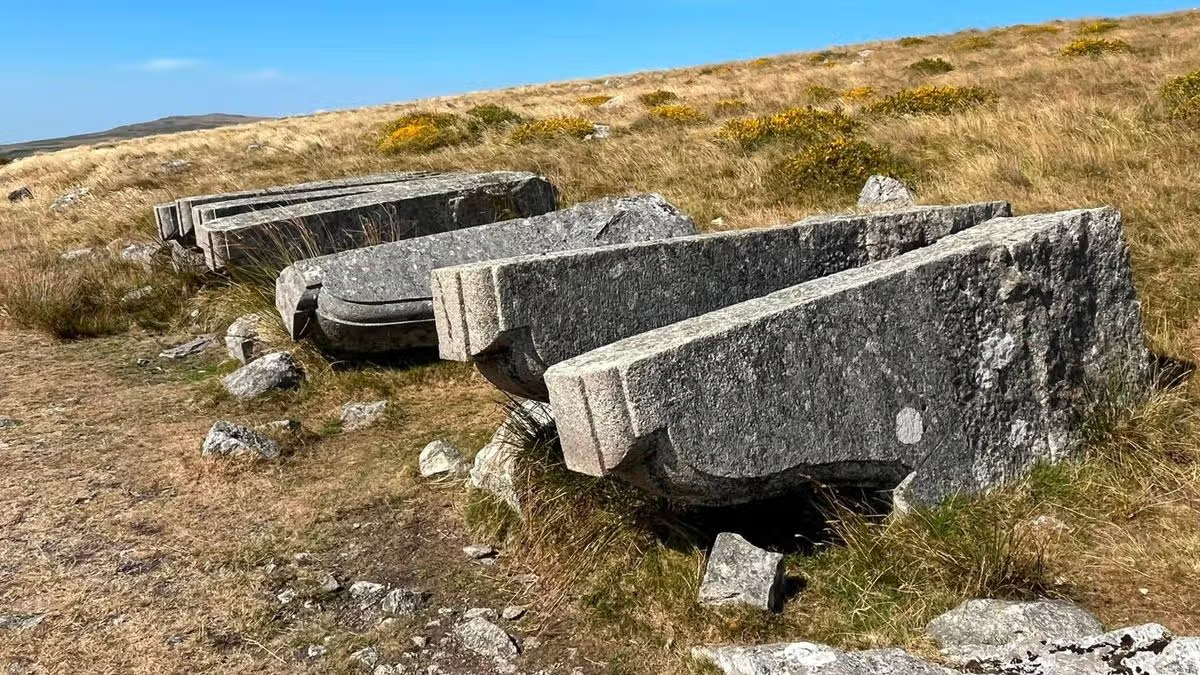
Beside a disused railway on Dartmoor lies a set of giant carved stones abandoned on the side of a grassy trail.
The blocks, painstakingly fashioned from granite in 1903, were destined to become part of one of London’s most famous engineering feats – Old London Bridge.
But the partially-finished dozen corbels – decorative brackets to carry heavy loads – were never needed and have lay abandoned on Dartmoor for more than a century.
This surprising industrial wasteland gives us a glimpse into an earlier age when the rocks of Dartmoor were plundered and the tors disembowelled for material.
Swelltor was one of the larger quarries in the area and was operational until the early twentieth century. The ruined stone house was a blacksmith’s and as you walk further along the path you will see the corbels.

Abandoned corbels on Dartmoor(Image: Kim Lowe)
They were destined for alterations made to the bridge and were supposed to extend the pavement out over the Thames.
But these examples weren’t needed and lie here still on Dartmoor.
Each measures around three metres by one metre and lie just outside the quarry itself.
In March 1903, nearly 1,600 tons of granite was blasted at Swelltor Quarry and some of it was used by the Plymouth firm Pethicks, which ran the quarries at Foggintor and Swelltor to fulfil the contract they held to supply the corbels for the work being undertaken to widen London Bridge.
The bridge itself, ‘New’ London Bridge, was opened in 1831 and replaced the great medieval bridge that had spanned the Thames since the 13th century.

Abandoned corbels on Dartmoor(Image: Kim Lowe)
By the beginning of the 20th century, the ‘new’ bridge wasn’t wide enough to accommodate both the traffic and the pedestrians, and the idea was to place a series of corbels on the sides of the bridge that would project out over the Thames and carry the extended pavement.
The work was undertaken, and the result can be seen today at Lake Havasu in Arizona. That’s because it was dismantled in 1967 and relocated over there to act as a tourist attraction.
Urban legend says the American entrepreneur who bought London Bridge in 1968 mistakenly thought it was Tower Bridge, something later confirmed to be untrue.
“The corbels left on the moor were either seconds or exceeded requirements,” explains Dartmoor resident Richard Hayden. “I have read that several of the corbels were in fact shipped off to Arizona in the 1960s when the bridge was sold.”

Abandoned stonework on Dartmoor(Image: Kim Lowe)
And it is not just London Bridge that Britain can thank Dartmoor for.
Nelson’s Column was once on Dartmoor. Well, it was in a sense, because the stone for that famous monument came from the moorland quarries.
Where in the prehistoric period people used the granite lying about on the surface of Dartmoor, more recently they have quarried for it.

Abandoned corbels on Dartmoor(Image: Kim Lowe)
Granite quarrying reached its peak in the 19th century, under the influence of Sir Thomas Tyrwhitt, the man who founded Princetown.
Granite from his quarries was used to build the prison at Princetown, and later for the Plymouth Breakwater.
Haytor Quarry provided the granite for the British Museum, while Merrivale Quarry refurbished Tower Bridge, paved Trafalgar Square and supplied the Falklands Memorial.
During the 20th century the moorland quarries struggled to compete with granite from Cornwall and overseas, and one by one they closed.