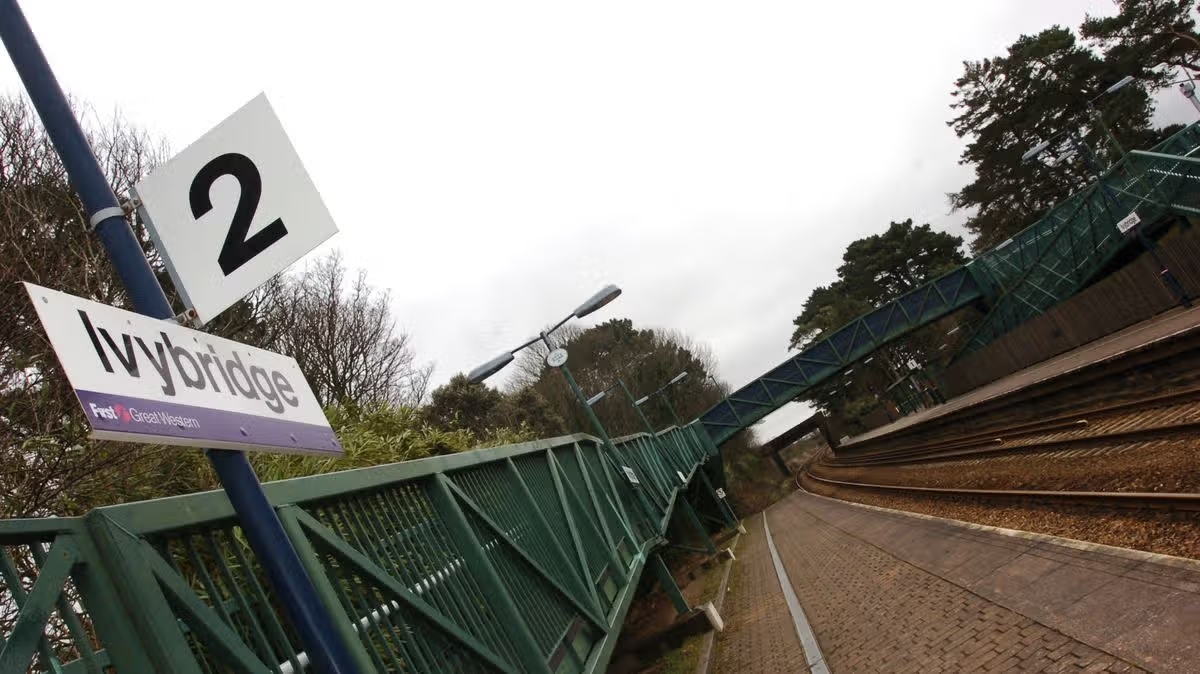
A feasibility study is soon to be completed on whether Ivybridge Railway Station platforms can be extended so more mainline trains can stop there.
At present many CrossCountry services don’t stop at Ivybridge because they are simply too long and do not have selective door opening, making the short platform a safety hazard.
South West Devon Conservative MP Rebecca Smith, who has been campaigning for better local railway services and sits on the cross-party Transport Committee, found that passenger usage in the town had increased by 16 per cent when she conducted a transport survey and there was a demand for more services.
There were nearly 137,000 entries and exits at Ivybridge in 2024/25..
The survey revealed that 94 per cent of respondents in Ivybridge wanted more trains to stop there and 80 per cent of those were more likely to use the train more often if that was the case.

South West Devon MP Rebecca Smith at Ivybridge station(Image: Screenshot from Rebecca Smith’s video)
Miss Smith said Network Rail had confirmed to her that they hoped to have the feasibility study, funded to the tune of £20,000 from South Hams District Council, ready in the next few weeks.
“I have pushed hard for improved services at Ivybridge with Network Rail, CrossCountry and GWR, alongside the Ivybridge Rail Users Group, PL:21 and South Hams District Council,” she said.
“We now need to understand whether the platforms can be extended. If it shows they can, we then need to secure the funding for the work.
“I have previously raised in parliament that 29 CrossCountry services were passing through Ivybridge without stopping, alongside 16 GWR services stopping there, so I believe that getting more services to call at Ivybridge could make a real difference for local residents.”
But the move may not be popular with commuters in Plymouth who want faster journeys between the city and London.
Plymouth City Council Tudor Evans (Lab, Ham) said the preoccupation of businesses in the city was to speed up the railway to London.
“The more stops you make on the line the slower that journey becomes. We have a couple of trains now that take three hours to London but that is with very few stops.
“Our focus is to get the Plymouth Metro up and running which would improve the service from Ivybridge to Plymouth and would allow people to use it for work. Little trains scooting up and down that line with an additional station at Plympton is what we want with a tap on, tap off facility like what is happening in Cornwall.”
Ms Smith said she wanted Ivybridge to be fully included in the proposed Plymouth Metro and benefit from the improved connections that would bring but improving the main line services would also help better connect her residents to Plymouth and Exeter as well as London.
The metro is to create a “turn up and go” rail service for the city’s eastern edges, helping to ease congestion on the A38, support homes and increase transport links for thousands of new workers planned for the city.
With 25,000 new jobs promised and a £7 billion defence deal Plymouth needs to have the transport infrastructure in place. The city centre is soon to get a boost with 2,000 workers from Babcock moving into a new engineering and capability centre at the former House of Faster building once it is refurbished.