An autistic Exmouth boy, aged five, being denied the chance to learn and make friends because his schooling is on hold, must wait more than a year before Devon education leaders thrash out his needs with his parents.
An Exmouth father says his severely autistic son isn’t just “lost in the system” but “lost in his front room” after criticising the county council for not meeting his educational needs, writes Fran McElhone.
Dan Wilson, whose son Barnaby is five but operates at the level of a two-year-old, is awaiting a tribunal hearing in March 2028 after disputing Devon County Council’s (DCC) decision that his needs can be met in a mainstream school. He describes his experience trying to find a solution to the matter as “an ordeal”. His tribunal is one of 677 pending against the authority by parents in relation to Special Educational Needs and Disabilities (SEND) provision.
We feel we have no option but to keep him at home. We feel abandoned.
However, in response the council has revealed it is in dire straits: while facing increasing demand for Special Educational Needs and Disabilities (SEND) support its SEND spend is tens of millions of pounds in debt, with a forecast of a further £88 million deficit for SEND this 2026/27.
Mr Wilson explained that in addition to having speech and learning difficulties, his son – “a wonderful child” – becomes easily frustrated and dysregulated. He received Barnaby’s Educational, Health and Care Plan (EHCP) in June – 10 months after it was due – which stated that he requires a unique curriculum, full-time one-to-one support and to be in a class of no more than 10 children.
Mr Wilson said he requested a place at either Millwater or Magdalen Court specialist schools but was told they had no spaces.


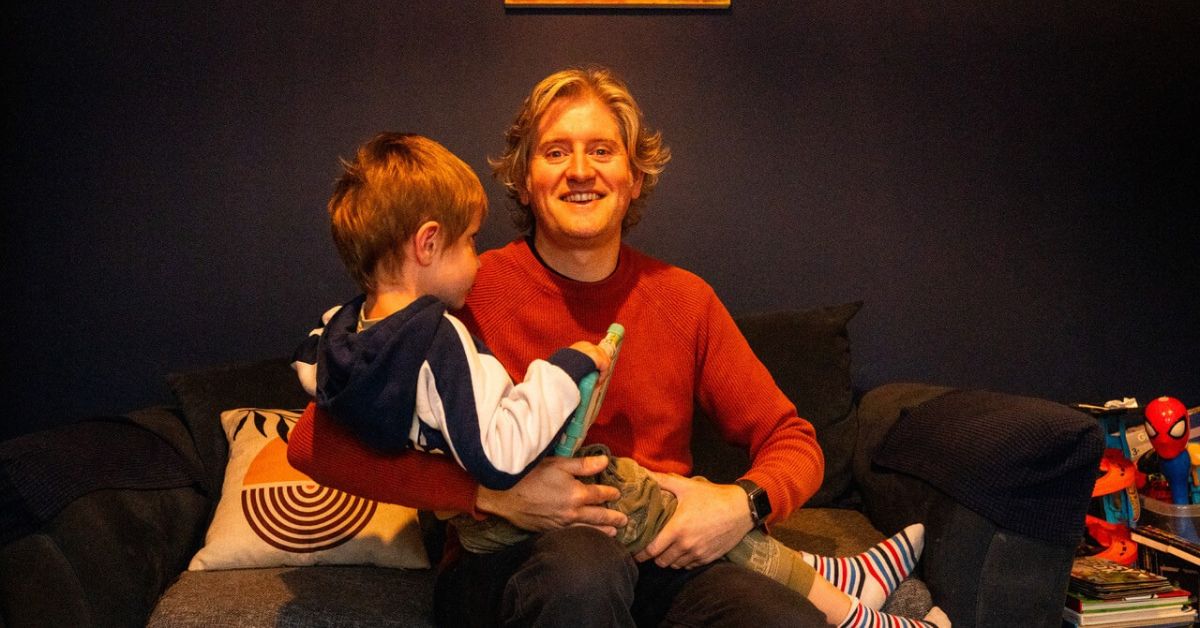
Dad Dan Wilson, from Exmouth, is urging the county council to find his autistic son, five, a specialist school instead of mainstream education.
Photo: Fran McElhone.
Instead, the council has offered Barnaby one-to-one support within a mixed early years class of at least 13 children and up to 30, at Exeter Road Primary School in Exmouth. But his dad is adamant that it would be “impossible” for his son’s needs to be met there.
“While we await the tribunal about Barnaby not going to Exeter Road Primary, the council wants to send him to Exeter Road Primary. You couldn’t make it up,” said Mr Wilson, who speaks highly of the primary school having been a governor there for five years and who has two daughters there.
“We know Barnaby’s needs can’t be met there and it wouldn’t be good for him or the other children, so we feel we have no option but to keep him at home. We feel abandoned. The tribunal is 18 months away – Barnaby’s not only lost in the education system, he’s lost in my front room. While my wife home-schools our daughter, she is able to look after Barnaby, but she’s not able to provide what he needs and it’s hugely stressful for her.”
Parents feel lied to, and the problem then is that people lose confidence in the council.
The council currently doesn’t have enough places in specialist schools to meet the high demand – a demand which is set to increase dramatically in the coming years.
There are more than 10,000 children in Devon with an EHCP. As of January, there were 1,845 pupils in state-funded specialist schools in Devon, across 12 sites.
“I have a lot of sympathy for the council because SEND is underfunded,” said Mr Wilson. “But they’re not transparent about it, making out that Barnaby’s needs can be met, when then can’t. Parents feel lied to, and the problem then is that people lose confidence in the council.
“Putting financial concerns before the needs of children makes no sense: an autistic child who hasn’t been educated becomes a vulnerable adult. The costs incurred for specialist education is nothing compared to what a vulnerable adult who may not be able to work or live independently, will cost. It’s all about today and nothing about tomorrow.”
Information from DCC showed:
677 appeals pending for Devon County Council in relation to SEND provision.Council facing 24 per cent rise in demand for SEND support by 2030, while forecasting further £88million deficit for SEND spend this 2026/27.Family of severely autistic boy waited 10 months for EHCP recommending specialist setting, but specialist schools are oversubscribed.More parents homeschooling in Devon than rest of England but “is often used as a last resort and not a positive choice”

Dan Wilson, from Exmouth, says it is ‘impossible’ his autistic son’s needs can be met through mainstream schooling. Photo: Fran McElhone.
In addition:
DCC was unable to confirm how many of the 10,000 children with EHCPs are ideally suited to education within a specialist school setting.The council is facing huge practical and financial challenges: more than 15 per cent of Devon’s pupils receive SEN support, higher than the national average, with needs becoming increasingly complex.The biggest challenge to the council is lack of funding from the government; Devon is a member of the f40 group, 43 of some of the lowest funded authorities in the country. The authority is calling for a review of the funding formula that sees Devon’s pupils being funded £5,000 less each, than some of the highest funded pupils elsewhere in the country.
Last year the council conducted an in-depth investigation called the Joint Strategic Needs Assessment for Children and Young People with Special Educational Needs and Disabilities in Devon. It found that while 42.9 per cent of Devon’s EHCP cohort remains in mainstream schools and 28.3 per cent attend special schools, a “significant” 13.7 per cent are educated elsewhere, almost double the England rate of 7.8 per cent.
The investigation concluded that “this reflects rising levels of emotionally based school avoidance, placement breakdowns, and reduced confidence in mainstream inclusion.”
With regards to ‘Elective Home Education’ the report noted that Devon’s rate is “significantly higher” than England, and “is often used as a last resort and not a positive choice”.
It also recorded that there has been a 117 per cent increase in EHCPs since 2018, compared with 80 per cent nationally, and by 2030 Devon is forecast to have more than 12,000 children and young people with EHCPs, representing a further 24 per cent increase.
But the council’s finances aren’t rising with the demand: while being one of the most under-funded local authorities in the country, it is crippled with historic debt which the Department for Education (DfE) is not adequately addressing.
Barnaby’s not only lost in the education system, he’s lost in my front room.
Recognising the “progress” made by the council on its SEND reform plan, the DfE has agreed to provide £191million to clear 90 per cent of the council’s historic deficit on SEND support, leaving £26.9million of historic deficit.
The council is currently forecasting a spend of £213million this financial year on SEND, against a budget of £125 million, leaving an overall deficit of £88million for 2026/27. To date, the DfE has not announced any write-off mechanism for future years.
The authority said: “We acknowledge where we have failed and recognise that our attempts to do better have not been good enough.”
The council also conducted a ‘sufficiency strategy’ which is a key component of the Devon SEND Strategy 2024 to 2027 within the wider SEND Transformation Programme.
The strategy recognised that:
Some children are travelling long distances to school because local provision does not support their needs.Special schools are full or oversubscribed.Devon is commissioning places in independent or out-of-county schools – at significant cost.Delays in EHCP processes have eroded family confidence: in recent years, fewer than one in 10 EHCPs in Devon were issued within the statutory 20-week timeframe, compared to a national average of around half.Families report frustration at having to “fight the system” to secure support, and schools face difficulty planning provision when decisions are slow.
The Devon SEND Sufficiency Strategy 2025 to 2030 sets out how the county will meet the needs of children and young people with SEND over the next five years.
It stated that:
“Despite efforts to improve, lots of families continue to express frustration and disappointment, describing their experience as a ‘battle’ or a ‘fight’. Families grapple with bureaucratic hurdles, poor communication and a lack of joining up between agencies. “The system for supporting children and young people with SEND in Devon has fallen short of expectations. We acknowledge where we have failed and recognise that our attempts to do better have not been good enough. Families rightly demand real improvements that positively impact their day-to-day lives.“We recognise that we need system-wide change to address the challenges the local area faces and to improve the experiences of children and young people with SEND, and their families, in Devon.”
A Devon County Council spokesperson said: “Our spend on SEND support has increased not only as more children and young people need high levels of support but due to inflation increasing the costs of meeting those needs.
“We are working to strengthen inclusion and early support, working with mainstream education settings so more children and young people can go to their local nursery, school or post-16 college.
“This includes starting to deliver the government’s ambitious Experts at Hand initiative.”
Experts at Hand is a new pilot initiative launched this autumn which aims to bring specialist advice and support including speech and language therapists, educational psychologists, occupational therapists, and specialist teachers, into education settings and help children and young people earlier.
The DCC spokesperson added: “We’re also working with the DfE to deliver an additional 300 special school places by 2030, along with more specialist bases in mainstream schools.”