
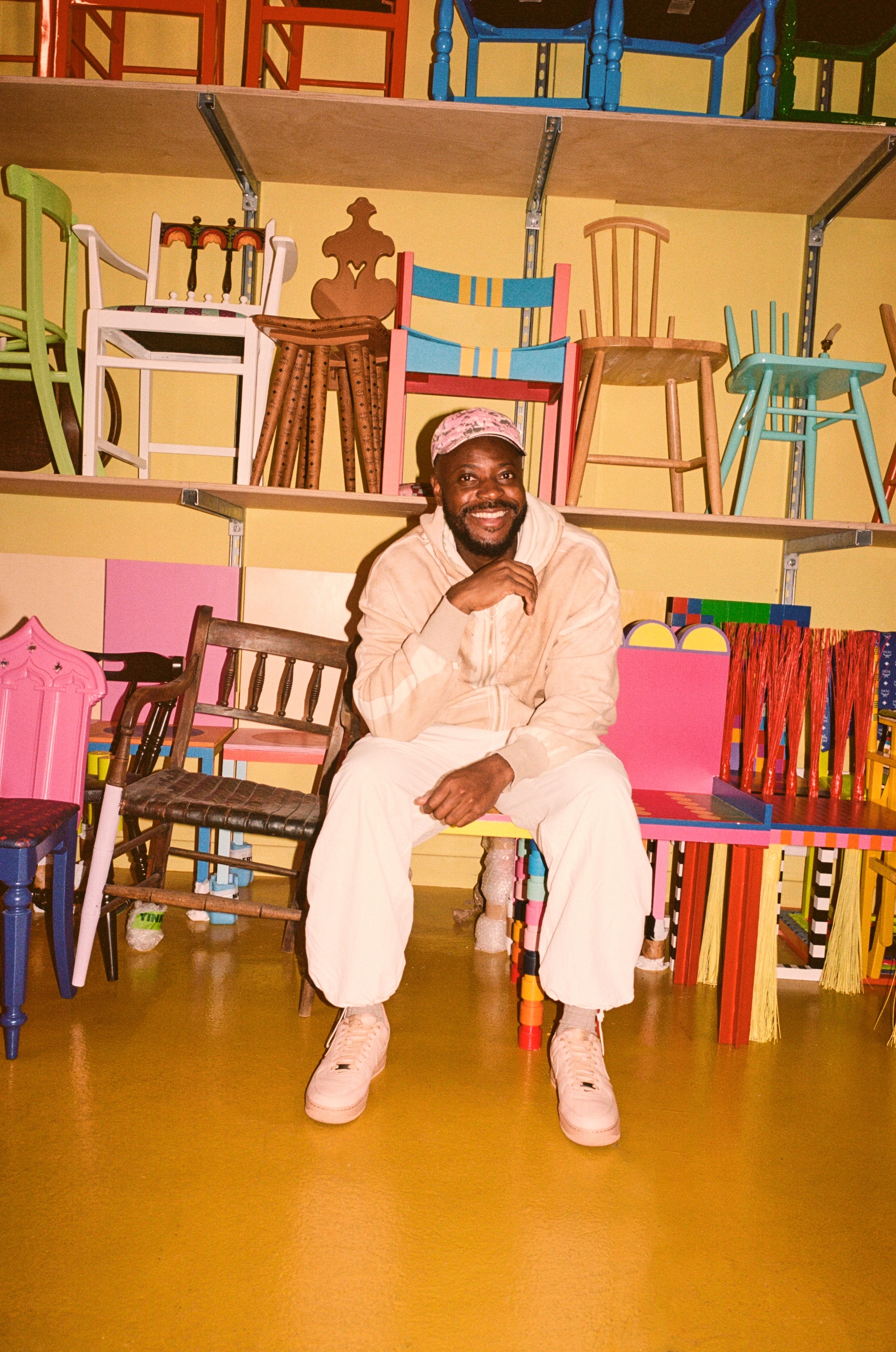
During Frieze London and UK Black History Month, Yinka Ilori is bringing his new debut monograph, Chairman, to life with his first-ever exhibition dedicated entirely to his chair practice.
Taking place from 14th–16th October at Walter Sickert Community Centre in Islington, the exhibition brings together a decade of chairs exploring memory, heritage, storytelling and community — returning the work to the same part of London where Ilori grew up.
The setting feels particularly important. Rather than presenting Chairman inside a conventional gallery, Ilori is placing the exhibition within the community that helped shape him, while this year’s Black History Month theme, Honouring Our Communities, adds another layer to the project.
For Ilori, chairs have never simply been furniture. Over the past decade, discarded and overlooked objects have become vehicles for colour, memory and storytelling, shaped by his British-Nigerian heritage and his experiences growing up in North London.
FAD caught up with Yinka Ilori to talk about bringing Chairman home, the stories held by everyday objects, growing up between cultures and what he hopes the Yinka Ilori Foundation can make possible for the next generation.
 You’re bringing Chairman back to Islington, to the neighbourhood where you grew up. What does it mean to show this body of work there, rather than in a more conventional gallery setting?
It feels really special, actually. I grew up in Islington, and so much of what I make comes from the things I saw growing up, the people around me and the different communities that make North London what it is. You don’t always realise how much a place influences you until you look back, so bringing CHAIRMAN back home feels like bringing all those different chapters together in one place.
I also love that it’s happening at Walter Sickert Community Centre because I’ve always believed that art and design don’t need to be confined to a museum, gallery or somewhere official to be meaningful. To me, the community itself is a museum. The people who live here carry so much history, so many stories and so much lived experience. In a way, they’re walking artefacts themselves!
My chairs have always been about people, stories and bringing people together, so showing them in a community space feels really natural.
I want to challenge the idea that your work has to be displayed in a traditional institution to be seen or appreciated. Not everyone has the opportunity to visit a gallery or feels that those spaces are for them, and I think it’s important to bring art to people rather than always expecting people to come to art.
That’s also why showing CHAIRMAN during Frieze feels so important to me. People might usually spend that week visiting galleries in other parts of London, but now they have a reason to come to Islington, explore the neighbourhood and experience art somewhere they might not ordinarily expect to find it.
I want people to see that art doesn’t have to belong to one place or one particular week; it can be everywhere, all around us. Ultimately, I want people to come in, find a chair that speaks to them and maybe see something of their own lives in the work. That’s what I’m really excited about.
You’ve been working with chairs for around a decade. What keeps bringing you back to that form, and how has your relationship with the chair changed over that time?
I think it all started with curiosity. I’ve always been drawn to things people overlook, and chairs are a perfect example. We sit on them every day, but we don’t really think about them.
I remember looking out of a bus window in London and spotting a discarded chair on the street. It got me thinking about who had owned it, the stories it could tell and what else it could become instead of ending up in a skip.
Ten years later, I’m still curious about those things, but the work has grown with me. Chairs have become a way for me to explore memory, community and our connection to the places we call home.
I love taking something so familiar and giving it a new life through colour, pattern and form. It’s amazing how something as simple as a chair can hold so much meaning.
I think that’s what keeps bringing me back. There are always new stories to tell and new ways to look at something we think we already know. And honestly, I don’t think I’m finished with chairs just yet!
 Your work often carries memory, colour, language and references to British-Nigerian life. How do those different parts of your identity find their way into the objects you make?
I think a lot of it comes from growing up in a Nigerian household in North London. You’re surrounded by so many different things — music, food, family, your neighbours, the colours and patterns around you. As a child, you take all of that in without even realising it, and it becomes part of how you see the world.
Colour and pattern are a big part of who I am because they’re tied to so many memories. I think about the bright dresses my grandmother used to wear, or the patterns on the furniture in our home. Those things stay with you and become part of your visual language.
I love how colour can change how something makes you feel, and how patterns can tell a story without saying a word.
All these influences naturally find their way into my work. Growing up between different cultures has taught me that you don’t have to choose one part of yourself over another. You can bring everything together and create something new from it.
I think that’s what makes the work personal to me, while still allowing other people to connect with it through their own memories and experiences.
This year’s Black History Month theme is Honouring Our Communities. What does community mean to you now, particularly in relation to the places and people that shaped you growing up in London?
Community has always been a huge part of who I am and what I do. Growing up in Islington, I was surrounded by different cultures, families and people from all walks of life.
Those everyday experiences really shaped me — the people I met, the places I went and the feeling of being part of something bigger than yourself.
That sense of community runs through all my work. I’ve always wanted to create things that bring people together, spark conversations and make people feel something.
For me, design isn’t just about making something beautiful; it’s about how it makes people feel and how it can connect us. You don’t have to come from the same background to find common ground.
For me, honouring our communities means celebrating the people and places that have shaped us, remembering where we came from and finding ways to give something back.
My roots in Islington are a big part of who I am, and community will always be at the heart of what I do.
You’ve spoken about the Yinka Ilori Foundation and giving something back. What do you want the Foundation to make possible for the next generation that perhaps wasn’t available to you when you were starting out?
I want the next generation to have opportunities to explore their creativity, even if they don’t know where to start.
I know how important it is to have the space to experiment, make mistakes and figure out what you’re good at. Sometimes, all you need is someone to believe in you and help you see what’s possible.
That’s what I want the Yinka Ilori Foundation to help make happen: giving more young people access to play, creativity, resources and the confidence to share their ideas.
For me, creativity isn’t just about becoming an artist or designer; it’s about seeing the world differently and realising that your perspective matters.
I want young people to feel that where they come from, their experiences and ideas are something to be proud of, and that they can use all of those things to create something amazing.
Yinka Ilori: Chairman, 14th–16th October 2026, Walter Sickert Community Centre, Islington, London
CategoriesTags