
Travel, for all its allure and appeal, can definitely be unpredictable.
And although our travel partner Collette Travel does its best to take any worry or inconvenience out of a trip abroad, there are some things that are beyond its control.
One of those things, it turns out, is the level of the Rhine River, which has been experiencing 30-year lows after a very hot, dry summer. And it also turns out that our planned cruise on one of those fancy riverboats I’d been hearing so much about was scheduled to float past some of the areas that had been most affected.
Still, there was rain in the forecast and hope in my heart as we departed, already knowing that our cruise would be cut one day short and our itinerary looked almost nothing like the one we had signed up for.
And things started off well enough. We flew into Zurich, then took a coach for a few hours to Strasbourg, France, where we stayed in a hotel the first night so that we could experience this charming Rhine River gem with its canals, half-timber houses and delightful mix of French and German heritage.
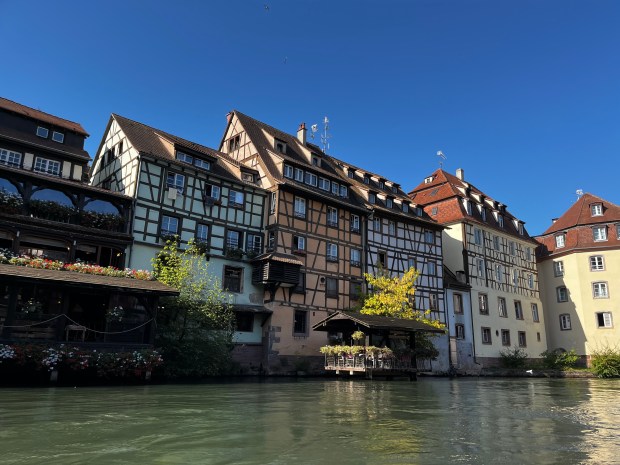 Strasbourg, France, from the canal. (Jess Fleming / Pioneer Press)
We cruised through the canals, learned about the topsy-turvy history of the Alsace region (which also produces some great cold-weather wine) and had a hearty lunch (my spaetzle was fantastic) at a historic local restaurant. So far so good!
After a pretty mediocre hotel dinner where we met our fellow cruise-ship passengers, we got some sleep before waking up and getting back on the coach to transfer to Koblenz, Germany, where the Rhine and Moselle rivers meet. Thankfully, the water levels on the Moselle were higher, so we were able to cruise along this lovely river for a few days.
We settled in and unpacked, hopeful that we’d have to do that just once. Spoiler alert: We’d have to unpack and re-pack one more time before the trip was over.
Our original itinerary included just a tiny piece of the Moselle, which boasts an absolutely gorgeous, rural river valley. And that itinerary did not stop in Bernkastel-Kues, which ended up being a favorite among many in our group.

A square in the charming Moselle River town of Bernkastel-Kues, Germany. (Jess Fleming / Pioneer Press)

Our group in Bernkastel-Kues. The narrow house behind us was used in Harry Potter and the Deathly Hallows. (Courtesy of
Mihaela Petrescu)

Bernkastel-Kues, Germany, from the Moselle River. (Jess Fleming / Pioneer Press)

Wine tasting at Dr. Pauly-Bergweiler in Bernkastel-Kues, Germany. (Jess Fleming / Pioneer Press)
Show Caption
1 of 4
A square in the charming Moselle River town of Bernkastel-Kues, Germany. (Jess Fleming / Pioneer Press)
Upon arrival, a local guide walked us through the tiny historic center, where we learned more about how this region flipped from French to German rule over the centuries. Currently a German city, the wineries charmingly creep right up to the medieval city limits.
The wine Bernkastel is best known for is locally known as “doctor wine,” so named because an archbishop in the 14th century was convinced this minerally wine, grown on a very small plot on a steep, sun-soaked hill, cured him of a feverish ailment that doctors could not.
We did a tasting at Dr. Pauly-Bergweiler, a winery that was founded in the 1550s. Many of us were fans of the dry rieslings, and a few of us (not me) even liked the sweeter, late-harvest varieties.

The view from the castle in Cochem, Germany. (Jess Fleming / Pioneer Press)

Sausage and German potato salad in Cochem, Germany. (Jess Fleming / Pioneer Press)

The castle in Cochem, Germany. (Courtesy of Ed Fleming)
Show Caption
1 of 3
The view from the castle in Cochem, Germany. (Jess Fleming / Pioneer Press)
The next day, our boat arrived in Cochem, a fairytale town best known for its massive castle.
We toured the town briefly, then most of us took a steep uphill walk to catch some vans that took us up to the castle, parts of which date to 1000 A.D. It was almost completely destroyed in the 1600s by the French, then purchased by a businessman in the 1800s and rebuilt in a Neo-Gothic style. The businessman, Louis Ravené, used the massive castle as a summer home. Can you imagine?
Anyway, at some point the castle was given to the city of Cochem, which now runs it as a museum. The interior is still decorated with historic artwork and furniture, including some pretty incredible suits of armor, but the best part about trekking up the hill is probably the view. It’s spectacular.
Already growing weary of the fancy meals on the ship, which didn’t bear any resemblance to the traditional food of the area, my husband and I decided to stay in town for lunch and found a lovely riverside patio. We ordered sausage with German potato salad and jagerschnitzel, as all the menus seemed to be overrun with that item. Indeed, both were excellent and just what I was craving.
It was after Cochem that our trip went fully sideways. The Rhine River levels had continued to drop and we were informed that we would not be able to sail upon it. We’d have to take a coach to Cologne, our next scheduled stop, and then continue on the road, not the river, to Utrecht, Netherlands, where we would board a new ship.
This was exactly the situation most of us had been hoping to avoid, but with the river levels being so unpredictable, there was nothing we could do.
After dinner on the ship, we went to bed early, as our bags had to be outside our cabin at the crack of dawn.
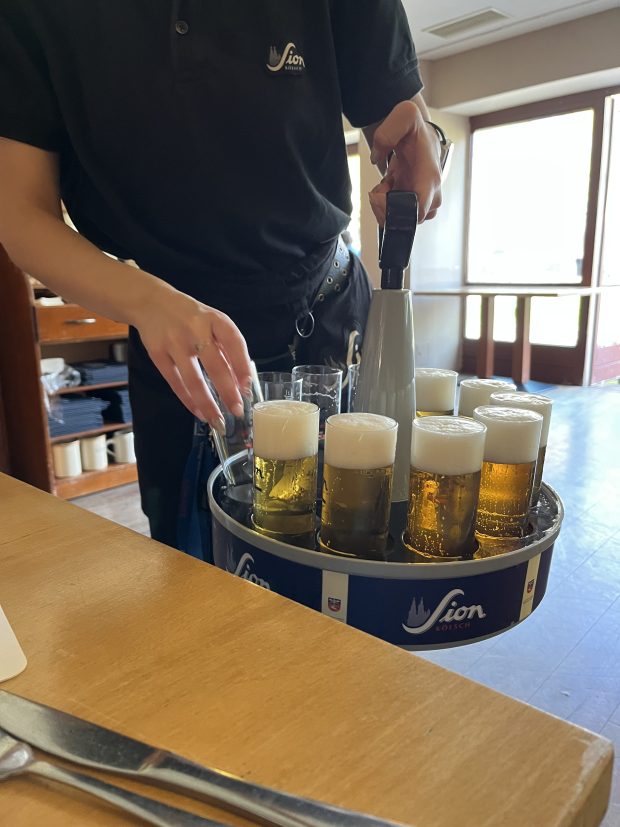 Kolsch service in Cologne, Germany. (Jess Fleming / Pioneer Press)
A long bus ride took us to Cologne, Germany, where we were treated to a massive German lunch, replete with sausages, potatoes, a vinegary slaw and kolsch service. A few Twin Cities breweries started offering this Cologne tradition this summer, which consists of drinking the cracker-crisp beer from slender .2-liter glasses. The idea is that someone replaces that beer as soon as you finish it, making a hash mark on your coaster so they know how many you’ve had. We managed to get three or four out of our overworked server, but I’d love to do it when there are not 100 people to serve at once. Next time!
We also took a guided tour through the bustling city and marveled at its Gothic cathedral (the interior is also worth a peek — it reminded me a bit of Sagrada Familia in Barcelona). After, I bought a bottle of 4711 Cologne (not the original scent; I liked some of the more modern formulations better). It’s the original! As in, the first cologne, created in 1792. It’s much lighter than French perfume, and I think my daughter, who is more into personal scents than I am, will enjoy it.
Late that afternoon, we boarded our new ship — a bigger, slightly newer vessel — in Utrecht, Netherlands. We remained docked for the evening, along with at least a dozen other vessels, which unfortunately meant that our side of the ship had another ship for a view out of our windows.
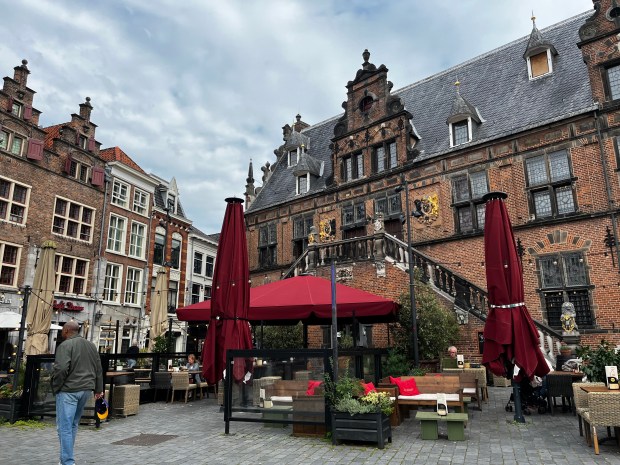 A tiny portion of the city that was not destroyed by bombs during World War II in Nijmegen, Netherlands. (Jess Fleming / Pioneer Press)
The next morning, those of us who chose to do so took a bus ride to Nijmegen, Netherlands for a walking tour. It was about an hour on a coach to get there, and many people in our group chose to sit it out after a long bus ride the day before. And honestly? The town was cute, but much of the historic city center had been bombed to smithereens in World War II, so a little too modern for my European small-city tastes. There was an outdoor market, though, so my husband and I scored some excellent Gouda that we’ll probably use as part of a cheese tray during the holidays.
In the evening, the crew had a lovely surprise for us. After dinner, we took a nighttime cruise through Rotterdam, the second largest city in the Netherlands. It was also heavily bombed during the war, but its modern buildings and colorful lighted bridges made for beautiful reflections on the water. Many of us lingered on the sun deck, taking photos until the scenery faded to black and the yawns overtook us.
The next day, the last official one of our trip, we’d wake in Amsterdam, one of my favorite cities in Europe.

A bridge in Rotterdam, Netherlands at night. (Courtesy of Ed Fleming)

A stall at the Flower Market in Amsterdam. (Jess Fleming / Pioneer Press)

Stamppot at De Blauwe Hollander in Amsterdam. (Jess Fleming / Pioneer Press)

A windmill along the Rhine River. (Courtesy of Ed Fleming)

Bikes and canals are part of the charm in Amsterdam. (Jess Fleming / Pioneer Press)
Show Caption
1 of 5
A bridge in Rotterdam, Netherlands at night. (Courtesy of Ed Fleming)
We got a short walking tour and a canal ride, which is one of the best ways to see the city. The tall, often leaning houses, built over the North Sea, never fail to delight me. And the endless sea of bicyclists traversing the canals is a sight to behold. We noshed on some fries — a must-order in Amsterdam, and bitterballen, the little deep-fried balls of meat that are also a must-have here, before heading back to the ship for a lovely captain’s gala, where we all wore the fancy clothes we’d brought along.
My husband and I stayed in Amsterdam for a few extra days, because even though he’d been here a handful of times in his 20s when he was backpacking through Europe, he was broke then so couldn’t afford to hit the museums. And last time I was in the city, I was too chicken to go to the historic Red Light District, so we made it a point of walking through that area (during the day, and it wasn’t scary at all!)
Even on my second visit to the Anne Frank House, I cried. There’s something about her story that really gets to me — I think it’s probably imagining what an incredible writing career she would have had if she’d survived. And the Van Gogh Museum also moved me. I knew he was one of my favorite artists, and I knew he struggled with his mental health, but I learned so much about his life and his art that looking at his paintings now feels even more special.
We had traditional Dutch food at De Blauwe Hollander, where I tried stamppot, a dish that combines mashed potatoes and greens or sauerkraut, topped with sausage or other meat and drenched in gravy and could not believe that no one is doing this in Minnesota. It’s the perfect mid-winter stick-to-your ribs dish. We wandered through the flower market, and ate Dutch pancakes. They are thin, like crepes, and you can get them topped with sweet stuff, but we (wisely) chose bacon and cheese. For our last dinner, we tried Surinamese food — a beguiling and delicious mix of African, Indian, Chinese and Indonesian flavors — at Warung Spang Makandra. It was a relaxing end to an unpredictable journey.
Even though this trip was quite different from what we signed up for, it was still lovely in many ways. If you’re looking to cruise a European river, though, I’d recommend you do it in the spring, when the water levels are more predictable. Live and learn, I suppose.
Interested in traveling with Jess?
We currently have room in two future trips — Prague, Vienna and Budapest and Egypt.
We’ll travel to those three Eastern European cities from Sept. 27-Oct. 7 2027. Some highlights: the statue-lined Charles Bridge and castle district in Prague, a classical music performance and a Viennese Waltz lesson in Vienna, and strudel lessons and the Danube Promenade in Budapest. The website is here: groups.gocollette.com/en-US/link/1370799
And in February 2028, we’re heading to Egypt! This is a bucket list tour for me — we’ll spend three days in Cairo before cruising the Nile (no worries about river levels there) and hitting the Valley of the Kings and King Tut’s tomb. I cannot wait. The website is here: groups.gocollette.com/en-US/link/1415064
Contact me at eat@pioneerpress.com with any questions!