

BMW put a great deal of effort into the K-series. In all, it’s said that five years of development, 10,000 hours of engine dyno time and 400,000 kilometers of real-world test riding were done before the first ones were ready for the European market. All that led to a pretty sophisticated and reliable machine, but those two words don’t bode well for the poor soul attempting to modify one.
The K-series is tough due to its asymmetrical, stressed-member engine and rigid shaft drive, which completely dictate the bike’s geometry. Strip away the factory plastic, and you are instantly fighting a severed visual line, massive Bosch induction plumbing and an industrial frame BMW never intended the world to see. That said, affordable donor prices and the allure of its distinctive longitudinal inline-four have led builders to step up to the challenge, most recently, Carl Cerra at Melbourne’s Skunk Machine.

Leveraging 25 years of automotive design, Cerra and his longtime collaborator Anthony Cheung completely reengineered a 1989 K100 into a machine they call ‘Disruption.’ It wasn’t designed to fit in a particular category, but instead, it was an exercise in alternative history: what would a K-series look like if BMW’s contemporary design studio built it today?
“For me, retro doesn’t mean replicating or copying something from the past,” Cerra explains. “It means understanding the original design’s character and heritage, then reinterpreting it in a way that feels relevant today. The K100 has a very distinctive mechanical identity, and we wanted to retain that while rethinking almost everything around it.”
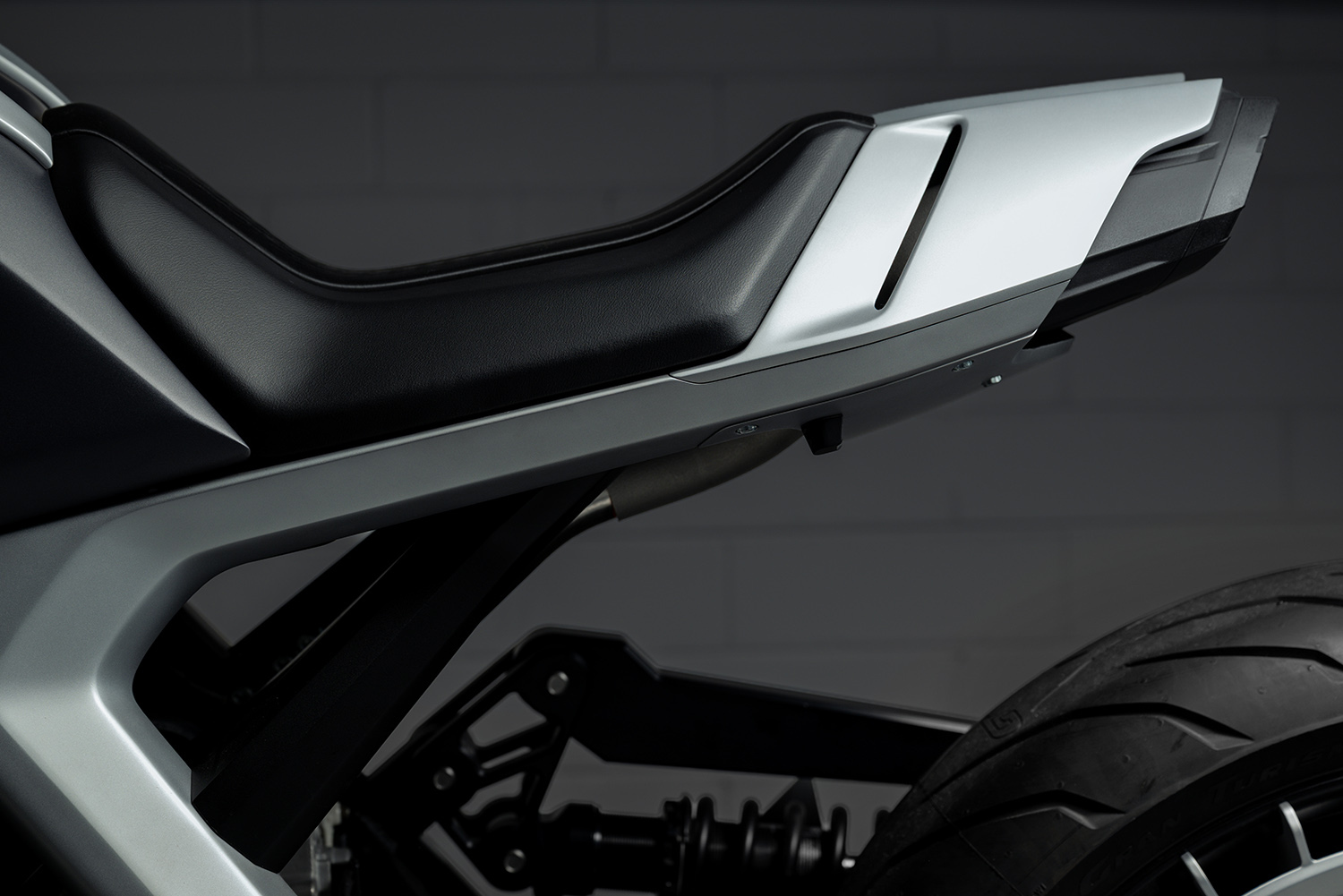
Cerra states that one of the key design objectives was to make the K-series frame disappear as much as possible, starting with a whole new subframe. If you’ve ever seen one stripped of its plastic, the rear subframe points down at an unflattering angle, and Skunk Machine’s new frame gives the bike more purposeful, forward-facing geometry. The seat and surrounding bodywork came next, each piece carefully considered with complementary lines and OE levels of fit, finish and function.

The fuel tank came with its share of challenges as well. The aluminum cell houses a high-pressure fuel pump, a specific inline fuel filter and a pressurized return line, and the underside is sculpted to clear the frame and other EFI components. While the tank was worth reusing, its shape needed a complete rethink, and Skunk Machine designed a complete skin over the tank to rework the body lines. You’d never recognize it as the stock piece, and the bespoke scoops on each side cleverly hide the seam where the original fairing intersected.

In the past, a great deal of reinterpreting the K100’s appearance would have involved a heavy dose of clay modeling for Skunk Machine, but for Disruption, Cerra and Cheung dove headfirst into the 3D world of virtual reality. “Working in VR allowed us to walk around the virtual motorcycle, assess its proportions and stance, and understand how the different volumes and components related to one another,” says Cerra. “It also meant the customer could put on a headset in the studio and experience the design at full size.”

The transformation goes far beyond the skin, though, and Skunk Machine went to great lengths to ensure a contemporary riding experience as well. The factory front end was scrapped in favor of inverted Honda CBR1000 forks, secured by massive CNC-machined triple clamps. The top clamp has a particularly attractive shape, designed for integrated Motogadget instrumentation before the final piece was ever cut.
Out back, the client specifically requested a horizontal shock setup from SideWinder Meccanica, which declutters the rear wheel massively while improving performance. This configuration factored into the final design of the custom rear-set controls, in addition to the bike’s rear-end aesthetic.

One of the most impactful visual elements is the custom wheel set. Skunk Machine developed a pair of bespoke wheels for the project, each borrowing cues from road racing BMWs of the 1980s and ’90s. The rear features a massive turbo-fan-style hubcap that looks like it’s straight off of a DTM car, but with Skunk Machine’s own unique twist. “We wanted to give the motorcycle a subtle visual connection to the marque’s history without copying an existing design,” Cerra explains.
On a motorcycle where every piece looks to have been carefully considered (and reconsidered), some of the details are easily lost in the whole, but Cerra is quick to point out some of his favorite touches. A coolant expansion tank could have been made to be invisible, but Skunk Machine instead crafted an incredibly trick custom piece with a quartz-glass viewing window, making a vital engine fluid a visual design element.

Cerra also speaks highly of Fabio Senesi at SES Factory, who crafted the exposed TIG-welded headers. While these sections showcase laser-straight, pie-cut craftsmanship, other parts of the exhaust feature bends and textures that exceed conventional means. “Some of the stainless-steel exhaust sections were additively manufactured,” Cerra says. “This gave us the freedom to accommodate tight bends and introduce surface texture into the pipes, rather than relying entirely on conventional round tubing.” After disappearing into the subframe, the exhaust terminates in a pair of fighter-jet-style exhaust tips, seamlessly integrated into the tail section.

When asked about the most rewarding and difficult aspects of the project, builders always reveal something about the process. The reward at the end of the journey for Skunk Machine was a familiar one—how thrilled the client was after experiencing how well the bike worked on the open road—but Cerra summarized the most difficult aspect best.
“One of the hardest parts of a project like this is choosing the right direction and knowing when to stop developing it. Design is effectively infinite,” Cerra explains. “You can keep exploring alternatives, refining surfaces and finding new opportunities to improve something. If you let it, the process can continue indefinitely.”

Looking at this clean-sheet K-series, Carl Cerra and Anthony Cheung can rest easy knowing Disruption is everything they set out to achieve. It’s traded its ’90s sport touring aesthetic for chiseled contemporary lines, all without abandoning its maker’s heritage—like something the modern Motorrad designers got their hands on.
Skunk Machine | Website | Instagram | Facebook | Photos by F Style Photos


Shopping the Bike EXIF store supports the site and helps us publish more original motorcycle stories.
Shop for $28.99
, opens in a new tab