
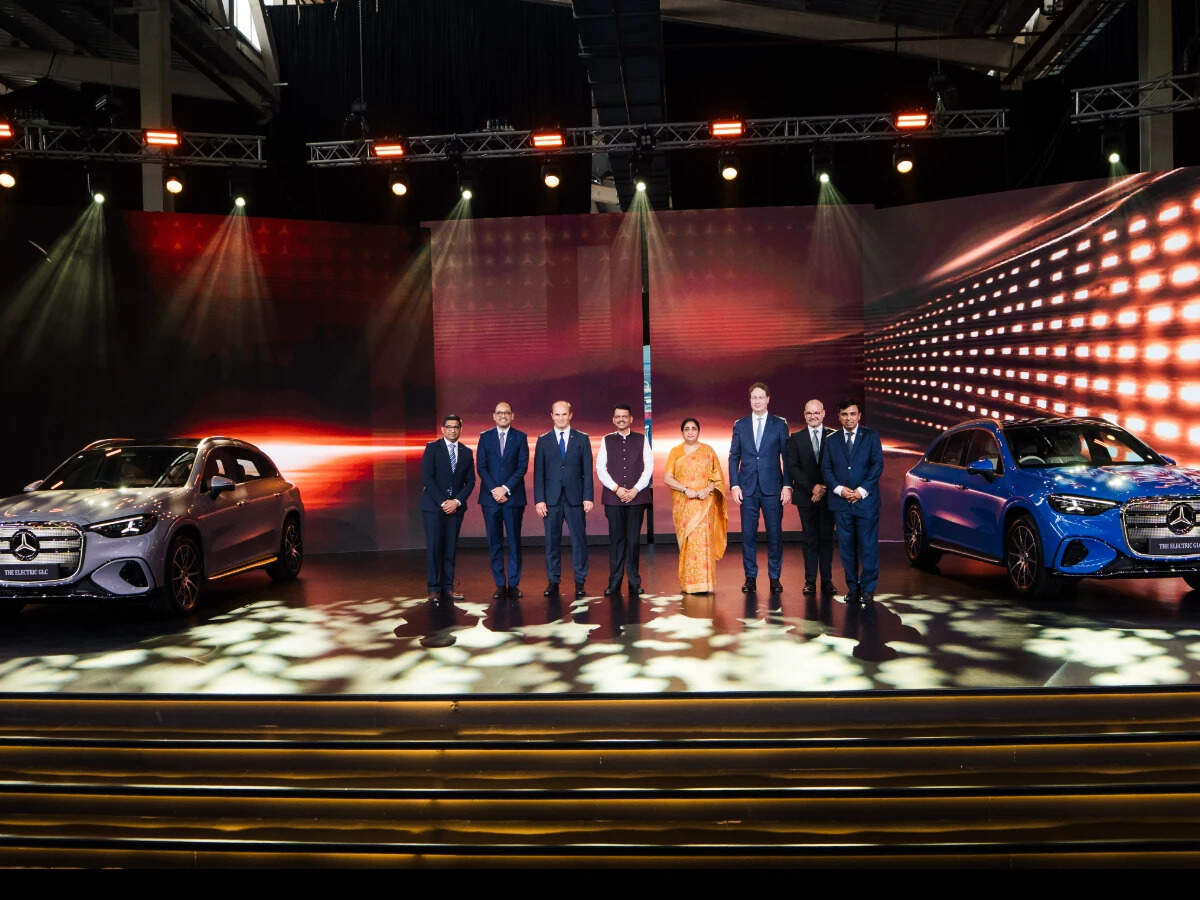
For Santosh Iyer, MD & CEO of Mercedes-Benz India, the recent launch of the electric GLC was a special moment in more ways than one.
Apart from the fact that the company’s top leadership team was present on the occasion, along with Maharashtra’s political heavyweights, it marked a coming-of-age in the pace of localisation in Merc’s Indian operations.
“This was a record time where we were able to get this car in India in a locally produced format in six months from its global launch,” Iyer told ET Auto in a recent interview. It also reaffirmed the importance of India in the Mercedes-Benz growth template.
The Indian subsidiary had already localised the EQS SUV in India and has been following a top-down strategy in its electrification strategy — “from the top end of the segment with an EQS and now in the core luxury segment with a GLC and so on and so forth.”
As Iyer put it, “Basically, we have taken a very different approach towards electrification for India because we feel that now is the time for a higher growth trajectory.”
This is because the charging ecosystem is in place and consumer acceptance for electric luxury cars is also increasing.
This is the largest investment by any luxury player in India where the money has gone into deep localisation as well.Santosh Iyer, MD & CEO, Mercedes-Benz India
Phased localisationThe localisation exercise has been happening in phases, and with the electric GLC, the clear target was it had to be carried out in record time.
This was not going to be easy since a whole lot of changes would have to be incorporated in terms of getting the model ready for a right-hand-drive market, followed by certification challenges and so on.
“I think it has been an incredible effort by the team. Our direction for the future would also be to look at such kinds of timelines from the global launch to India,” said Iyer.
Localisation levels, of course, vary from product to product and, from an investment perspective, ₹200 crore have been pumped in this year, primarily for the GLC electric. The total investments made thus far by Mercedes-Benz for its India operations are in the region of ₹3,200 crore.
“This is the largest investment by any luxury player in India where the money has gone into deep localisation as well,” he said. To that extent, the commitment is deeper with the company also having to set up the supplier ecosystem for every car line.
“This is a continuous process and we have a full-fledged sourcing office in India not only for us but the world,” said Iyer.
We have more than a thousand bookings and are sold out till March. Our top focus is to get more kits and allocations for India.Santosh Iyer
Volumes are key
The degree of localisation will depend on the scale and volumes. In the automobile industry, the threshold for deeper localisation is 40,000 to 50,000 units, and that will take some more time in the Indian context.
For now, volumes are in the range of 20,000 luxury cars. The average per car line is 1,000 to 1,200 units and, on the higher side, 4,000 to 4,500 cars.
“Our localisation approach is not limited to India for India but for the world. If a component can be supplied to the global ecosystem, it is fine with us. We have to look at it from a holistic perspective,” said Iyer.
The bigger challenge right now for Mercedes in India is its inability to get sufficient kits for the GLC electric since demand for this car is high.
“We have more than a thousand bookings and are sold out till March. Our top focus is to get more kits and allocations for India,” he said.
This applies not only to the GLC but also to the new CLA. “If we had had these cars, we could have easily done a thousand more units actually. This clearly shows that the demand is there even though we are just not able to fulfil those requirements,” explained Iyer.
More supplies in 2027
He was hopeful that things would improve starting in the second quarter of 2027, when the desired quantities would be in place.
“There is always a time to ramp up. These are brand new cars and maybe for some of these lines, we should have much better supplies as well by Q2 or Q3 of next year,” he said.
By the end of the day, developing a new car model involves a long lead time where things are planned out 36 to 48 months in advance. “So, you can’t press the switch today because people are already working on the next cycles,” said Iyer.
Consequently, it becomes too late for any other changes to happen, and what “we can do is work with our suppliers to only maximise what they can produce and give them a much firmer commitment for the long term”.
Doing this would help in getting more allocations.
According to Iyer, the quality of local content produced in India is “great” along with a strong level of cost-competitiveness. Bremen in Germany is the home plant for GLC, and India then adds “wherever it is possible” on different powertrains as well as seats, glasses, etc.
He recalled the time when E-Class also started at a very small basis and is today at a very high level of localisation with all the glasses and glazing made in India.
The GLC has the potential to be the largest selling EV in India.Santosh Iyer
Huge potential for electric GLC
“If I look at the GLC, it has the potential to be the largest selling EV in India. So, in that sense, it will definitely help us in the long run also to localise further,” said Iyer.
Since supplies for GLC will be limited, the sales team has been told not to go out all guns blazing because the order books are full until the end of March.
“But I have said that when it comes to GLC delivery, these customers get an outstanding product backed with some flexibility,” he added.
Mercedes used to give wall boxes with every EV, but customers today can get greater flexibility. Some of them already have an EV in their household and do not need another wall box. The company is therefore offering a residual value guarantee of around 60 per cent for this car over four years or so.
Likewise, charging is also a major challenge when it comes to payment apps. This has been set right now with MB.Charge, where the top charging providers in India have been aggregated into one app. Payment can, therefore, happen after the charging.
“So, there is a lot of convenience we have given to customers to ensure that a product like GLC poses no worries at all,” said Iyer. MB.OS is also one of the leading-edge operating systems, where customers can make full use of all the technology going into the car.
Robust sourcing strategy
As a global company, Mercedes-Benz has maintained a robust sourcing strategy for decades. The company has also constantly subscribed to free/cross-border trade. As he put it, the best and most competent supplier worldwide should be able to get what is right for the consumer.
“So, in that sense, we have been able to navigate this in India too. For us, how we manage our business and ecosystem is more relevant than than question why (source) from one geography or the other,” said Iyer.
For instance, even while relations between the two countries are still fraught with tension, China is still India’s largest trading partner.
The Mercedes India chief said there were other, more important issues to worry about, such as commodity pricing and the weak rupee, which had led to multiple price increases. This year has already seen three hikes with the fourth now due in January. “So, in a way and manner, we are riding the tiger,” he quipped.
Even while market demand for Mercedes products remained strong, this double whammy of high prices and a depreciating currency would have a big impact.
We have a lot of cost measures internally to mitigate and do not need to pass on the entire burden to the customer.Santosh Iyer
Keeping customers cushioned
“We have a lot of cost measures internally to mitigate and do not need to pass on the entire burden to the customer. However, there is a limitation there as well and we have to see how to navigate this,” said Iyer.
To overcome this, the company is now offering lower-EMI products, EMI holidays, and so on to help customers mitigate price increases and maintain demand momentum.
“We are not participating in market discounts the way a couple of brands are doing,” he said.
Gone are the days when companies could pass on the full cost impact to the market. Consumers today will not accept such a practice and will end up deferring their purchases or look elsewhere.
“We have to be pragmatic and look at each and every lever that is possible to ensure that we maintain sustainable growth,” said Iyer.
The core customer base for Mercedes in India largely comprises large and medium industries. Even while geopolitical tensions have been prevailing for a few years now — beginning with the Russia-Ukraine conflict — and supply shocks are ongoing, all this has already been factored into market sentiments.
Sentiments remain positive
According to Iyer, everybody now has realised that this uncertainty will continue. Cars are also bought for festivals, anniversaries and other special occasions. With the number of IPOs happening lately, there is a lot of positivity out there in the market as well.
“These startup entrepreneurs are not waiting for tomorrow. They are actually trying to own a Mercedes-Benz today with what they have earned. It is more about rewarding themselves and that makes up for the sentiment effect among some repeat buyers who may postpone purchases,” reasoned Iyer.
On rivals and competitive pressure, he said the focus would be more on customer experience and value rather than on volume as the prism.
“Volumes are an outcome of what we do. Sustainable and longterm growth is more critical than short term gains,” he reiterated.
Published On Nov 12, 2026 at 04:25 PM IST
Join the community of 2M+ industry professionals.
Subscribe to Newsletter to get latest insights & analysis in your inbox.
All about ETAuto industry right on your smartphone!
