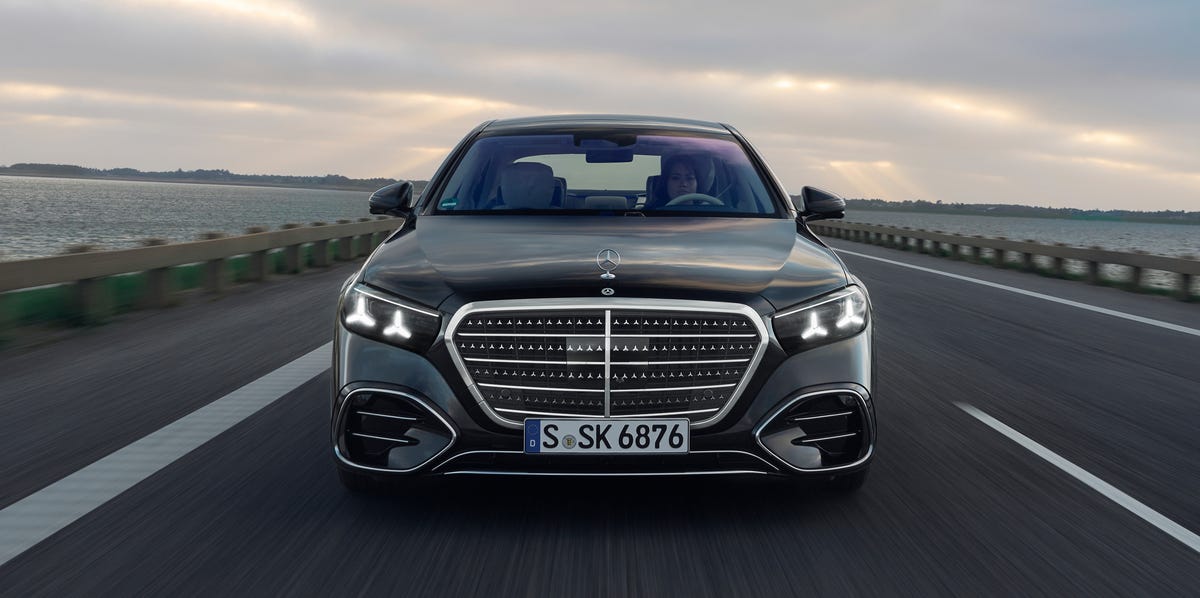
It used to be that six years made for a long product cycle for a car, but given uncertainties about tariffs, EV adoption, and Chinese competition, car companies seem to be stretching cycles much further. Take this new 2027 Mercedes-Benz S-class. This generation S-class was introduced for 2021, but instead of a full redesign, it’s only getting a mid-cycle upgrade. But as upgrades go, it’s a doozy, with over half the parts in the car—some 2700—changed or redesigned, affecting just about everything you see, touch, and feel. The main parts not changed are the major body panels.
Appearance Tweaks Inside and Out
Start at the front. The grille is now deeper, enlarged by some 20 percent. Its perimeter is illuminated at night, and the grille is decorated with countless tiny three-pointed stars. The stand-up ornament on the hood can be illuminated. New, slimmer headlights house daytime running lights in the shape of three-pointed stars—two per light. A new bumper accommodates these changes and sports a prominent air intake at each lower corner.
Changes to the rear are fewer, but still obvious. The taillights are thinner, and each contains three highlighted three-pointed stars. The chrome strip at the bottom edge of the trunklid is much thinner, and the rear bumper is also new.
Slide behind the wheel, and you’ll see a completely revised dashboard with new screens, vents, and a center console. While the instrument cluster is still a stand-up 12.3-inch screen, the 14.4-inch main central screen is now integrated into the dashboard instead of sitting separately. It’s similar to the E-class layout. And there’s a standard 12.3-inch passenger screen as well.
These screens run on the latest-generation MBUX system. New steering-wheel controls can operate the cluster and main screen; they’re a bit simpler than before but still demand a learning curve. Voice activation, however, is improved, making it easier to bend the system to your will. I counted eight different display options on the cluster. Thankfully, one of them sported a traditional twin-dial layout.
As in the previous model, the interior is very spacious, though the underside of the dashboard seems to extend unusually low. There’s no problem with kneeroom, but it looks tight. The driving position is generally excellent, but the top of the steering wheel cut off the upper part of the instrument cluster when I lowered it to my comfortable driving position.
Same Three Flavors
Three engines will be offered in the American market, as before, but they’ve all been upgraded. The S500 comes with the 3.0-liter inline-six, abetted by an electric supercharger, a turbocharger, and electric assist from a 48-volt hybrid system. Detail changes have increased power from 429 to 443 horses, while torque swells from 384 to 443 pound-feet—and up to 472 during short periods of “overtorque.”
The S580 comes with a twin-turbo 4.0-liter V-8, also coupled with a 48-volt electric motor generating 23 horsepower and 151 pound-feet, though the e-motor doesn’t factor into overall output. The V-8 has a new flat-plane crankshaft that provides equally spaced exhaust pulses to both turbos, helping them to spool up more quickly. Horsepower swells from 496 to 530.
The S580e is the plug-in hybrid model, which provided an excellent 58 miles of real-world highway range when we tested it in 2023. It now also provides more power, using the same 443-hp six found in the S500, coupled with a slightly more powerful electric motor. Combined power rises from 510 to 577 horsepower, while peak combined torque remains at 553 pound-feet, which we suspect is the limit of the nine-speed automatic transmission used across the board.
Driving the New S-Class
We spent most of our time in the S500 and S580, both of which were plenty quick. In fact, in most under-100-mph driving situations, the S500 felt almost as quick as its V-8 sibling, though perhaps the 500 spent more time in its lower gears.
Flat-foot the S500 from a dead stop, and it moves off smartly. An instant later, you feel a surge as the electric supercharger adds boost. And in the next instant comes the push from the turbocharger coming alive. Unless you’re really paying attention, it feels like one continuous strong stream of acceleration. Mercedes claims a 60-mph time of 4.3 seconds, and that seems reasonable.
Despite not having the electric supercharger, the S580 accelerates just as hard, given its additional displacement and perhaps the quicker spool of its smaller turbos. Mercedes says the 580 will hit 60 in 3.9 seconds, but we think it might be a couple ticks quicker than that. With either engine, the Mercedes 9G-Tronic transmission shifts quickly and smoothly, and the 4Matic all-wheel-drive system easily puts the power to the pavement.
This S-class is no small car, weighing roughly 5000 pounds without its hybrid gear, and stretching more than 17 feet long. It’s never going to feel like a Miata. But it handled everything we threw at it with grace and aplomb. One reason is the standard AirMatic suspension that uses air springs and adaptive dampers to tailor the suspension to the road and driving conditions.
A new feature of this system is that S-class cars share details about road conditions and coordinate with a Mercedes Intelligent Cloud that then transmits the data to other S-class cars encountering the same roads. Since we had multiple cars driving over the same routes, the system was well populated with data, and it might be one reason that the ride and handling were so refined.
The same goes for the basic controls. The steering is not razor sharp, but it is very precise, smooth, and natural feeling. The weighting increases slightly in Sport mode, but not excessively. Brake feel is similar—not race-car hard, but very progressive—making the car easy to drive with chauffeur-worthy smoothness.

Mercedes-Benz
A silent ride is no surprise in the S-class, especially with the standard heat- and noise-insulating laminated side glass, but Mercedes does pipe in a bit of artificial engine sound, especially at high revs. You can select between Balanced and Powerful soundtracks, both of which are elevated in volume if you also select Sport mode.
The level of standard equipment on the previous S-class was already astonishing—including just about every safety feature and driver assist invented to date—but there are a few new additions for this latest version. The 4.5-degree rear-axle steering is now standard, improving both high-speed stability and parking-lot maneuverability. (Ten-degree rear steering remains optional.) And the new digital LED headlights can provide high-beam assist and adaptive high beams; these allow more powerful lighting in traffic without blinding other drivers.
Prices haven’t been announced, but the current S500 starts at $120,850, while the S580 and S580e go for about $132,000. Given the tariff situation, we wouldn’t expect them to be any cheaper when the S500 and S580 arrive in the third quarter of this year, with the PHEV following in Q4. At those prices, it’s hard to talk about value, but this S-class is a very satisfying luxury car—even if it’s not a from-the-ground-up redesign.
➡️ Skip the lot. Let Car and Driver help you find your next car. Specifications
Specifications
2027 Mercedes-Benz S-class
Vehicle Type: front-engine, all-wheel-drive, 4- or 5-passenger, 4-door sedan
PRICE (C/D EST)
Base: S500, $122,000; S580, $133,000
POWERTRAINS
supercharged, turbocharged, and intercooled DOHC 24-valve 3.0-liter inline-6, 443 hp, 443 lb-ft; twin-turbocharged and intercooled DOHC 32-valve 4.0-liter V-8, 530 hp, 553 lb-ft
TRANSMISSION
9-speed automatic
DIMENSIONS
Wheelbase: 126.6 in
Length: 208.8 in
Width: 75.6 in
Height: 59.2 in
Trunk Volume: 19 ft3
Curb Weight (C/D est): 4850–5050 lb
PERFORMANCE (C/D EST)
60 mph: 3.7–4.3 sec
100 mph: 9.5–11.0 sec
1/4-Mile: 12.3–12.9 sec
Top Speed: 155 mph
EPA FUEL ECONOMY (C/D EST)
Combined/City/Highway: 19–23/16–20/24–29 mpg
—
2027 Mercedes-Benz S-class PHEV
Vehicle Type: front-engine, front-motor, all-wheel-drive, 4- or 5-passenger, 4-door sedan
PRICE (C/D EST)
Base: S580e, $133,500
POWERTRAINS
supercharged, turbocharged, and intercooled DOHC 24-valve 3.0-liter inline-6, 443 hp, 413 lb-ft + AC motor, 161 hp, 354 lb-ft (combined output: 577 hp, 553 lb-ft; 22-kWh lithium-ion battery pack)
Transmission: 9-speed automatic
DIMENSIONS
Wheelbase: 126.6 in
Length: 208.8 in
Width: 75.6 in
Height: 59.2 in
Trunk Volume: 123
Curb Weight (C/D est): 5550 lb
PERFORMANCE (C/D EST)
60 mph: 3.9 sec
100 mph: 9.7 sec
1/4-Mile: 12.1 sec
Top Speed: 155 mph
EPA FUEL ECONOMY (C/D EST)
Combined/City/Highway: 24/21/30 mpg
Combined Gasoline + Electricity: 53 MPGe
EV Range: 50 mi

Csaba Csere joined Car and Driver in 1980 and never really left. After serving as Technical Editor and Director, he was Editor-in-Chief from 1993 until his retirement from active duty in 2008. He continues to dabble in automotive journalism and WRL racing, as well as ministering to his 1965 Jaguar E-type, 2017 Porsche 911, 2009 Mercedes SL550, 2013 Porsche Cayenne S, and four motorcycles—when not skiing or hiking near his home in Colorado.