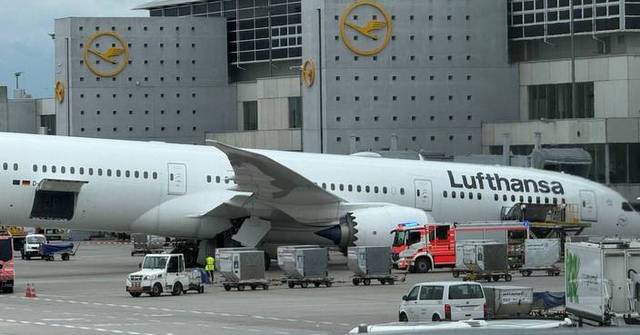
German airline Lufthansa said several employees were injured on Thursday after the nose gear of a Boeing jet collapsed while the aircraft was parked at a gate at Frankfurt airport.
Only crew members and ground staff were on board the Boeing 787-9 Dreamliner when the front tip of the plane crashed to the ground ahead of passenger boarding for a scheduled flight to Los Angeles. The flight was later canceled.
“Several employees were injured and are currently receiving medical attention,” Lufthansa said in a statement, adding that it and relevant authorities were investigating.
The aircraft is just over a year old and was delivered to Lufthansa in January, one of the newest additions to the airline’s wide-body fleet, according to Flightradar24. Since entering service in February, the plane has operated 137 flights, the flight-tracking website said.
Boeing said it is “aware of the incident” and “supporting our customer.”
Video footage from the scene appeared to show the front wheels of the aircraft sliding forward and the plane’s nose falling several meters (yards) as a ground crew member standing nearby quickly backed away. The doors to the nose gear bay broke off upon impact.
Jeff Guzzetti, a former U.S. federal aviation crash investigator, said it is “very unusual” for a nose landing gear to collapse while an aircraft is at a standstill. He cautioned it is too early to speculate on the cause of the incident, but he said potential factors could include prior damage to the landing gear, a mechanical failure or issues related to maintenance work.
Investigators, he said, will be looking closely at the plane’s maintenance history and system records, and may also review flight data to understand how the aircraft’s landing gear had been operating in previous landings.
“They’re going to look at every square inch of that nose landing gear strut and the mechanisms that operate it,” Guzzetti said.
A 2021 incident at London’s Heathrow Airport also involved the nose landing gear of a Boeing 787. According to a report by the UK’s Air Accidents Investigation Branch, a 787-8 was undergoing maintenance at a gate when its nose landing gear retracted during testing, causing the aircraft’s nose to drop onto the pavement. Investigators found that a locking pin intended to prevent retraction had been inserted into the wrong position, allowing the gear to fold despite safeguards designed to keep it extended.
The 787 Dreamliner, a wide-body twin-aisle aircraft used primarily on long-haul international routes, first entered service in 2011. The version involved in Thursday’s incident can carry up to 296 passengers, depending on configuration.
In recent years, the 787 program had been plagued by production flaws and quality-control issues, with shipments of the large plane temporarily halted on multiple occasions.
Issues with the 787 started in 2020 when small gaps were found between panels of the fuselage that are made of carbon composite material. That prompted inspections that turned up problems with a pressurization bulkhead at the front of the plane.
In May 2021, Boeing halted 787 deliveries while U.S. federal regulators looked over documentation of work that was done on new planes.
In June 2023, Boeing said 787 deliveries were delayed again while it inspected fittings on part of the aircraft’s tail — the horizontal stabilizer — after identifying a “nonconforming condition.” The company said at the time that the issue would affect near-term deliveries but was not considered a safety risk for aircraft already in service.
Yamat, AP’s airlines and travel writer, reported from Las Vegas.

A Lufthansa ‘Dreamliner’ aircraft lies on its nose in front of a terminal at the Frankfurt Airport in Frankfurt, Germany, Thursday, June 4, 2026, after the nose landing gear collapsed. (Mike Seeboth/dpa via AP)

A Lufthansa “Dreamliner ” aircraft lies on its nose in front of a terminal at Frankfurt Airport after the nose landing gear collapsed on Thursday, June 4, 2026 in Frankfurt, Germany, (Mike Seeboth/dpa via AP)
BARCELONA, Spain (AP) — Pope Leo XIV is delving into the hotly contested issue of migration by visiting two flashpoints — Spain’s Canary Islands in the Atlantic next week, and Italy’s Lampedusa island in the Mediterranean in early July.
These rocky, remote outposts of Europe have struggled with the arrival of tens of thousands of mostly African migrants through some of the world’s deadliest migration routes. Even as numbers decreased this year, especially in the Canaries, the issue continues to roil politics in these historically Catholic countries.
Many Catholics and migrants hope the upcoming papal trips will refocus attention on solidarity and support — and away from divisive political debate that is splitting the right in addition to pitting it against the left.
“Stuck in the middle are the migrants,” said the Most Rev. José Mazuelos, the bishop of Canarias, whose diocese includes several of the islands. “So the church says, ‘Let’s give them a face, because we’re talking about people, not numbers.’”
Among them is Eslim Jallow, 27. Dreaming of a more prosperous future, Jallow and his younger brother left Gambia and landed in the Canary Islands in 2023. At first, Jallow struggled to adapt, but he quickly learned Spanish, took courses and now earns a living as a programmer and web developer in Las Palmas de Gran Canaria.
“Perhaps the pope will change the way in which people here look at immigrants,” Jallow said. “Immigrants should be treated with dignity and respect, not ignored.”
Like most migrants arriving in the islands, he isn’t Catholic. But he feels that Leo “speaks for us, he reminds the world we are also human beings.”
Advocating for migrants globally was a priority for Pope Francis. He went to Lampedusa in 2013 on his first pastoral visit outside Rome and, three years later on the Greek island of Lesbos, he brought back with him a dozen Syrian Muslim refugees.
Under Leo, the Catholic Church has continued to call for their humane treatment around the world, including decrying mass deportations in his home country, the United States.
“Pope Leo is signaling how important immigration is to him by doing these two trips early in his papacy,” said Michele Pistone, a Villanova University professor who leads its new center on immigration.
In the Canaries, Leo is expected at the port of Arguineguín, on the island of Gran Canaria, on June 11 to pay homage to thousands of migrants who died or disappeared en route. The next day, he will meet migrants at a camp on the island of Tenerife.
The archipelago has been the epicenter of a humanitarian crisis that in 2024 saw the arrival of nearly 47,000 migrants from North and West Africa, including several thousand unaccompanied minors.
Like Jallow, half of them landed in El Hierro island — nearly triple its population, said the Most Rev. Eloy Santiago, bishop of Tenerife, whose diocese includes that smaller island. Its resources were strained to a breaking point, even though most migrants only stayed a few days.
“If a boat arrives, the couple of local doctors have to go out running to take care of them, and then the local residents who had their medical appointments can’t have them,” Santiago said.
Catholic organizations are among those that aid migrants from the moment they step out of rickety, overcrowded boats.
Arrivals have slowed dramatically this year, in part due to stricter controls along the African coast. But the most challenging task remains — how to help those who arrived as minors, were entrusted to state care, and are thrown out into the streets when they turn 18, often with no job prospects and no support.
Caya Suárez, secretary-general for the Catholic charity Caritas in the Canaries, has seen firsthand how migrants coming of age on the islands are the most vulnerable.
“That’s a very bad moment, even though they’d been waiting for it with hope, because they see they are still stuck without alternatives,” she said.
Caritas tries to help the young adults find housing and jobs, she added. It’s also relocated a few young migrants to Madrid, a small village in the largely rural region of Galicia, and elsewhere on the mainland, with the help of parishes there even as the governments of other Spanish regions have been reluctant to take on underage migrants.
Many residents in the Canaries feel like they’ve been abandoned to cope with an unsolvable problem — how to stretch even farther resources for migrants who thought they’d be within reach of economic prosperity and free to travel across the European Union, and instead end up on the street, struggling to send remittances home but also to leave.
Compounded with the perception that national and European political institutions tend to see it as an exclusively “island problem,” the situation is generating a growing malaise even among generous islanders who have long been accustomed to migration to and from Latin America, the Canaries’ bishops said.
“The pope’s word can help so that in the middle of this fatigue, people can buck up again because they see they are supported,” said Santiago, who was born and ordained a priest on the islands.
At the national level, Spain’s Catholic Church also backed a new measure giving temporary residency permits to potentially more than half a million foreigners in the country illegally, many from Latin America.
They often work in hospitality, agriculture and eldercare, boosting the economy, according to the socialist government of Prime Minister Pedro Sánchez — and to the church.
“In the matter of immigration, the church’s position gets into a head-on collision with the position of the right,” said Pablo Simón, a political science professor at University Carlos III in Madrid.
That has created a rift between the church and far-right parties, like Vox in Spain, which has criticized the church on immigration, despite often couching its anti-migrant rhetoric in religious terms.
Days before she is expected to meet Leo, Isabel Díaz Ayuso, the firebrand Popular Party conservative regional leader of Madrid, described the migrant legalization push as “importing mass poverty.”
The Rev. Fernando Redondo, who leads the migration department of the Spanish bishops’ conference, said the church’s stance is in line with the Christian mandate to welcome the stranger. But he added it needs better understanding among the many faithful who believe migrants come to steal jobs or live off welfare.
“We have a big challenge, which is raising awareness among our faithful … that from the viewpoint of faith, to welcome a migrant person is to welcome Christ himself,” Redondo said. “Then, of course, there needs to be ways, proper social and political ways, so that migration doesn’t become a total mess.”
In the Canaries, ordinary people have been on the front lines of that often life-endangering chaos — fishermen who hand out drinking water to migrants on ramshackle rafts, sunbathers who run into the sea to help landing migrants, the volunteers who greet them in more than a dozen languages.
But they have also seen that integration can work, as in a small mountain village that was emptying out until a center for three dozen migrant children was opened, creating jobs and filling up the school — and the local church’s annual feast day procession.
That’s why many look forward to Leo bringing a simple but crucial message of reconciliation that focuses on the people impacted, not on the politics.
“The pope doesn’t support this slogan of ‘let’s go, open doors for the whole world here.’ Nobody supports that,” Mazuelos said. “When here comes a gentleman in a wooden boat after five days in the Atlantic, what are we supposed to do, kick him back? We’ve got to find a way to welcome him.”
Dell’Orto reported from Minneapolis.
Associated Press religion coverage receives support through the AP’s collaboration with The Conversation US, with funding from Lilly Endowment Inc. The AP is solely responsible for this content.

FILE – A police officer speaks with migrants and asylum-seekers in Gran Canaria island, Spain, Tuesday, Aug. 18, 2020. (AP Photo/Emilio Morenatti, File)

FILE – Migrants disembark at the port of “La Estaca” in Valverde on the Canary island of El Hierro, Spain, Aug. 26, 2024. Emergency services said the migrants arrived by boat after a 13-day voyage from Senegal. (AP Photo/Maria Ximena, File)

FILE – Mamadou Patherazi, from Guinea, sits on a bench at the Modern Christian Mission church in Fuerteventura, Canary Islands, Spain, on Aug. 22, 2020. (AP Photo/Emilio Morenatti, File)

FILE – Migrants crowd a wooden boat as they sail to the port in La Restinga on the Canary island of El Hierro, Spain, Sunday, Aug. 18, 2024. (AP Photo/Maria Ximena, File)

FILE – Migrants react as they arrive at the port in La Restinga on the Canary island of El Hierro, Spain, on, Aug. 19, 2024. (AP Photo/Maria Ximena, File)