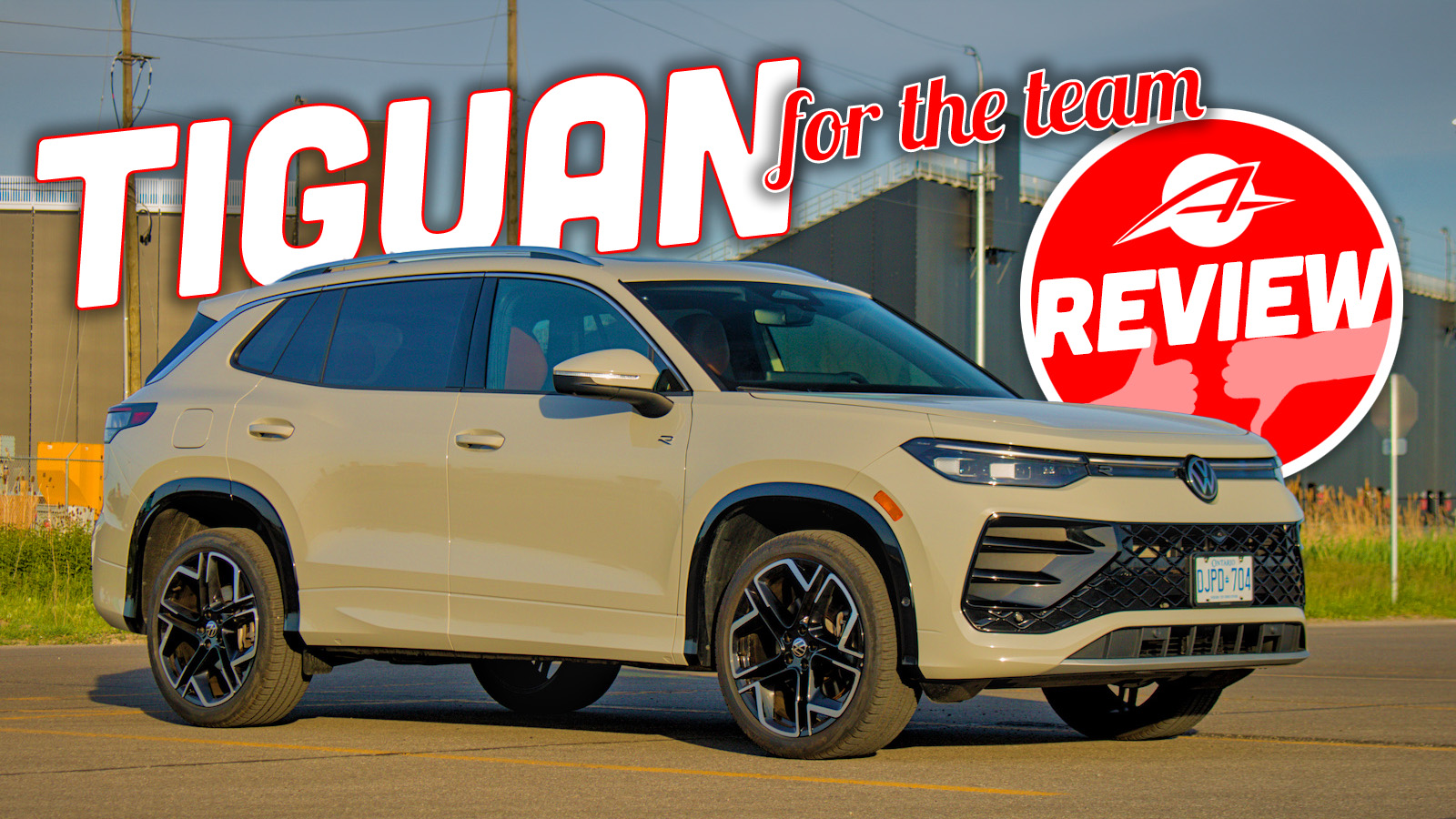
“Everybody wants to drive a compact crossover” sounds like a terrible Tears For Fears parody, but it seems to be the state of the new car market right now. From hybrid models to electric ones to swoopy-roofed ones to plastic-clad ones, shoppers appear to be spoiled for choice so long as they want a two-box thing with reasonable ground clearance. The trouble is, there aren’t many options for people wanting more power and features without some of the running costs that come with a luxury badge. The Volkswagen Tiguan Turbo is one of the few.
It’s a bit like a meat lovers’ pizza, in the sense that it truly has everything on it. More power than a Golf GTI, an enormous touchscreen, and some luxuries you normally wouldn’t expect to see in this class of car. That’s all well and good on paper, but how does it fare on the road? I spent a week in one to find out.


[Full disclosure: Volkswagen Canada let me borrow this Tiguan Turbo for a week so long as I kept the shiny side up, returned it clean with a full tank of fuel, and reviewed it.]
The Basics
Engine: 2.0-liter twin-cam 16-valve turbocharged and intercooled inline-four.
Transmission: Eight-speed conventional torque converter automatic.
Drive: Full-time all-wheel-drive.
Output: 268 horsepower from 5,500 to 6,500 RPM, 258 lb.-ft. of torque from 1,900 to 5,400 RPM.
Fuel Economy: 22 MPG city, 29 MPG highway, 25 MPG combined (10.7 L/100km city, 8.0 L/100km highway, 9.5 L/100km combined).
Base Price: $44,560 including freight ($52,295 in Canada).
Price As-Tested: $44,560 including freight ($52,295 in Canada).
Why Does It Exist?
 Photo credit: Thomas Hundal
By now, it should be crystal clear that the compact crossover is simply the new default genre of car. They’re generally well-sized, practical and comfortable, so it shouldn’t be a surprise that just about every automaker under the sun builds at least one. For the past 17 years, Volkswagen’s fighter in this arena has been the Tiguan. It’s now in its third generation, growing up whilst waging battle against models like the Toyota RAV4, Honda CR-V, Hyundai Tucson, Ford Escape, and Chevrolet Equinox.
How Does It Look?
 Photo credit: Thomas Hundal
Machismo is so hot right now in the compact crossover universe. Chiseled character lines, squared-off silhouettes, a slice of faux-SUV posturing. Not so much with the Tiguan. While the previous generation of this compact crossover featured an almost impossibly starched pinch down the flank, the new one’s gone all rounded. Sure, the aggressive latticework of a grille does look a bit jowled, but the overall look of the new Tiguan works surprisingly well with the minimal black cladding. There’s an honesty to it, an admission that this is a family car, not something trying to be a five-o’clock shadowed off-roader.
What About The Interior?
 Photo credit: Thomas Hundal
Slide behind the wheel of the top-shelf Tiguan, and you’re immediately greeted by a sense of richness. Sure, there’s some shiny black plastic, but that’s more than balanced out by a litany of lovely materials. Leatherette with contrast stitching and piping adorns the dashboard and door cards, soft padding on the center console cushions your right knee, and guess what? That wood trim has a lovely, deep open-pore grain. You also get delightfully smooth leather wrapped around the steering wheel, cold alloy pedals, and plenty of soft-touch plastics in the first row. Sure, things feel a bit cheaper in back, but hardwearing plastics where you kids sit doesn’t necessarily seem like a bad thing.
 Photo credit: Thomas Hundal
As for comfort, the big surprise comes in the front seats. These heated and ventilated thrones could use a smidge more thigh support, but they are equipped with a massage function. Normally, at this price level, you’d just expect that to consist of the lumbar support gently poking you in the back, but no. Volkswagen’s specified a litany of air bladders that are far more adept than you’d expect. They’re only on the seat backrest and don’t cover plumb-center of your back, but they put in work. Speaking of functionality, interior space is good, and the adjustable center armrest is a much appreciated touch. Mind you, 33.8 cu.-ft. (957 L) of cargo space with the rear seat up falls behind the RAV4’s 37.8 cu.-ft. (1,070 L) and the CR-V’s 36.3 cu.-ft. (1,028 L) so keep that in mind if you, say, haul hockey bags on a regular basis.
How Does It Drive?
 Photo credit: Thomas Hundal
While all Tiguans come with forced induction, Volkswagen seems to have borrowed a page from the Porsche playbook by adding “Turbo” to the official name of its quickest compact crossover. Compared to the standard model, the two-liter turbocharged inline-four here pumps out an additional 67 horsepower and 37 lb.-ft. of torque, totalling 268 and 258 respectively — big-dog stuff by the standards of the market, but don’t confuse this thing for a Golf GTI with a backpack.
 Photo credit: Thomas Hundal
Actually, this is probably a good time for a history lesson. Jump back just over a quarter of a century, and the first turbocharged GTI landed on American shores. It was reasonably punchy for a sport compact, but that turbocharged engine was also used in the midsize Passat. That generation of Passat made its mark with huge refinement, and that’s exactly what we’re seeing with this Tiguan. The eight-speed automatic transmission isn’t always quick but it’s remarkably smooth, and that tidal wave of torque from the robust engine means the top-spec Tiguan merges in a manner that punches above its price bracket.
 Photo credit: Thomas Hundal
It’s a similar deal with the ride and handling balance of the Tiguan Turbo. Light, accurate steering makes placement on the road easy without encumbering parking maneuvers, wind noise is pleasantly hushed, and the suspension tuning is certainly more taut than on most Japanese and American rivals. While this does have the effect of transmitting some moderate bumps into the cabin, high-speed stability is excellent for this sort of vehicle, and there’s an assured confidence and reasonably good level of roll resistance in the corners that you simply won’t find in many competitors. The Tiguan Turbo has a certain level of transparency, disappearing beneath you as it performs its duties as highly competent transportation. Mind you, the tradeoff does come at the pumps. With great power comes 25 MPG combined. An available hybrid powertrain would go a long way toward reducing running costs.
Does It Have The Electronic Crap I Want?
 Photo credit: Thomas Hundal
If the aforementioned massaging front seats weren’t enough of an indication, the Tiguan Turbo comes loaded to the gills. We’re talking about an enormous 15-inch touchscreen infotainment system, a properly configurable digital cluster, a HUD, push-to-start, LED lighting, a panoramic moonroof, wireless phone charging, a 360-degree camera system with front and rear parking sensors, power-folding mirrors, three-zone climate control, a power liftgate, a heated steering wheel, a full suite of driver assistance systems, the works. A stellar list of equipment, but the spec sheet alone doesn’t convey its usability.
 Photo credit: Thomas Hundal
Several years ago, Volkswagen went all-in on touch-sensitive controls with disastrous results. Non-illuminated capacitive-touch sliders for volume and temperature control proved irksome, capacitive-touch steering wheel controls occasionally resulted in a heated steering wheel activation you didn’t want, and the infotainment systems themselves were slow and cumbersome. Since then, Volkswagen’s reversed course, and the new Tiguan features some interesting Band-Aids. The sliders for volume and temperature are now illuminated and still a bit fiddly to use, but do you see what’s in the photo above? That’s a proper volume knob in the console, and you can press the middle of it to turn it into a drive mode selector. It’s a big step up in usability, as is the all-buttons steering wheel controls and the substantially revised infotainment system. While certainly not perfect, it’s all movement in the right direction.
 Photo credit: Thomas Hundal
The top-spec Tiguan Turbo also gives you a Harman/Kardon sound system that’s quite good by the standards of the segment, provided you take the time to tweak the equalizer. Clean low-end, crisp but not overwhelming highs, fairly level mid-range, and low overall distortion for the class. Plus, it’s a lot more fun to listen to than the RAV4’s JBL system or the Tucson’s Bose stereo. Job well done, I reckon.
Three Things To Know About The 2026 Volkswagen Tiguan Turbo
The massaging seats are surprisingly good.
That smooth, torquey engine only needs regular gasoline.
It’s a well-appointed cruiser, not a hot hatch in disguise.
Does The Volkswagen Tiguan Turbo Fulfill Its Purpose?
 Photo credit: Thomas Hundal
The Volkswagen Tiguan Turbo isn’t really a performance model, but instead something more important: proof that the Volkswagen many North Americans fell in love with—a maker of refined, well-appointed cars—is still alive somewhere in Wolfsburg. This loaded model’s $44,560 ($52,295 in Canada) price tag may be near the tippy-top of the mainstream compact crossover market, but you’re getting something genuinely luxurious for that sort of money.
When it comes to this sort of well-appointed, smooth, powerful compact crossover, there aren’t many real rivals to the Tiguan Turbo. The Toyota RAV4 Plug-In Hybrid is potent and vastly more efficient, but the interior materials are a noticeable step down and the overall calibration isn’t on the Volkswagen’s level. The Mazda CX-50 Turbo is the closest thing on the market, and while its six-speed automatic doesn’t quite match the sophistication of the Tiguan’s eight-speed and overall equipment levels aren’t as high, it’s a lovely choice for someone seeking gobs of torque and more driving engagement. Still, if you want massaging seats or that lovely wood trim, it’s Tiguan or bust.
What’s The Punctum Of The Volkswagen Tiguan Turbo?
 Photo credit: Thomas Hundal
Just like Volkswagen used to make.
Top graphic image: Thomas Hundal