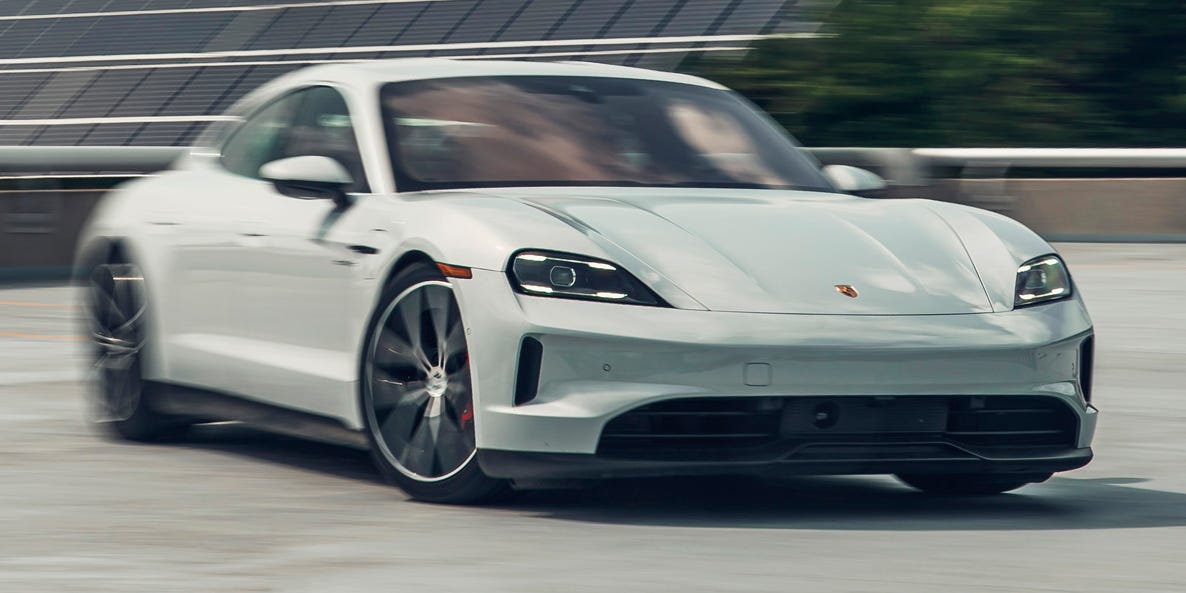
Overview
The Taycan proves that even a fabled brand like Porsche can remain true to its identity across the switch to electric propulsion. There’s no rear-mounted flat-six engine to be found here, but effortless acceleration and scalpel-sharp reflexes imbue the Taycan with the same kind of behind-the-wheel magic that you get in a 911.
The Taycan lineup is vast, and there isn’t a single disappointment in the trim hierarchy. Even the base rear-wheel-drive model packs enough firepower to thrill, while the top-dog, all-wheel-drive Turbo GT can rip a hole through space with its 1019 horsepower and ability to blast to 60 mph in 1.9 seconds. There’s a similar amount of variety available in the Taycan’s interior, which is rather spartan when left alone but can be optioned to be downright luxurious with a hefty budget. You’ll need deep pockets regardless, as the Taycan commands a premium over rivals such as the Lucid Air and the Tesla Model S—both of which are roomier, more practical, and offer more range per charge.
Expert Tip: One of the Taycan’s primary drawbacks is limited cargo space, which Porsche has addressed by offering a station-wagon variant called the Taycan Cross Turismo that we review separately.

 What’s New for 2027?
The 2027 model year brings a host of tweaks to the Taycan lineup. The biggest change is the introduction of a new E-Shift feature that allows the driver to make virtual gear changes with steering-wheel-mounted paddles. The system is activated with a toggle on the wheel and features eight simulated gears to row through. When the system is engaged, a tachometer appears on the digital gauge cluster, and artificial engine noise is pumped into the cabin.
On a more practical note, all Taycans now come standard with the larger 105-kWh Performance Battery Plus battery pack, and the passenger-side DC fast-charging port is now NACS native. Small changes have also been made to the Taycan’s infotainment software, now allowing for widget customization.
 What’s Your Car Worth?
Car and Driver calculates your car’s value in three free and easy steps – using the same Black Book® data dealers use to appraise vehicles.
Pricing and Which One to BuyEV Motor, Power, and Performance EV Motors: 402-hp single motor, 429-hp dual motor, 536-hp dual motor, 690-hp dual motor, 938-hp dual motor, 1019-hp dual motor Drivetrains: front-wheel drive, all-wheel drive
Except for the base model, which is powered by a single rear-mounted electric motor, all other Taycan models feature dual electric motors, with one powering the front wheels and the other powering the rear. Base model Taycans and Taycan 4 models make between 402 and 429 horsepower, the 4S makes 536 ponies, the GTS pumps out 690, and the Turbo S makes up to 938 horsepower for short periods—but that requires using the car’s launch-control feature. Without launch control engaged, the electric motors combine for a still-impressive 764 horsepower. The top-dog Turbo GT model offers a mind-blowing 1019 horsepower when using the launch-control feature and 777 ponies in normal driving.
All Taycan models also have a two-speed direct-drive transmission that plays a pivotal role in both the Taycan’s rapid acceleration and excellent range. An air-spring suspension system is standard, and all-wheel-drive models can be had with adaptive dampers. The Taycan’s low-slung driving position, talkative steering, and precise handling make it special among electric vehicles. And it’s comfortable too. In our test of a 2025 model, we were particularly impressed with the optional Porsche Active Ride active-suspension option, which limits body roll and does a great job filtering out road imperfections.
0–60-MPH Times C/D 60-mph Test: 4.1 seconds (Taycan), 4.0 seconds (Taycan 4), 3.1 seconds (Taycan 4S), 1.9 seconds (Turbo GT)Range, Charging, and Battery Life C/D Range Test: 330 miles (Taycan 4S), 270 miles (Turbo GT)
The EPA estimates that the Taycan can travel between 251 and 315 miles on a single charge, depending on the trim and battery selection. That is less than rivals such as the Lucid Air and the Tesla Model S, both of which can crest 400 miles on a charge. In our 75-mph highway range test, the Taycan 4S beat its EPA estimate and delivered 330 miles, and the Taycan Turbo GT delivered 270 miles. The Taycan can be charged on a DC connection at up to 320 kilowatts. Porsche says that in ideal conditions, the battery can charge from 10 to 80 percent in just 18 minutes. In our testing, the Taycan Turbo GT charged from 10 percent to 90 percent in 24 minutes.
Fuel Economy and Real-World MPGe EPA City Ratings: 80-94 MPGe EPA Highway Ratings: 78-92 MPGe
EPA fuel economy ratings for the Taycan range from as high as 94 MPGe city to as low as 80 MPGe city. Highway ratings range from 78 to 92 MPGe. MPGe stands for miles per gallon of gas equivalent, an EPA metric that estimates PHEV and EV vehicle fuel efficiency. For more information about the Taycan’s fuel economy, visit the EPA’s website.
Interior, Comfort, and Cargo
First Row: Inside the sleek-looking Taycan, the interior design is simple and recalls what we’ve seen in other Porsche models. As expected, the cabin seats and interior panels can be covered in a range of rich materials and color schemes. There’s a long list of luxury options, including four-zone climate control, massaging front seats, and heated rear seats.
Second Row: The Taycan comes standard with seating for four, but there’s an option to add a third, middle spot in the back seat—though three across will be a squeeze. We found the electrified Porsche’s rear accommodations and storage space to be a bit lacking, and contortions are required to get into the low front seats.
Cargo Capacity: In our testing, we fit four carry-on suitcases in the Taycan’s trunk, and a total of 16 with the rear seats folded. The front trunk holds just one carry-on.
Infotainment and Connectivity Infotainment: 10.3-inch touchscreen Connectivity: Bluetooth, wireless Apple CarPlay and Android Auto Audio System: 10-speaker stereo (standard), 14-speaker Bose stereo (optional), 21-speaker Burmester stereo
There’s no shortage of screens inside the Taycan, but there is a shortage of physical buttons and knobs. Along with a curved 16.8-inch display for the gauges, two centrally located touchscreens control the infotainment system. The upper one is integrated into the dash and measures 10.9 inches. It provides access to important functions and is now faster than before, thanks to updates to its computing hardware. Software can be downloaded through a new app center, and smart-home and in-car systems can now be controlled with voice commands via Amazon Alexa.
The lower 8.4-inch touchscreen enables users to adjust climate settings, check the battery status, input navigation details, interact with wireless Apple CarPlay and Android Auto features, and open and close the trunks and charge ports. Another 10.9-inch touchscreen is available for the front-seat passenger, and there’s an optional 5.9-inch touchscreen in the back seat that controls the rear HVAC and seat heating. The Taycan’s optional Bose and Burmester sound systems now offer Dolby Atmos surround sound to elevate the in-car listening experience even further.
Safety and Driver-Assistance Features
Every Taycan is equipped with standard driver-assistance technology that includes forward-collision warning and automated emergency braking, as well as lane-departure warning and lane-keeping assist. Of course, Porsche also offers more advanced tech for a price.
Standard Safety Features: automated emergency braking with pedestrian detection, lane-departure warning with lane-keeping assist Optional Safety Features: adaptive cruise control with a lane-centering feature
For information about the Taycan’s crash-test results, visit the National Highway Traffic Safety Administration (NHTSA) and Insurance Institute for Highway Safety (IIHS) websites.
Warranty and Maintenance Coverage
Porsche provides a competitive warranty plan that’s comparable to what other luxury EV makers offer. However, coverage of the Taycan’s electrical components is capped at eight years or 100,000 miles, whereas Tesla offers unlimited mileage for the same amount of time.
Limited Warranty: four years or 50,000 miles Powertrain Warranty: eight years or 100,000 miles Complimentary Maintenance: noneC/D Test Results and Specs
Each year, we put hundreds of vehicles through our rigorous instrumented testing regimen. If the data in the chart below is for a different model year, that’s because this vehicle hasn’t changed from when we last tested it, and the test results remain accurate.
 Specifications
Specifications
2025 Porsche Taycan 4S
Vehicle Type: front- and rear-motor, all-wheel-drive, 4-passenger, 4-door sedan
PRICE
Base/As Tested: $120,495/$154,685
POWERTRAIN
Front Motor: permanent-magnet synchronous AC
Rear Motor: permanent-magnet synchronous AC
Combined Power: 590 hp
Combined Torque: 523 lb-ft
Battery Pack: liquid-cooled lithium-ion, 97 kWh
Onboard Charger: 11.0 kW
Peak DC Fast-Charge Rate: 320 kW
Transmissions, F/R: direct-drive, 2-speed automatic
CHASSIS
Suspension, F/R: control arms/multilink
Brakes, F/R: 14.2-in vented disc/14.1-in vented disc
Tires: Hankook Ion Evo
245/40R-21 100Y NFO
285/35R-21 105Y NFO
DIMENSIONS
Wheelbase: 114.2 in
Length: 195.4 in
Width: 77.4 in
Height: 54.2 in
Trunk Volume: 14 ft3
Front Trunk Volume: 3 ft3
Curb Weight: 5143 lb
C/D TEST RESULTS
60 mph: 3.1 sec
100 mph: 7.2 sec
1/4-Mile: 11.2 sec @ 125 mph
130 mph: 12.2 sec
150 mph: 16.9 sec
Results above omit 1-ft rollout of 0.2 sec.
Rolling Start, 5–60 mph: 3.4 sec
Top Gear, 30–50 mph: 1.4 sec
Top Gear, 50–70 mph: 1.9 sec
Top Speed (gov ltd): 159 mph
Braking, 70–0 mph: 151 ft
Braking, 100–0 mph: 306 ft
Roadholding, 300-ft Skidpad: 1.00 g
C/D FUEL ECONOMY AND CHARGING
Observed: 89 MPGe
75-mph Highway Range: 330 mi
EPA FUEL ECONOMY
Combined/City/Highway: 87/89/85 MPGe
Range: 295 mi
2025 Porsche Taycan Turbo GT
Vehicle Type: front- and rear-motor, all-wheel-drive, 4-passenger, 4-door sedan
PRICE
Base/As Tested: $231,995/$254,817
POWERTRAIN
Front Motor: permanent-magnet synchronous AC
Rear Motor: permanent-magnet synchronous AC
Combined Power: 1019 hp
Combined Torque: 914 lb-ft
Battery Pack: liquid-cooled lithium-ion, 97 kWh
Onboard Charger: 11.0 kW
Peak DC Fast-Charge Rate: 320 kW
Transmissions, F/R: direct-drive/2-speed automatic
CHASSIS
Suspension, F/R: control arms/multilink
Brakes, F/R: 16.5-in vented, cross-drilled carbon-ceramic disc/16.1-in vented, cross-drilled carbon-ceramic disc
Tires: Pirelli P Zero Trofeo RS Elect
F: 265/35ZR-21 (101Y) NF0
R: 305/30ZR-21 (104Y) NF0
DIMENSIONS
Wheelbase: 114.2 in
Length: 195.6 in
Width: 78.7 in
Height: 54.3 in
Cargo Volume, F/R: 3/12 ft3
Curb Weight: 5203 lb
C/D TEST RESULTS
60 mph: 1.9 sec
100 mph: 4.2 sec
130 mph: 6.8 sec
150 mph: 9.3 sec
1/4-Mile: 9.3 sec @ 150 mph
170 mph: 13.2 sec
Results above omit 1-ft rollout of 0.2 sec.
Rolling Start, 5–60 mph: 2.2 sec
Top Gear, 30–50 mph: 1.0 sec
Top Gear, 50–70 mph: 1.2 sec
Top Speed (gov ltd): 180 mph
Braking, 70–0 mph: 141 ft
Braking, 100–0 mph: 274 ft
Roadholding, 300-ft Skidpad: 1.08 g
EPA FUEL ECONOMY
Combined/City/Highway: 82/86/78 MPGe
Range: 276 mi