
“Nobody with a good car needs to be justified.” That’s the memorable line from Wise Blood, spoken by Hazel Motes, a charlatan played by Brad Dourif in the 1979 movie adaptation of the 1952 book. It’s been playing in my head for the last couple of days since I wrote about the tax loophole Caprices and Camaros, partially because it’s inspired a song by Gang of Four on their 1983 album, Hard. That bodes well for a 1983 mindset in this article.
The definition of what is a “good car” strongly depends on the context and the elements and the atmosphere and the State of Things, but historically, for a lot of people, it has been an American car with a V8. It’s highly likely that in the original book by Flannery O’Connor, it was one of those as well. Chevy’s original introduction of the Camaro as a Mustang competitor, as a blue-collar sports car, was directed straight into the hero car niche. Buying such a car would make you somebody, someone in command of both the car and where the car was headed.


As I was putting the finishing touches on my story about the ways people would squeeze a 4000-pound full-size station wagon through the eye of the needle that is the Finnish motor vehicle registration authority, Matt asked “Did people really want a Caprice that much?” Back in the day, a large V8 car stood for more power than the car itself delivered. For a regular guy going to work at the margarine factory every morning, to be able to drive home with a five-liter V8, it was the dream, no matter if it was a wagon limited to 50mph with a big sticker. Contrast that with being able to get a Chevrolet sports car.
The Future Arrives In A Camaro To Shake Things Up
 Photo: Chevrolet via Car Brochures & AdvertsThe third-generation Camaro was a design revelation in the early ‘80s when it was unveiled: in place of the earlier shapes that still dated back to a 1960s aesthetic, it was sharp and bold and even futuristic, with no chrome anywhere except the lug nuts. It was 500lbs lighter than the earlier generation. The German market ad’s tagline translates as “Experience another world.”
The deep-inset sealed beam headlights and square jaw gave it a certain unemotional look that its Firebird cousin couldn’t match with its pop-up design front, even if both had a distinct shark shape. While the Trans Am was the correct choice to base the Knight Rider hero car on, the Camaro had more visual muscle, and as Chevy’s blue-collar sports car, its design could not be improved upon. Period road tests compared the shape to Italian exotics, and the five-spoke wheels probably helped.
 Photo: Chevrolet
The Bishop alerted me to the significance of the Chevrolet Camaro Z28-E, the E standing for Export, not Economy.
Poised to show the Camaro’s sports car potential and available equipment, the ZK3 code cars included a complete option package as standard, including rear disc brakes, a locking rear differential, front air dam and side accents in silver, and a leather steering wheel. Not included: catalytic converters, thus giving the carbureted 305 small block the full 155 horsepower available from the factory in 1983.
The car in the black-and-white photos above and below, which matches the advert above, must be a very early model, as the car has darker lower body accents and the clear headlight covers that weren’t fitted on all of the Z28-E cars. Note the lack of rear spoiler, too.
The Z28-E was exported to Japan as well, as this Japanese market commercial shows. It also rules.
The Camaro Z28-E: E For Expensive
 Photo: Chevrolet
The amount of kit GM put in the Z28-E shows that the company was intent on winning coupe buyers over from established German marques. Too bad they overshot: despite its working-class origins, the Z28-E was horrendously expensive imported from America, partially due to unfavorable exchange rates. In 1983, the Deutschmark kept depreciating while the US dollar surged.
In today’s money, the Z28-E cost $130,000 in Finland due to local taxation on top of the exchange rates against the Finnish Mark. In the 1984 price lists, a Camaro Z28-E is priced at an eye-watering 291,500 FIM while a Mercedes-Benz 280 CE is tens of thousands cheaper at 259,000. No matter how well the Camaro was spec’d, it didn’t start out as a Mercedes competitor when it was first built.
A Z28-E review in the 17/1983 issue of the Finnish Tekniikan Maailma magazine notes that a new Camaro cost between 59,500 and 78,400 FIM in the States: that’s $31k to $41k today, and the lower price likely stands for the $8,000 that a base Sport Coupe with the 2.5 Iron Duke cost, with the Z28 an extra two grand on top. While it took dedication to tear out the rear seats and put a pickup bed in there to skip taxes, it’s not that difficult to justify it. And hey, nobody with a good car …
 Auto Motor und Sport 11/1982
The authoritative German automobile magazine Auto Motor und Sport tested the Z28-E in its 11/1982 issue, and also listed the Mercedes-Benz 280 CE as a suitable competitor. In the table above, the Mercedes is noted to cost some 4,500 Deutschmark less, despite having 30 more horsepower and strongly undercutting the Camaro’s 0-100 km/h (0-62 mph) time. In the test, AMS notes that “the era of the cheap American V8 seems to be over.”
The front-wheel-drive Lancia Gamma coupe, itself perfectly weird, cost the same as the Mercedes-Benz; the three-liter Opel Monza with comparable power and speed to the Mercedes-Benz was far cheaper, while the BMW E24 628 CSi did cost significantly more at over 50,000 DM. The Camaro couldn’t quite crack 200 km/h, while the Monza would go on until 214 km/h, over 130 mph.
The Camaro’s German 44,200 DM price corresponds to a touch under $59,900 today (52,200 Euros). In 1982, the Camaro Z28 started from $9,700, which is $33,475 today, but Road & Track tested a 1982 Z28 with the 165-horsepower Cross-Fire fuel-injected engine with four-wheel disc brakes and a locking rear differential among other equipment, and said the total came to $13,635 ($47k today).
In the early 1980s, the 280 E and the 280 CE were discontinued in the States, as those models were first neutered by emissions regulations and then replaced with diesel and turbodiesel models. In 1981, you could still get a 145-horsepower 280 CE that cost $30,314. That’s an immense $111k today, meaning that not only was the Camaro Z28-E expensive in Germany, but the Mercedes-Benz was also far, far cheaper there. This was still the era when grey-market Mercedes-Benz cars were sold in the States, before the 1988 Motor Vehicle Safety Compliance Act ended that.
 Photo: Opel
That said, the competitors that Auto Motor und Sport listed are more traditionally GT cars compared to what the Camaro stood for. The Z28-E was a shot at making a sports car, while its export pricing aimed it against European grand tourers. The Monza was the coupe version of the Opel Senator sedan, which also shared some of its underpinnings with Australian Holdens. But unlike those, the Monza never got a V8 and relied on inline six power.
What about a real sports car? Well, you could always look at the Porsche 911. The 1983 911 SC, with 204 horsepower, cost 48,000 DM – just a few thousand more than the Camaro, making it a “known good” for German buyers.
The Mercedes-Benz SLC coupe was already discontinued in 1981, leaving only the SL convertible from the C107/R107 generation on sale. The SL cost significantly more than the 280 CE coupe, as you’d pay 365,000 FIM in 1984 for one, or $178k in today’s money. But if you wanted a coupe, the 280 CE would do fine, especially as the M110 twin-cam produced a healthy 185 horsepower in a car that weighed the same as the Camaro, and offered a more useable rear seat than the SL.
 Photo: Mercedes-Benz
Mercedes and diesel were synonymous here, of course, but a W123 would more often have a 200 D engine with 60-odd horsepower and a 0-100 time of next Tuesday.
Bang For The Buck
 Photo: Opel
For those looking for cheaper sporty cars than the Camaro in the same Finnish price list, an Opel Manta with a two-liter engine was 111 grand FIM. An AE86 Toyota Corolla GT Coupé was a hundred. A Fiat Supermirafiori with the coveted 2.0-liter twin cam was less than 80,000.
A lot of enthusiasts here, 40 years later, would be happy with any of those, even if you couldn’t get the Fiat as a two-door anymore after 1982. The Manta especially was spiritually closer to what a Camaro originally stood for: coupe shape, rear-wheel drive, priced to be attainable by a regular dude – especially in Germany, where it cost half as much as here.
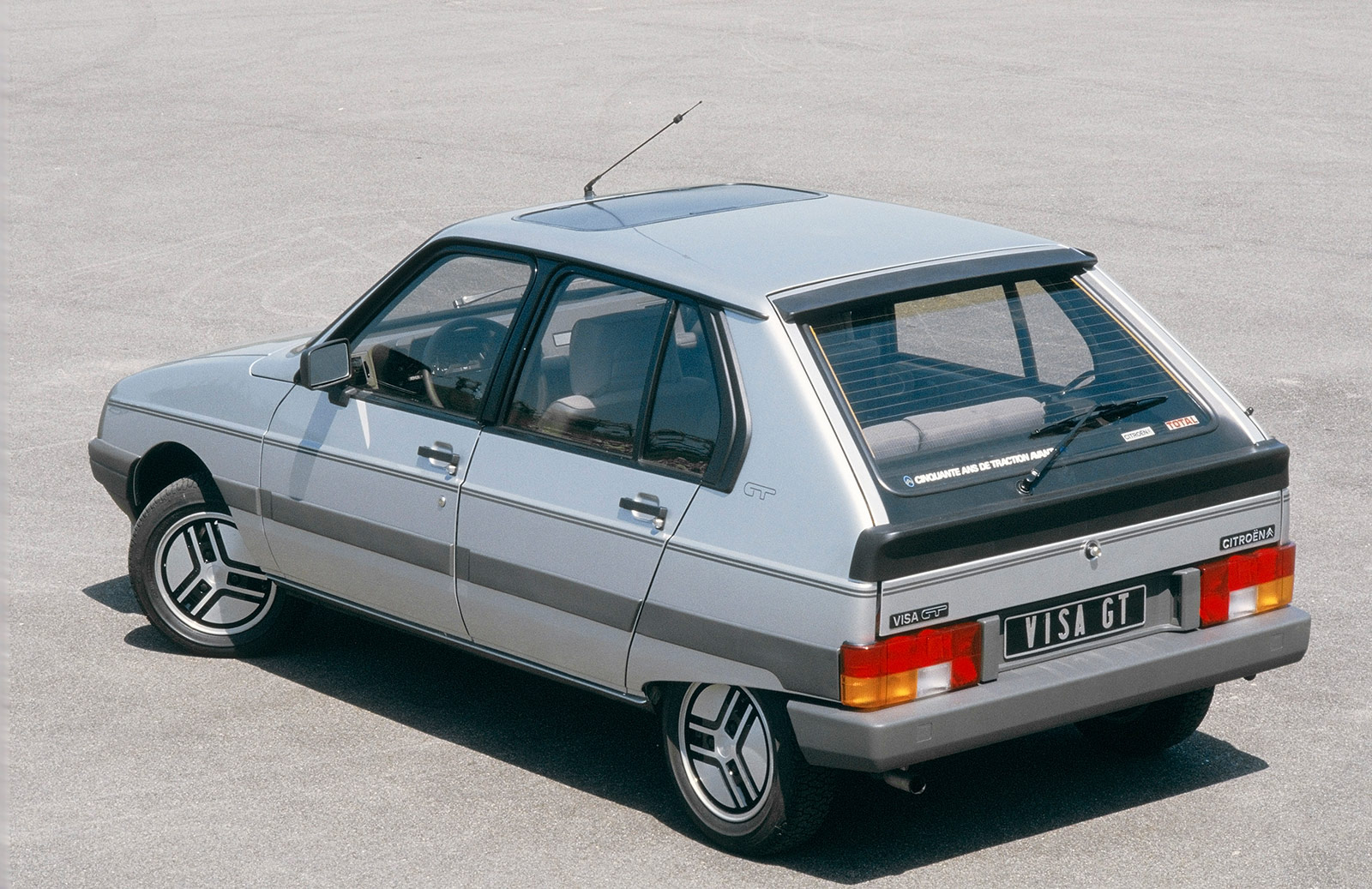 Photo: Citroën
One of the cheapest relatively quick cars was the Citroën Visa GT: it only had 80 horsepower, but because it weighed nothing, it reached 100km/h (62 mph) in 10.9 seconds. According to the Finnish article, the Camaro Z28-E with the tested three-speed automatic was half a second quicker. Half a second!
And the Citroën cost the same here as a base Camaro did in the States: a little over 60,000 FIM, or $28.500 today. Nobody in their right mind would cross-shop them, but it illustrates what you would get for your money here and in America. For a Z28 in the US, you’d pay what the aforementioned two-liter Fiat cost here. Then again, a “Fiat Brava,” as it was called there, cost nine thousand dollars in 1983, so not too far from the mark.
A price table in the same issue also reveals what one had to pay in Finland compared to the rest of Europe: a Volvo 240 cost double here in 1984 compared to Sweden, a VW Golf cost double compared to Germany, and for a Mercedes-Benz 190E, you had to pay 2.75 times as much here as in Germany. Conversely, a Saab 900 cost less here than in Denmark or Norway, partially because the local manufacturing plant meant reduced costs.
The price proposition for the Z28-E wasn’t a uniquely Finnish or German problem. The Belgian automotive magazine AutoGids notes in its November 1983 issue:
“The pleasure of the big American, its beefy V8, its automatic transmission, its power steering here and overdrive there, exists and survives with this Camaro. Of course, it is no longer the muscle car of yesteryear, but the 5-liter V8 has retained some of the driving pleasure… and some of the fuel consumption. Meanwhile, the chassis has improved considerably in terms of handling, brakes, and steering, so the car can deliver a perhaps somewhat primitive but clearly present driving pleasure. Unfortunately, there are financial factors that come to cloud the rugged-idyllic picture.
With the Californian atmosphere we were able to experience for 10 days in Belgium (T-top panels safely stowed away), winter seemed far off. The Camaro is a clear example of the efforts the American industry is making to overcome its handicaps while still retaining the interesting characteristics of their cars. Some of those handicaps hang over our heads as well: unleaded gasoline, which for efficiency’s sake sharply reduces the engine’s power output, e.g. Many of those efforts have already borne fruit: aerodynamics, brakes, steering, and handling. Less successful are the still high weight and space utilization.
As for consumption and efficiency in general, electronic developments in the style of BMW could already improve things considerably. But then the price would presumably go up again.”
Despite the odds not being in its favour, Chevrolet did manage to sell some Z28-Es in Europe, and a number of them have survived to present day, among all the grey-market examples. Not every Camaro in Finland is a pick-up, but it takes a careful eye to note which Camaros had been really expensive when new.
Top graphic images: Mercedes-Benz; Chevrolet