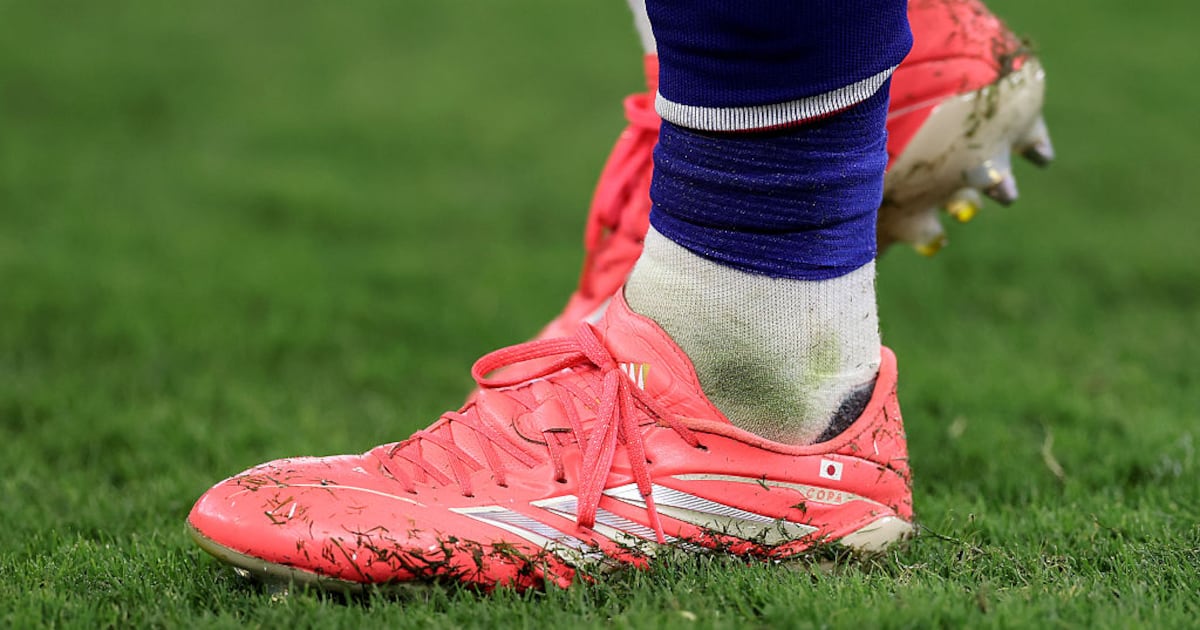
The Brazilian yellow and Moroccan red soccer kits typically offer a striking color splash against the green pitch, but their vibrancy was muted during the countries’ group stage match to the bright pink on the players’ feet.
At one point during the second half, 17 of the 22 players were all wearing pink soccer cleats interjecting 34 splashes of neon-tinted fuchsia onto the field of play. Similar adoption has been seen across the World Cup.
This isn’t just one model of footwear dominating the sport, either, but the independent choices of its three biggest apparel providers — Adidas, Nike and Puma — all opting for similar hues during the same tournament.
All three brands noted that design cycles for these elite-level products are typically around two years, meaning this shared fashion perspective is a coincidence dating back to roughly 2024 for the cleats, or boots, as most of the world calls them.
“Pink works on a football pitch in a way few colors do,” said Dominique Gathier, VP/Teamsport at Puma. “It reads immediately against green, photographs brilliantly, and carries a cultural energy right now: confidence, self-expression, personality. Players at this level want to be seen.”
Gathier added that, for Puma, pink is part of a broader “unified brand moment” spanning running, basketball and golf launches from earlier in 2026. He noted that the color is more a heritage than a trend, citing the 2014 Tricks model that packaged one electric blue shoe with a pink one. Nike echoed a similar theme, pointing back to its 1998 R9 Mercurial cleat that first broke the tradition of the black boot and said the modern Mercurial is created to enhance the athlete’s speed and mimic the faster, more intense game play and cultural identity.
“The athlete should understand what the boot is built to do without explanation,” said Odinga Nimako, Director of Global Football Footwear at Nike. “That extends to color. Hyper Pink signals energy and speed. It is visible, it is immediate, and it matches the intent of the product.”
Nicolas Roche, Adidas Category Director for Football, added that “pink sits at the intersection of visibility, energy and self-expression,” while noting it combines a feeling of being both premium and performance-driven.
Reuters tracked the footwear worn by the starting 11 for all 48 World Cup participants and determined that Nike was most popular with 232 players, followed closely by Adidas at 218 and Puma in third with 44; all other brands combined for just 34. In other words, 94% of athletes are wearing boots from the three top brands, all of whom chose the same primary colorway.
Not all players have the same palette, of course — Adidas made Lionel Messi custom shoes in Argentinian colors — but the product differentiation becomes a bit more challenging when competitors have a shared sensibility.
All three brands, of course, emphasized that color is but one factor in marketing and storytelling to a consumer audience. Product innovation and brand ambassadors play a role, too.
Some of Nike’s biggest names are superstars Kylian Mbappé from France, Cristiano Ronaldo from Portugal and Vini Jr. from Brazil. In addition to Messi, Adidas has Spain’s Lamine Yamal, Germany’s Florian Wirtz and France’s Ousmane Dembele. Puma is represented by the biggest U.S. star, Christian Pulisic, as well as Portugal’s Diogo Dalot and the Netherlands’ Cody Gakpo.
For the first time since 2018, Nike’s two sub-brands are fundamentally different: “Two distinct tools for two distinct kinds of speed,” Nimako said. Vapor borrows its form and function from sprint spikes for the player operating in tight spaces with quick feet, short bursts, he added, while the Superfly uses the same ZoomX foam found in marathon super-shoes.
Nimako made the point that its color and innovation are intertwined, choosing to be intentional in applying “the brightest colors to areas of our key technologies with an intense amount of depth.” The Superfly shoe has a white heel accentuating the pink covering the front 3/4 of the shoe to signify its speed; the Vapor has a vertical color fade, from pink on top to white below to suggest weightlessness.
The Adidas F50 Hyperfast Evo is its lightest World Cup model yet and was revealed just after Adidas fitted the first two marathoners to break the two-hour mark with 97-gram (3.4-ounce) shoes, while the soccer cousin weighs 130 grams (4.6 ounces). Its F50 Elite product line, with both laced and lace-less options, is only slightly heavier while adding what Roche described as an “a precision-grip coating” to help a player’s touch on the ball.
Gathier highlighted Puma’s three offerings by noting that the Future 9 is designed for playmakers, the Ultra 6 is built for speed and the King 20, the brand’s flagship, is an all-around offering with a soft TotalTouch+ upper.