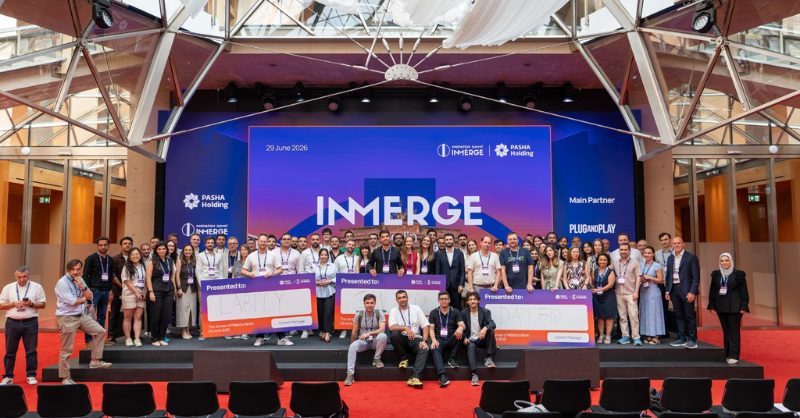
INMerge Ventures, the fund attached to Azerbaijan’s flagship startup summit, has $4 million in authorised capital. On June 29 in Berlin, its managing partner shared a stage with representatives from SAP, Microsoft Germany and a director at one of Germany’s largest development banks, all there to discuss how money should move between Europe and Central Asia.
That gap, a fund smaller than a single seed round next to institutions managing tens of billions, is the real story underneath INMerge Innovation Summit’s Berlin stop, the third and final leg of its 2026 international series after Istanbul and Tashkent.
Held at the AXICA Convention Centre as an official side event of GITEX Europe and organised with Plug and Play, the day was framed by its organisers as a bridge-building event between Europe and Azerbaijan, the Caucasus, and Central Asia.
Tech Funding News followed the sessions to see whether that bridge has any traffic yet.
The trust corridor has a name and a track record
Founded in Azerbaijan in 2021, INMerge describes itself as a platform that connects startups, investors, corporates, and technology leaders through events, partnerships, and ecosystem-building initiatives, aiming to accelerate the region’s innovation ecosystem by fostering meaningful connections, knowledge exchange, and investment opportunities.
 Image credits: INMerge Summit
The day opened with remarks from H.E. Nasimi Aghayev, Ambassador of the Republic of Azerbaijan to Germany, before Martin Gutmann delivered the keynote, “Are we celebrating the wrong leaders?”, built around reflecting on the evolving qualities of leadership in a fast-changing global innovation landscape, and challenging conventional ideas of what effective leadership looks like.
The day’s headline panel, “Trust corridors: rebuilding financial bridges between Europe and emerging markets,” could easily have been another stage exercise in cross-border platitudes. It wasn’t, mostly because of who was on it.
 Image credits: INMerge Summit
Ekaterina Galitsyna, who spoke for KfW IPEX-Bank, is the bank’s director for Eastern Europe and Central Asia, and three weeks before Berlin, she was in Tashkent meeting Uzbek officials directly about financing the country’s textile export sector, alongside Germany’s AKA Bank.
Galitsyna, Bahruz Naghiyev of PASHA Bank Azerbaijan and Zuzana Franz of ODDO BHF, moderated by Rza Aliyev of NGIC, argued that the gap between Europe and Central Eurasia is a confidence problem rather than a distance one.
The market backs them up. Venture funding in the Caucasus and Central Asia has grown roughly sixfold over the past six years, according to research from RISE Research, EA Group and BGlobal Ventures conducted with Crunchbase and Kazakhstan’s Ministry of Digital Development. Average round sizes nearly doubled between 2022 and 2023.
Azerbaijan’s own venture infrastructure tells the same story in miniature. Caucasus Ventures, the country’s first institutional fund, launched in 2022 with backing from PASHA Holding, the same conglomerate that runs INMerge. INMerge Ventures followed in October 2024 with that $4 million in authorised capital, and a third fund backed by White Hill Capital is reportedly in the works to push the country’s total managed venture assets toward $15 million.
For context, that is roughly the size of a single mid-sized Series A in Berlin or London. Tughra Musayeva, who holds the dual title of head of innovations at PASHA Financial Holding and managing partner at INMerge Ventures, moderated Berlin’s AI and big tech panel, meaning the fund with the smallest balance sheet at the table was also setting the terms of the conversation.
Farid Mammadov, CEO at PASHA Financial Holding, described Berlin’s purpose as extending the conversation “beyond regional borders” toward a “stronger bridge between Europe, Azerbaijan, the Caucasus, Central Asia, and emerging innovation markets.”
A separate fireside chat, “Beyond efficiency: Wellbeing, Culture and the Future of Work,” featured Ad Boon of PASHA Holding and Martin Gutmann of the Lucerne School of Business, moderated by Maria Ivanova of Gingo Partners.
 Image credits: INMerge Summit
The conversation explored how organisations can balance productivity with employee wellbeing, an inclusive culture, and long-term resilience, part of a broader push toward more human-centred approaches to work and the day’s softest, least contentious programming.
Big tech’s regional pitch
The panel “From Berlin labs to emerging market scale: AI, Big Tech and the next innovation bridge” carried the day’s clearest commercial intent.
 Image credits: INMerge Summit
It examined how AI and global technology companies are shaping opportunities in high-growth markets, with speakers Mammad Karim of Caucasus Ventures, Mehti Aslanov of PASHA Financial Holding, Alexandra Begue of SAP and Valeria Sadovykh of Microsoft Germany, moderated by Tughra Musayeva of PASHA Financial Holding.
The panel focused on how ideas developed in hubs like Berlin can be exported to high-growth markets through partnerships, investment, and ecosystem collaboration, rather than direct expansion, a more capital-efficient route for big tech and corporates wary of building from scratch in unfamiliar regulatory environments.
Sintro takes the Berlin crown
Berlin was not INMerge’s first attempt at this thesis this year, and the roadshow’s prior stops offer a useful gut check. Istanbul, the series opener in February, drew close to 200 attendees for a day co-hosted with Tenity, opening with a keynote on AI investment strategy from Fahed Bizzari and a panel featuring 500 Emerging Europe, Yapı Kredi and Türkiye’s Presidential Investment Office.
Each regional stop has closed with the same format: a Startup Pitch Competition judged by leading investors, sending three startups to the Baku flagship: one fully funded and two with partial support. Tashkent’s winners were never publicly named in INMerge’s own materials. Berlin followed the identical pattern.
Sintro won outright and will receive a fully funded trip to the main INMerge Innovation Summit in Baku on November 30 and December 1, with a shot at the $50,000 IN Battle prize. Datfid and Lan fly placed as runners-up with partial funding.
What Baku needs to prove
As the final stop in the 2026 international series, Berlin’s organisers framed the day as underscoring INMerge’s role in connecting Europe with Central Eurasia and reaffirming the summit’s mission to bring together ecosystems, capital and ideas ahead of the main event. The contrast with that main event raises the real stakes for November.
INMerge’s 2025 Baku flagship pulled more than 5,000 participants, 150 speakers, 100 startups and over 80 venture funds, according to Azerbaijan’s Ministry of Science and Education. The roadshow’s job is recruitment, and on that narrow measure, Berlin delivered exactly what Istanbul and Tashkent did: one keynote, two or three panels, a fireside chat and a pitch competition, with the institutional names changing city to city.
International investors are circling the Caucasus and Central Asia as global trade routes shift, with Azerbaijan’s position on the Middle Corridor between China and Europe cited as a structural advantage. The open question raised there is the same one implicit in Tashkent’s “Digital Silk Road” panel: whether the region can convert strategic positioning into deal flow before investor patience runs out.
For TFN, that is the frame worth watching. INMerge has now spent a year methodically introducing European institutional capital to Azerbaijani and Central Asian operators across three cities, on the record, through a fund with a balance sheet smaller than the deals its own panellists discuss daily.
Whether that asymmetry resolves into actual term sheets or simply repeats as a well-attended conversation is the only metric that will matter when the flagship opens in November.
This article is produced in a content partnership with INMerge Summit.