Rheinmetall CEO says arms dependence on US was intentional Thousands of Mercedes-Benz workers are set to protest across Germany Labor union IG Metall has called rallies outside major factory sites Firefighters rescued two window cleaners from 44th floor of high-rise in Frankfurt am Main
Here are the latest headlines from Germany on Friday, July 3, 2026:
Don’t let the algorithm hide the news. If you rely on our team for trusted reporting, please take a moment to select us as your Preferred Source on Google by clicking here and hitting the “star” or “preferred” button, so you’ll always see our verified news first.
Germany requests urgent meeting with Chinese ambassador over Russian reports
Germany requested urgent talks with China’s ambassador over reports that China was training Russian soldiers, a German Foreign Ministry spokesperson in Berlin said on Friday, confirming information first reported by Der Spiegel magazine.
The invitation for “urgent” talks, which falls short of a diplomatic summons, came two days after Reuters reported that China covertly trained Russian forces last year with the personal approval of Russia’s defense minister.
“Anything that enables Russia to continue its war of aggression against Ukraine also threatens our security,” Reuters cited a Foreign Ministry source as saying. “Consequently, China’s decisive and growing support for Russia’s brutal war of aggression directly impacts our security.”
Russia has sustained considerable losses almost four-and-a-half years into its full-scale invasion of Ukraine, leading to various measures seeking to recruit new soldiers without combat experience and prepare them for frontline service.
Renewed sharp dip in 2026 asylum applications, half-year figures show
Germany’s Federal Office for Migration and Refugees has published updated data on asylum applications through the end of June.
The Interior Ministry subdepartment revealed that it had received 39,646 first-time asylum applications in the first six months of the year.
That compares to 61,336 in the same period in 2025 and roughly 121,000 in the first half of 2024.
The reductions come amid efforts in both Berlin and Brussels to reduce overall migration.
German Interior Minister Alexander Dobrindt ordered an intensification of border controls after taking office in April 2025. He also instructed Federal Police to turn back would-be asylum-seekers — except those who are ill, pregnant or otherwise in need of special assistance — at Germany’s land borders.
He argued this was possible on the basis that they were entering via another safe European country where they should apply for asylum first, a position that has been undermined by court rulings in some individual cases.
According to the ministry, 14,270 people were turned back or deported at Germany’s borders in the first half of this year. The figures indicated that 494 suspected people-smugglers were arrested during the same period.
A package of reforms to EU asylum rules also came into force on June 12 this year, among other things making it easier for EU member states to send people to third countries with which they have no connection. However, systemic changes resulting from these new laws could take months or even years to realize. Knowledge of the plans might already play some role in individuals’ decisions on where to seek asylum, though.
Rheinmetall CEO opens fire on Merkel, saying German armsmakers were ‘not really wanted’
The CEO of German weapons manufacturer Rheinmetall, Armin Papperger, fired broadsides at former-Chancellor Angela Merkel at a security conference on Friday.
“Chancellor Angela Merkel said to us: We don’t really need you — if there’s a problem, we’ll call the Americans,” Papperger told newspaper Die Welt’s security conference, the outlet reported. Papperger said dependence on the US was by design.
The CEO of the arms giant — whose share price exploded in the years after Russia’s full scale invasion of Ukraine but which has now halved from its peaks of late 2025 — said there had been no “great demand for weapons systems in Germany itself” prior to 2022.
He alleged that Rheinmetall and other companies had been put in the Schumddelecke, a figurative German term for the dirty corner of a room or building where unwanted or taboo things are discarded.
“We were not really wanted by the powers that be in Germany,” he said.
Germany has had a restrictive stance on weapons manufacturers since its defeat in World War II, including limitations on types of weapons companies can export to which countries.
It meant that some of the most frequent political discussions surrounding the industry did focus on contentious decisions to sell weaponry to governments or militaries with questionable human rights records.
That said, Germany always remained among the world’s most prolific weapons exporters by value, along with the five permanent UN Security Council members.
In terms of more current priorities, Papperger said Germany still needed to improve its response times as it seeks to expand its defense manufacturing capabilities.
“Speed is the decisive point,” he said, saying that Ukraine was fast, whereas Germany still needed “too long from the development phase to being battle-ready.”
That said, Papperger also said progress had been made, “We have overtaken the Americans in conventional munitions and in the mean time are better set up than them.”
He said his company’s artillery shell production capacity had risen from 70,000 to 1 million rounds annually. “We are better than the pessimists in Germany think,” Papperger said.
Trail points to Germany as Monaco seeks Ukrainian woman after bombing
An Interpol Red Notice and media reports on Friday suggest that a search for a Ukrainian woman suspected of a bomb attack targeting a Ukrainian oligarch sanctioned by Kyiv for alleged ties to Russia could lead to Germany.
The Interpol notice seeking the Ukrainian woman specifies that she speaks German.
An investigator in Monaco said on Friday that her last known residential address was in Germany. Prosecutors in Germany said on Friday that officers had searched a rented apartment in Frankfurt a day earlier. A vehicle searched by the woman was also searched and secured, they said.
Read the full story here.
Adoptions in Germany fall to post-reunification low
Adoptions in Germany have fallen to their lowest level since reunification, continuing a long-term decline.
The Federal Statistical Office said Friday that 3,517 children were adopted last year, down 4%, or 145 adoptions, from the previous year.
The number of adoptions had peaked at 8,687 in 1993 but had more than halved by 2009. Since then, the figure has remained relatively stable at a low level, with a slight recent downward trend.
More than a quarter of children adopted in 2025 were infants under the age of 1, while a further 31% were 1 or 2 years old. The average age at adoption was 5 years and 1 month.
Most children were living with a biological parent and a stepparent before adoption, accounting for 74% of cases. One in 10 was adopted from a hospital or mother-and-child home, while 8% came from foster families.
In 3% of cases, the adoption followed an anonymous birth or the child being left at a baby hatch, while 2% followed care at a children’s home. Only 56 children, or 1.6%, were adopted from abroad, most often from Thailand, South Africa, Burkina Faso and Sri Lanka.
Despite the overall decline, stepchild adoptions have become increasingly important. Their share of all adoptions rose from 54% in 2010 to a record 75% in 2025.
The statistics office said this was mainly due to stepmothers in same-sex partnerships.
Officials cited changing family structures, expanded state support for families, stricter child protection rules and advances in reproductive medicine as possible reasons for the overall decline. They also pointed to a fall in third-party adoptions, meaning adoptions by people who are neither stepparents nor relatives.
Steinmeier hails US-German ties on independence anniversary
German President Frank-Walter Steinmeier has hailed the close bond between Germany and the United States on the 250th anniversary of the US Declaration of Independence.
In a congratulatory letter to US President Donald Trump, Steinmeier said the shared history between the two countries remained central to Germany, despite recent tensions.
“The history we share with the United States means a great deal to us Germans,” the letter said. “It carries responsibility. It forges our unity within the NATO Alliance, which defends more than just our security, it defends the 250-year promise of liberty, justice, and self-determination.”
Steinmeier said those ideals had shaped world history and deeply influenced Germany’s relationship with the US.
He noted that Germans helped build the American republic in the 19th century, while Germany’s own path to democracy in the 20th century would have been unthinkable without the US.
Steinmeier recalled that US troops helped liberate Europe from Nazi rule and that Washington later gave West Germany a new chance at freedom and prosperity, supporting the rule of law, economic recovery and democratic culture.
He also referred to former US president Ronald Reagan’s 1987 call in West Berlin for Soviet leader Mikhail Gorbachev to tear down the Berlin Wall.
“Both the rebirth in freedom and Germany’s reunification would have been inconceivable without the United States,” Steinmeier wrote.
Klopp signals interest in Germany job, says DFB
Former Borussia Dortmund and Liverpool coach Jürgen Klopp has signaled he is willing to succeed Julian Nagelsmann as Germany coach, the German Football Association said Friday.
The DFB said its leadership would now seek talks with Klopp after Nagelsmann resigned following Germany’s round-of-32 exit at the World Cup.
“With regard to filling the coaching post, the DFB leadership will now seek talks with Jürgen Klopp,” the federation said.
“He has already signalled his fundamental willingness to take on the position.”
Nagelsmann leaves Germany job after World Cup exit
Well, it had been widely expected ever since Germany’s shock exit to Paraguay at the 2026 World Cup.
The German Football Association has confirmed that 38-year-old Julian Nagelsmann is no longer national team head coach.
Read more about the story here.
Customs seize 16 kg of ketamine at Berlin airport
Customs officials have revealed that they seized 16 kilograms (just over 35 pounds) of ketamine from a traveler at Berlin Brandenburg Airport.
The 22-year-old was stopped in early June while traveling from Berlin to Zurich, with a final destination of Hong Kong.
Officials said eight vacuum-sealed bags containing a white crystalline substance were found hidden among clothes in his luggage. A test using a detection device identified the substance as ketamine hydrochloride.
Customs officers arrested the man at the departure gate after he had passed the boarding checkpoint. They said he was forced to the ground and handcuffed because of possible resistance, flight risk, the high potential sentence and suspected links to organized crime.
Officers seized the ketamine and his mobile phone as evidence. The case has been handed to the Berlin-Brandenburg customs investigation office.
Ketamine hydrochloride is used in medicine as a painkiller and anesthetic. On the black market, it is also used as a party drug because it can have disinhibiting and euphoric effects and, at higher doses, trigger hallucinations.
Window cleaners rescued from high-rise platform in Frankfurt
Firefighters have rescued two window cleaners from a faulty suspended platform on a high-rise in Frankfurt am Main.
The platform initially became stuck on the facade at about the 44th floor, before coming loose and putting the two workers in danger, a fire service spokesperson said.
Specialist height rescuers used a winch to pull the men up one by one, lifting them 11 floors to safety.
The fire service said it was believed to be the “highest rescue operation in an urban area in Germany.”
A total of 24 firefighters were involved, including five height rescue specialists. Officials said a technical fault was likely to blame.
Mercedes workers protest tougher cost cuts
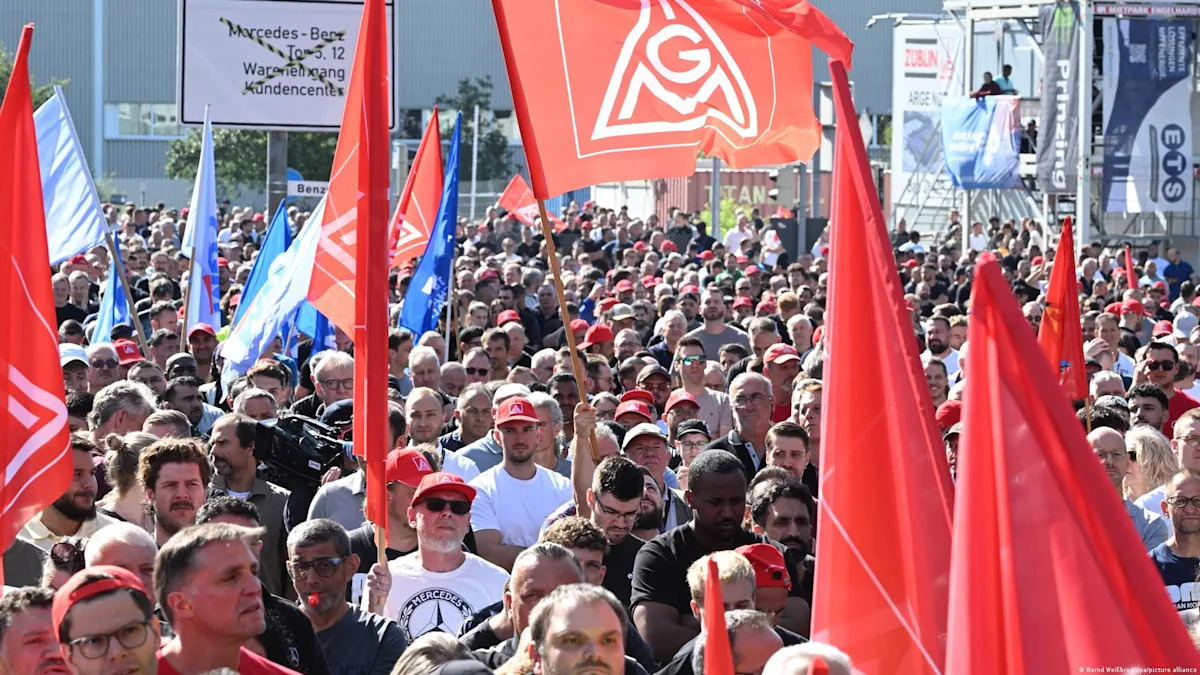
Thousands of Mercedes-Benz workers are set to protest across Germany against the carmaker’s tougher cost-cutting drive.
Germany’s largest trade union IG Metall called the demonstrations outside factory gates, with rallies planned at sites including Sindelfingen, Untertürkheim, Rastatt, Bremen, Berlin, Hamburg and Düsseldorf.
The union said the Mercedes protests would mark the start of further action across the auto industry. It accused carmakers and suppliers of focusing on job cuts and relocation rather than real solutions, saying around 50,000 jobs were cut in the sector last year.
“The employees are not to blame for the crisis,” IG Metall said.
In a letter to workers in Germany, the board said the company must keep cutting costs to remain competitive. “Despite all our efforts, the situation in Germany today is dramatic,” it said.
Mercedes said it took employees’ concerns seriously and wanted to inform staff early and transparently, including on difficult decisions.
As an immediate step, around 90,000 of the company’s roughly 108,000 employees in Germany will not receive a collectively agreed special payment in July as expected. The payment, worth 18.4% of a single monthly wage, is to be postponed until next year.
Mercedes also said it wanted to speed up processes, streamline structures and make hourly labor costs cheaper.
Welcome to our coverage
Guten Tag from the DW newsroom in Bonn.
You join us as the automaker Mercedes-Benz faces a wave of protests in Germany as workers push back against a tougher cost-cutting drive.
The IG Metall union says staff are being made to pay for a crisis they did not cause.
Over in Frankfurt am Main, firefighters carried out a high-rise rescue when window cleaners got stuck on a faulty suspended platform.
Stay with us for these stories and more of the things that Germany is talking about today.