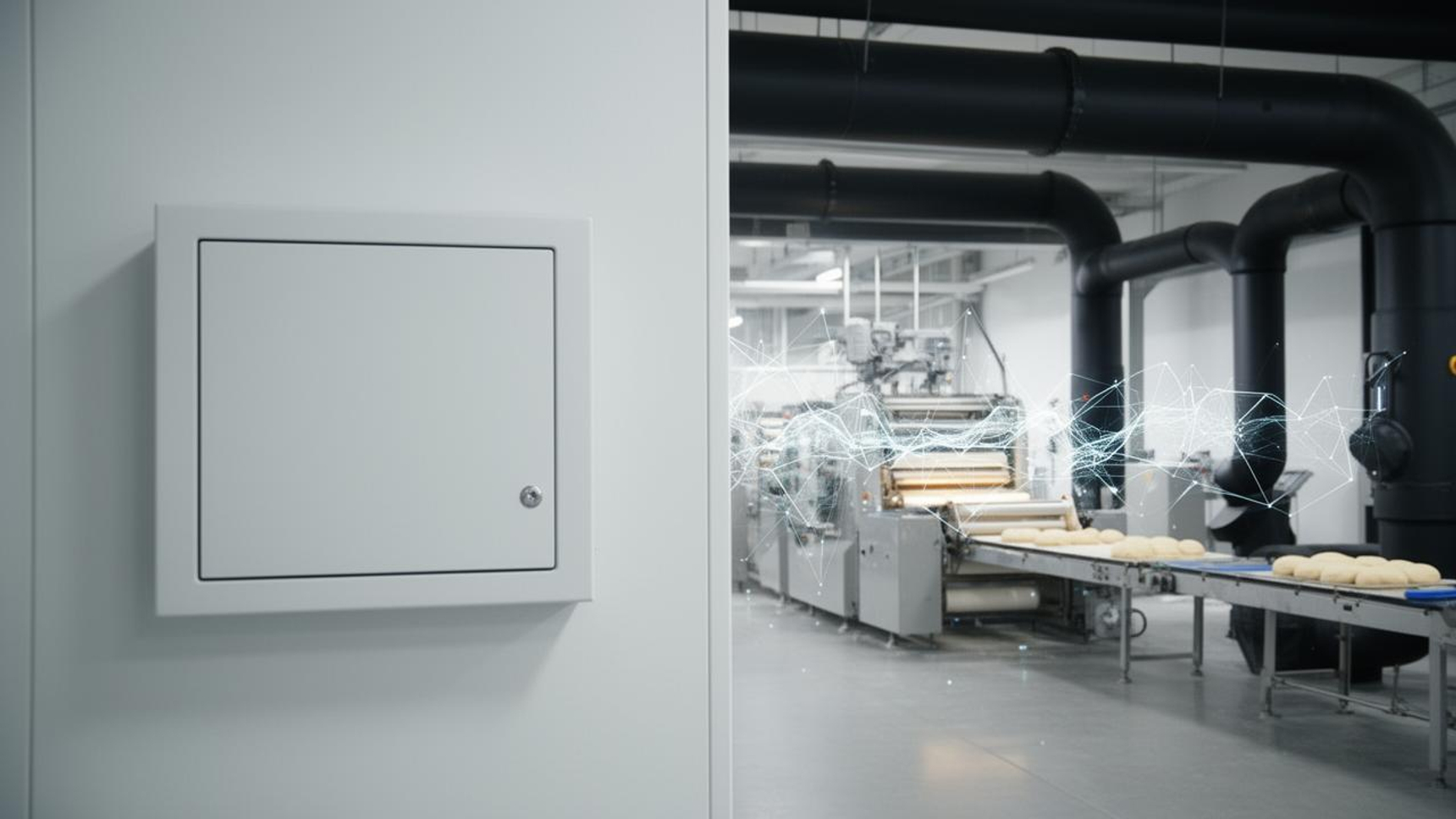
The industrial world is populated by people who “cannot afford to make mistakes.” They spend their days wrestling with parameters, equipment, energy consumption, and quality risks. Their achievements often involve preventing an accident or stabilizing a production line, rather than generating surprises. While general-purpose AI in the consumer space is busy chatting and writing code, the manufacturing sector has posed three soul-searching questions to AI: Where are its boundaries? Who takes responsibility if it tweaks a parameter incorrectly? And what makes its conclusions trustworthy?
Ahead of the 2026 World Artificial Intelligence Conference (WAIC), Siemens has provided answers through a series of already-deployed industrial AI practices. From a fingernail-sized embedded protocol conversion board, to an energy-efficiency AI that takes over an entire building’s chiller plant, to an engineering agent capable of autonomously writing automation code, Siemens has charted a clear and pragmatic path: the competition in industrial AI is shifting from “who has the bigger parameters” to “who understands the nuances of the process better.”
A single board unblocks the “meridians” of aging production lines
In automotive parts automated conveyor lines and heat-treatment injection molding lines, a vast number of legacy assets remain in operation. These devices often only feature ModbusRTU serial communication interfaces, while the main control systems have been upgraded to Siemens S7-1500 series Profinet IO controllers. To solve the problem of legacy variable frequency drives (VFDs) and intelligent temperature controllers being unable to connect to high-speed industrial Ethernet, the WL-OEM-B40 embedded protocol conversion board has become the key to low-cost digital retrofitting.
This is an OEM board with an embedded full-stack Profinet protocol. By connecting an external isolated MAX485 chip via a hardware UART, it enables bidirectional data exchange between a Profinet master station and multiple ModbusRTU slave devices. In a retrofit case involving a variable-speed conveyor unit, the board was embedded directly into the control cabinet’s mainboard, reusing the 24V DC power supply. A single RS485 bus connected seven three-phase asynchronous motor VFDs.
Using Siemens’ TIA Portal engineering platform, engineers simply install the WL-OEM-B40’s original GSDML file, drag and drop the configuration, and plan the IO buffer zones to complete commissioning—without needing to develop a protocol stack from scratch. Post-retrofit data shows the Profinet cycle is stable at 16ms, with transmission latency under 1 millisecond. VFDs that previously could only collect single-point signals via hardwiring can now transmit real-time operating parameters, fault codes, and energy consumption data back to the system, while receiving speed adjustment commands from the PLC. As a result, control cabinet volume was reduced by 30%, and overall material costs dropped by 18%.
In an application involving intelligent temperature controllers, the same board connected eight PID temperature controllers to the Profinet network. When an over-temperature fault occurs, the instrument’s fault register is set, and the PLC can trigger audible and visual alarms and execute a shutdown interlock within milliseconds—completely transforming the previously lagging model that relied on manual inspections. This retrofit approach of “just adding one board without replacing existing equipment” compressed the line shutdown and retrofit time to just half a day, offering an extremely high cost advantage for legacy asset upgrades.
From machine rooms to production lines: AI must be rooted in data
If the WL-OEM-B40 solves the physical layer connectivity problem, then Siemens’ “Smart Cooling Cube” AI BOX 2.0 and the Pringles factory’s digital twin system solve the trust problem at the decision-making layer.
In the chiller plant of the Crowne Plaza Shanghai Anting hotel, the Smart Cooling Cube has taken over the most grueling overnight “watch duty.” The energy consumption of chillers, water pumps, and cooling towers is affected by occupancy rates, weather, and banquet events, requiring constant fine-tuning. This AI system was installed, calibrated, and put into operation within three days, with preliminary data showing an approximately 7% improvement in plant energy efficiency. Behind this is a self-developed time-series foundation model—no months-long historical data collection, no on-site data scientists. The AI did not replace the engineer; rather, it took over the repetitive labor that “cannot stop, cannot be disrupted, yet no one wants to constantly monitor.”
On Pringles’ potato chip production line, the challenge is even more precise. Batch-to-batch differences in potato flour mean the dough recipe must be dynamically adjusted. In the past, this relied on the intuition of veteran operators. General-purpose large language models, lacking real-time production line data, are highly prone to “confidently spouting nonsense” hallucinations. Siemens’ solution was to deploy edge-side AI and digital twins. A sensor network collects real-time data on temperature, humidity, and protein levels, and the AI calculates the optimal recipe accordingly. This not only improved line performance by about 10% and reduced waste by about 13%, but also transformed the veteran operator’s “indescribable, untransferable” feel into a reproducible scientific method.
The “lower-bound” logic of industrial agents
Industry is a world defined by “lower bounds.” Whether a system is usable depends on how badly it fails at its worst moment. It is precisely based on this logic that Siemens launched the Eigen Engineering Agent.
Unveiled at Hannover Messe in April 2026 and formally introduced to China’s industrial sector at this year’s WAIC, this agent is not merely a conversational assistant. It is an AI that can directly enter the TIA Portal engineering platform to execute specific tasks. It can autonomously understand project requirements, write Programmable Logic Controller (PLC) code, complete Human-Machine Interface (HMI) visualization development and hardware network configuration, and continuously iterate and optimize until it meets preset quality standards.
According to Siemens, the Eigen Engineering Agent has been piloted across 19 countries with over a hundred enterprises, including customers such as Austria’s Andritz Metals, China’s CASMT, and the US-based Prism Systems. Pilot data shows the agent can improve overall solution quality by 80%, boost engineering efficiency by up to 50%, and achieve execution speeds 2 to 5 times faster than manual processes. Upon release, it was immediately opened to TIA Portal’s global user base of over 600,000 engineers, moving AI from “demo” to a real productivity tool.
More critically, Siemens has drawn clear boundaries for the Eigen Engineering Agent: the AI is responsible for trial-and-error and first drafts; the human is responsible for the final decision. This neatly answers the factory’s three original questions—permission tiering defines the boundary, human confirmation defines accountability, and the computational logic based on real-time industrial data provides a traceable basis for decisions.
At some of PepsiCo’s warehousing facilities in the United States, Siemens used 3D digital twins to simulate the entire production line in a virtual environment, identifying up to 90% of potential issues before physical modifications began. Initial deployment achieved a capacity increase of roughly 20%. These cases collectively point to a trend: as AI’s general capabilities gradually become a purchasable commodity, what is truly scarce is deep understanding of specific processes and the engineering capability to embed AI into existing chains of responsibility. As Siemens’ practices demonstrate, the decisive factor in industrial AI is not the size of the model’s parameters, but whether it can truly reside on the shop floor and become a reliable colleague—one who can withstand scrutiny—alongside those who “cannot afford to make mistakes.”