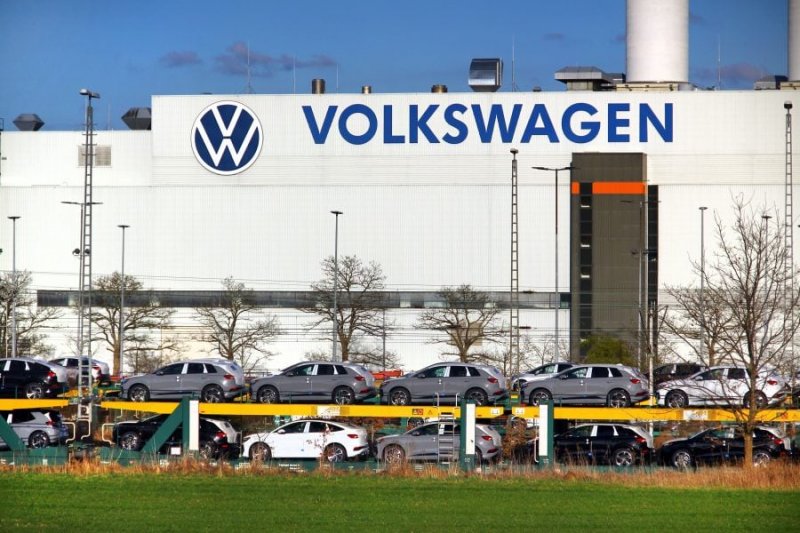
Volkswagen said on Friday that its decline in vehicle sales accelerated in the second quarter as the crisis-hit German automaker faces mounting pressure from weak demand and reports that it is considering cutting up to 100,000 jobs worldwide, News.Az reports, citing AFP.
The company said overall vehicle deliveries fell nearly 9% year-on-year in the April-June period, largely due to a sharp decline in demand in China. In the first quarter, Volkswagen’s sales had fallen by 4%.
“The situation in China remains challenging, and we were unable to escape a clearly declining overall market,” Volkswagen executive Marco Schubert said in a statement.
He added that the decline came “despite initial positive momentum from our newly introduced, locally developed electric vehicles there.”
Europe’s largest carmaker is facing growing pressure from U.S. tariffs, shrinking profit margins on electric vehicles and, above all, intensifying competition in China, the world’s largest automotive market.
The 10-brand group, which includes Volkswagen, Audi and Porsche, has already announced plans to cut at least 50,000 jobs in Germany by 2030.
However, recent media reports have suggested the company is considering reducing its global workforce by as many as 100,000 employees and closing four factories in Germany.
Germany’s powerful IG Metall union organized protests at Volkswagen facilities across the country on Thursday as company management presented its cost-cutting plans to the supervisory board.
There was no major announcement Thursday, with VW simply reiterating previous plans to cut capacity and its model line-up, and analysts said talks would likely take time.
“For now, people are sharpening their swords and firming up their positions,” auto analyst Stefan Bratzel of the Centre of Automotive Management told AFP.
“This is going to drag on for months and months.”
Volkswagen executives have repeatedly stressed the need for the company to slim down as collapsing sales in China have started to look less like a blip and more like a new normal.
It is a crisis hitting the whole German car industry — BMW said Friday its second-quarter car sales had fallen almost five percent worldwide, dragged down by a 30.2-percent plunge in China.
Chinese brands are also threatening Volkswagen on its home turf.
The likes of Geely, Xpeng and BYD took a nine percent share of the European market in March, according to automotive intelligence firm Dataforce, up from virtually zero three years ago.
“The Chinese are coming to Europe, also building factories which are highly efficient,” Volkswagen CEO Oliver Blume warned in April. “We cannot compete with underutilised plants.”
But labour representatives and the German state of Lower Saxony — both of whom take a dim view of possible plant closures — together hold more than half the seats on VW’s supervisory board.
This means any major restructuring is uncertain and will be hard fought.
“Fundamentally, Volkswagen is too big, too complex, too expensive and too slow,” auto analyst Bratzel said.