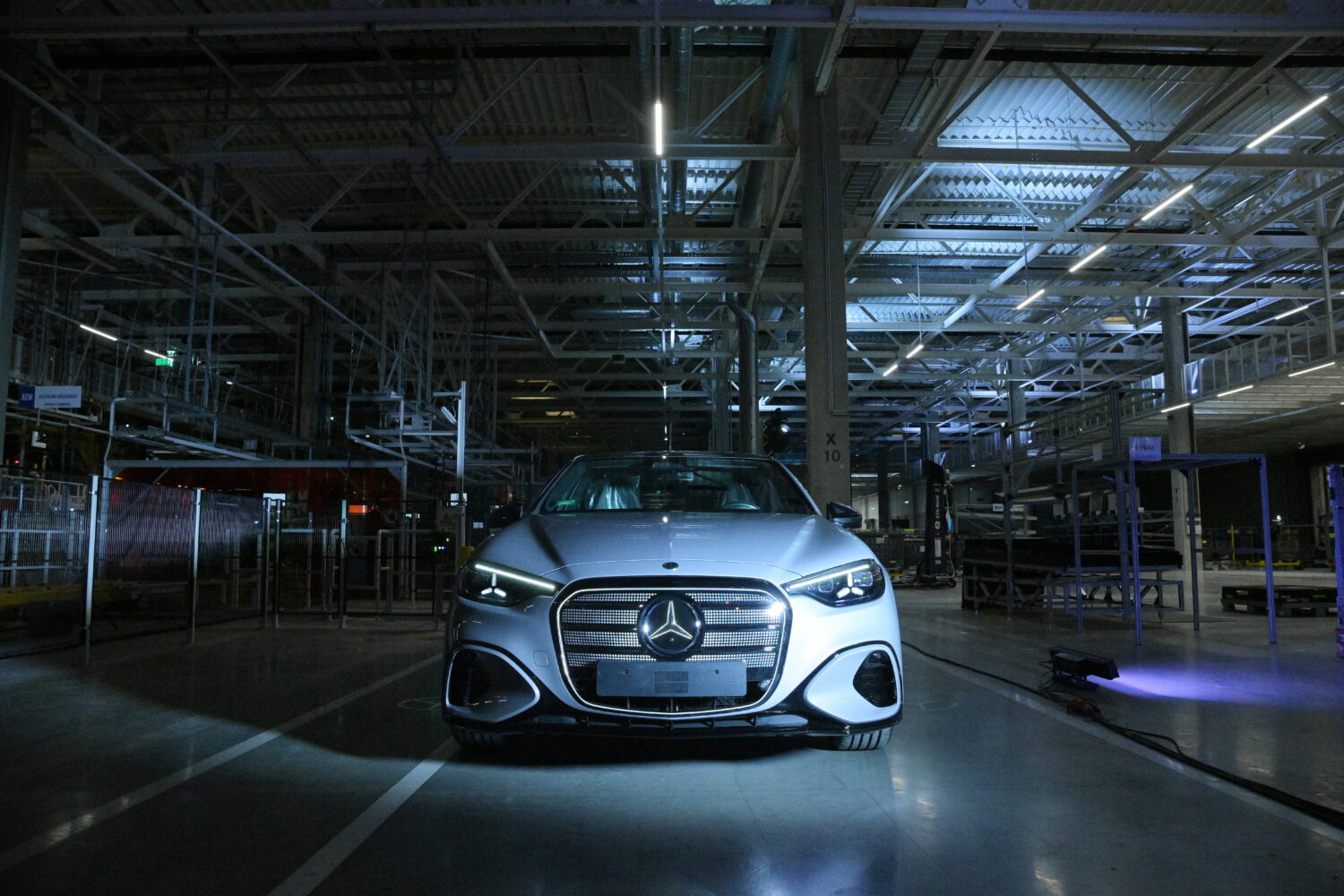
Mercedes-Benz is making a strong statement in the global competition within the automotive industry. On Monday, July 13, the Stuttgart-based car manufacturer officially inaugurated the extensive expansion of its plant in the central Hungarian city of Kecskemét. With an investment of one billion euros, the site has not only become the second-largest Mercedes plant in the world, but also holds the title of the largest Mercedes-Benz factory in all of Europe.
The ceremonial opening of the new section of the plant marks the beginning of a new era for the Hungarian location. In Kecskemét, series production has begun for the German manufacturer’s first purely electric entry-level model — the new electric C-Class.
Currently, the 5,000 employees at the site produce more than 100,000 vehicles per year.
In the long term, the plant’s capacity is expected to increase to as many as 350,000 vehicles annually.
Alongside this expansion, the company plans to nearly double its workforce to between 9,000 and 10,000 employees.
Christian Dickert, Managing Director and Plant Manager in Kecskemét, praised the workforce during the opening ceremony. Although he has only held the position for around one hundred days, he said he was highly impressed. “What this team has achieved is truly remarkable. Our employees have worked with enormous flexibility, full commitment, and an extraordinary team spirit,” Christian Dickert emphasized. He said the plant represents a strong foundation for the company’s future growth. The skills and innovative capabilities of Hungarian employees gave him great confidence for the years ahead.

Michael Schiebe, Member of the Board of Management of Mercedes-Benz Group AG responsible for Production, Quality and Supply Chain Management, speaks at the inauguration of the new production facilities of Mercedes-Benz Manufacturing Hungary Kft. and the official start of fully electric C-Class production. Photo: MTI/Szigetváry Zsolt
Michael Schiebe, a member of the Board of Management of Mercedes-Benz Group AG responsible for Production, Quality & Supply Chain Management, spoke about how the Kecskemét plant has developed over the past 14 years into Hungary’s largest automotive factory and, at the same time, the second-largest location in the company’s global production network. He recalled that
the one-billion-euro investment launched in 2022 expanded the factory site by more than double — from 200 to 440 hectares.
He added that five new, state-of-the-art production halls had been built, which are primarily powered by renewable energy and operate without CO₂ emissions.
Ola Källenius, Chairman of the Board of Management of Mercedes-Benz Group, emphasized the global importance of the billion-euro investment during his visit. He highlighted customer focus, innovation, and competitiveness as the company’s three core values, saying that these are being demonstrated at the highest level in Kecskemét. “The best way to predict the future is to create it yourself,” Ola Källenius quoted a well-known motto in his speech. He added that the Hungarian team proves this every day by viewing market competition not as a threat, but as motivation.
While the fundamental contracts and agreements for the major project were initiated under the previous government of Viktor Orbán and his Minister of Foreign Affairs and Trade, Péter Szijjártó, the current opening ceremony provided a new political stage.
Péter Magyar, the new prime minister, appeared as one of the speakers at the ceremonial handover. He also took the opportunity to test-drive the C-Class.

“Mercedes chose to expand not because of the Orbán government or Péter Szijjártó in particular, but despite these circumstances,” Prime Minister Péter Magyar wrote in a comment on his video. Photo: Facebook/Péter Magyar
While the opening ceremony under the TISZA government and Prime Minister Péter Magyar provided a new political backdrop, one detail behind the scenes attracted attention. The local city leadership was notably absent. The mayor of Kecskemét, Klaudia Szemereyné Pataki, stated shortly after the event on her social media page that
she and her colleagues at city hall had not attended the inauguration at the explicit request of the head of government.
The fact that a city’s leadership was not invited to the opening of such an internationally significant production facility is considered highly unusual. Since German corporate leadership generally adheres strictly to diplomatic conventions, the reason for this break with tradition is suspected to lie in Hungary’s domestic political power struggles. Despite the lack of a personal meeting, the mayor later emphasized her continued willingness to communicate and cooperate in the interests of the city of Kecskemét.
With the start of production of the electric C-Class and the expansion of its capacity, Kecskemét is strengthening its role as a strategic centerpiece in Mercedes-Benz’s global production network.
Related article
Mercedes-Benz Reveals Significant Cost Advantage of Kecskemét Plant
While discussions continue in Germany over efficiency and working conditions, Mercedes-Benz is investing in its future in Hungary.Continue reading
Via MTI, Featured image: MTI/Szigetváry Zsolt