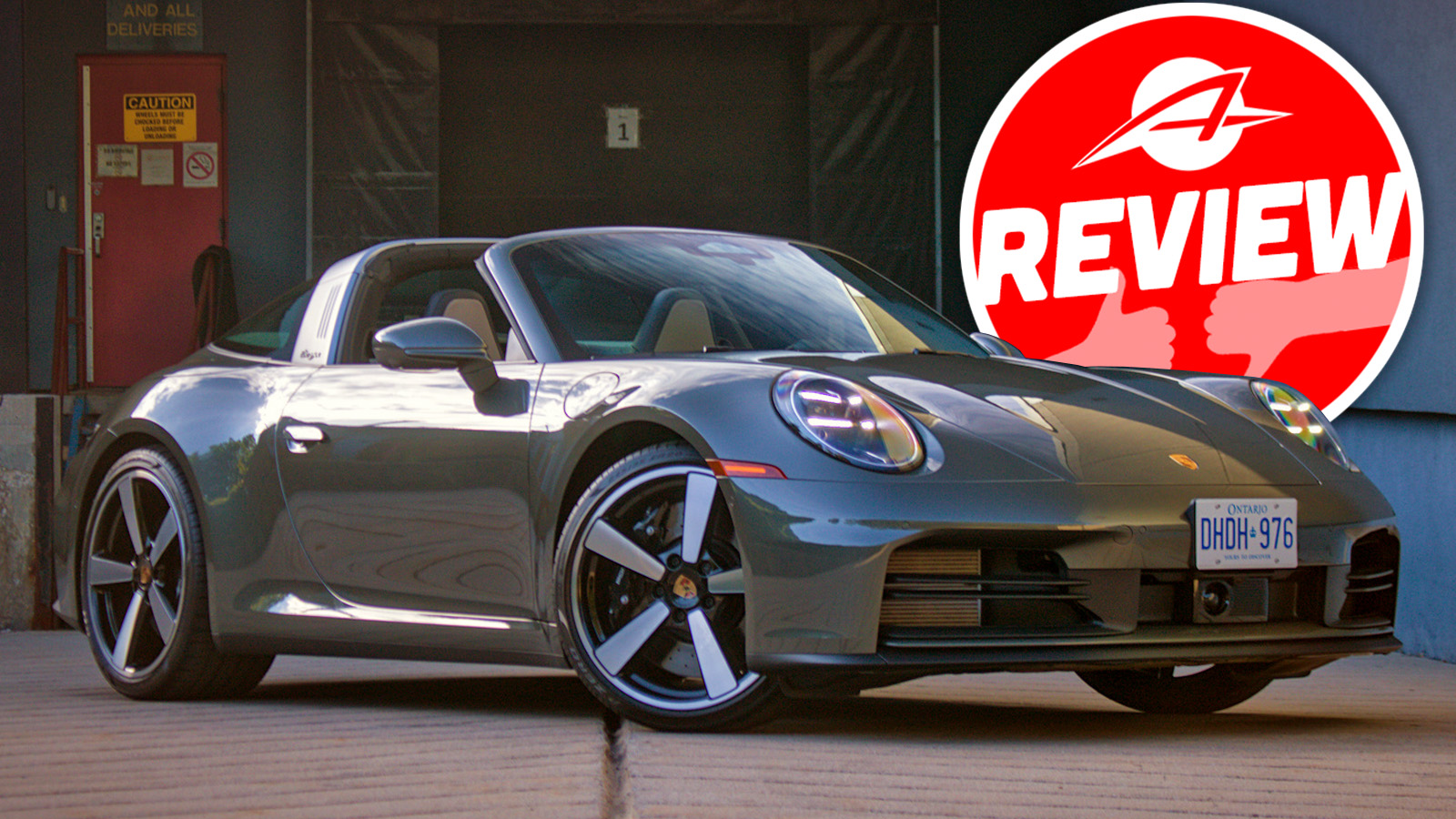
We as a species have a certain love affair with complexity. An iPhone tells the time just as well as an automatic watch, yet some of us still pay thousands to put tiny Swiss-made springs and gears on our wrists. We go slack-jawed at concerts adorned with moving set pieces and pyrotechnics, feel a certain satisfaction from videos showing hundreds of dominoes falling perfectly into place, and marvel at tens of thousands of dots coming together to form a perfectly pointillistic picture. Outstanding displays of creative effort say something about the human spirit, and that explains the Porsche 911 Targa 4S.
Of the 19 standard-issue variants of Porsche’s rear-engined sports car, the Targa 4S will perplex spec sheet jockeys the most. It’s more expensive and heavier than a Carrera 4S Cabriolet, you can’t operate the roof whilst moving at any meaningful speed, you can’t get it with the purity of rear-wheel-drive, and yet none of that really matters because it embodies a certain romance. Allow me to explain.


[Full disclosure: Porsche Canada let me borrow this 911 Targa 4S for a week so long as I kept the shiny side up, returned it clean with a full tank of premium fuel, and reviewed it.]
The Basics
Engine: Three-liter quad-cam 24-valve twin-turbocharged flat-six.
Transmission: Eight-speed dual-clutch automatic.
Drive: Full-time all-wheel-drive with limited-slip rear differential.
Output: 473 horsepower at 6,500 RPM, 390 lb.-ft. of torque from 2,000 RPM to 5,000 RPM.
Fuel Economy: 17 MPG city, 24 MPG highway, 20 MPG combined (13.8 L/100km city, 9.8 L/100km highway, 12.0 L/100km combined).
Base Price: $182,550 ($192,550 in Canada).
Price As-Tested: $213,480 ($226,680 in Canada).
Why Does It Exist?
 Photo credit: Thomas Hundal
In the 1960s, convertibles were generally lighter than their tin-topped counterparts, but they were also rather unsafe. Not only did cutting the roof off a car compromise its structural rigidity, but the tracing-paper-thin A-pillars of the time afforded virtually no rollover protection. With growing scrutiny of automobile safety resulting in—among other things—a fear of convertibles being banned, Porsche decided to take a more structurally sound approach. With a fixed rollover hoop, a removable roof panel, and a name recalling the Targa Florio road race, the 911 Targa was an instant icon. Small wonder this sort-of coupe-cabrio body style is still part of the 911 range today.
How Does It Look?
 Photo credit: Thomas Hundal
Like a Porsche 911, obviously. This might be the world’s most recognizable sports car lineage, in the sense that you could put the latest model in a time machine, send it back to the first full production year of the original model, and people would know what it is. Granted, trying to force too much old-school design language on a car is a risky endeavor, but the Targa 4S gets it just right. From the magnesium-clad roll hoop spanning the cabin to the wraparound rear window to the optional Fuchs-inspired alloy wheels, the throwback Targa treatment just fits, disguising an absolutely jaw-dropping top mechanism with familiar elements.
 Photo credit: Thomas Hundal
The 19-second ballet starts with the side windows dropping and the rear clamshell rising, window and all, like this sports car’s about to launch a missile. From there, the corners of the metallic roll hoop trim tuck inward to make room for the targa panel arms, then the fabric-clad roof takes a bow and disappears into a nook behind the rear seats, carried by seemingly impossibly thin legs. The roll hoop trim drops, the clamshell lowers, and the whole affair’s done within a single traffic light cycle. It’s a mesmerizingly complicated mechanism, one that makes Rube Goldberg seem like a purveyor of hammers.
All the arms, all the hinges, all the latches, all the microswitches required to pull off such a sequence boggle the mind. There are so many moving parts to the Targa 4S’ roof that it transcends the class barrier. It doesn’t matter that this thing costs more than $200,000 as-spec’d, Brooks Brothers broskis in the financial district and early-2000s GM truck owners in the hardware store parking lot both marvel at Porsche’s grand complication.
What About The Interior?
 Photo credit: Thomas Hundal
As cars continue to evolve into Best Buy branches on wheels, it’s easy to get the sense that some people on certain interior design teams are trying new things simply for the sake of newness. I’m certainly not saying Porsche’s immune to digital infuriation—the touchscreen-controlled air-con vents in the current Panamera are particularly ridiculous—but they haven’t cocked it up inside the 992.2 911. It starts by maintaining a decent selection of physical controls. The choice of capacitive-touch pads for track selection and some of the climate control functions isn’t ideal, but actual volume and tuning knobs, gratifyingly clicky toggle switches for temperature and fan speed, and real buttons for seat heating and ventilation are greatly appreciated. Then there’s the relative lack of a learning curve. Even if you’ve never driven a Porsche before, the only thing you’ll have to get used to is the starter button placement to the left of the steering wheel. Everything else works exactly as you’d expect, from the cruise control stalk to the dome lights.
What’s more, the sense of solidity is immense. Extending beyond the selection of leathers and the tactility of the various latches, buttons, switches, and knobs, the general build quality of this 911 Targa 4S is exactly what you’d expect from such a luxury item. You’ll find an excellent paint finish and spot-on panel gaps. You won’t find squeaks, rattles, or wind leaks, even though the life of a press car isn’t dissimilar to that of a rental minivan in NASCAR country.
 Photo credit: Thomas Hundal
Thanks to Porsche’s largely à la carte options menu, there are four different seat options available on the 911 Targa 4S. My test unit came with the 14-way Sport Seats, but don’t let the name fool you. When other options are more aggressive, these are essentially the wide-boy comfort seats. They’re probably great for someone who wears a larger pair of jeans than me, but their lateral support is lacking if you have, say, a 30-inch waist. However, the optional rear seats are perfectly usable by shorter passengers for modest distances. Four-up in the Targa was no sweat, and when you’re not using the rear seats, you can fold them down to fit a large checked bag. As for general ergonomics, they’re spot-on. Huge steering wheel rake and reach adjustment contribute to an excellent driving position, something that ought to be mandatory when you’re spending this sort of coin on a car.
How Does It Drive?
 Photo credit: Thomas Hundal
It’s been nearly a decade since we first saw Porsche’s MDC three-liter twin-turbocharged flat-six, but this downsized, turbocharged engine isn’t done yet. Charge coolers from the old Turbo and turbochargers from the old GTS mean the Targa 4S now makes 473 horsepower—29 more than the old 4S. That’s absolutely plenty, especially when hitched to Porsche’s eight-speed PDK dual-clutch automatic gearbox. Think quiet, sedate highway cruising thanks to multiple overdrive ratios, but savage acceleration due to closer lower ratios and launch control that really dumps the clutch. Porsche claims zero-to-60 mph in 3.5 seconds, but I’d estimate that figure to be quite conservative.
Beyond the hair-raising experience of a ruthlessly optimized sprint to highway speeds, the 911 Targa 4S’ engine does something many modern turbocharged units don’t: Reward you for winding it out. You’ll hear and feel a whole range of changes in tonality and intensity as the virtual needle sweeps across the tachometer, and despite power peaking at 6,500 RPM, Porsche’s mainstream sports car motor doesn’t fall on its face at the top of the rev range. Add in a plateau of torque around town and when passing, and this is still a satisfying engine nearly a decade after its introduction.
 Photo credit: Thomas Hundal
However, it’s not quite as satisfying as the way Porsche’s set up the ride and handling balance of the 911 Targa 4S. While high spring rates and stiff dampers make sense on the track, in the real world with frost heaves and potholes and cold fills, suspension like this is what you want. Think sensible, softer-than-the-GTS spring rates that breathe with bumpy roads and damping that keeps a lid on it all. Fair play to the actual structure of the car, too, as the body shell feels almost as rigid as that of the coupe. Add it all up and this sports car rides as well as many grand tourers, yet it doesn’t sacrifice much in the bends, if anything.
Porsche is still on top of the world when it comes to electric power steering calibration. It knows what it’s doing with its anti-roll bar rates and damping calibrations, and even its spec Pirelli tires. The result is a sports car with an aphid-like grip on the road that communicates just how much of it you’re using. Think steering that weights up naturally with load but starts to go light as you peer past the summit of tire-grip mountain, just enough body roll to tell you what’s going on without being a hindrance, hints at the grain of the surface, the tools you actually want when the road gets twisty. There’s fun to be had here at all manner of paces, and that’s part of the 911’s charm. It’s a fast car, but you don’t need to drive like your hair’s on fire to enjoy it.
Does It Have The Electronic Crap I Want?
 Photo credit: Thomas Hundal
While some Porsches of the past had spartan standard appointments, the latest 911 strikes a better balance. Included on every model, you’ll find wireless smartphone charging, front and rear parking sensors, a heated steering wheel, anti-dazzle matrix headlights, and auto-dimming side- and rear-view mirrors. Beyond that, the level of equipment really depends on how deep your pockets go. If you’re willing to splash cash, you can even option your 911 Targa 4S with night vision as a tactical deterrent against deer strikes.
As for the in-cabin screens, the infotainment’s remarkably good. A bit slow to boot from absolute cold, but the first screen you see is a very different sort of safety screen. Instead of being greeted by a screed of legalese advising you to not use the system whilst driving, you get to opt out of data transmission. At a time when you are often the product, that’s a welcome touch. The screen itself has deep black levels and proper responsiveness, and the menu structure makes perfect sense. It’s a similar deal with the digital instrument cluster, which is just so usable that the demise of a physical tachometer doesn’t feel like a hardship.
 Photo credit: Thomas Hundal
As for the optional Bose stereo, it’s the same here as it’s been in every 992-generation 911 I’ve tested: adequate, but certainly not exceptional. There’s decent amplification and a wide soundstage, but it feels like the signal processing scoops the midrange, detail isn’t exemplary, and there’s some noticeable distortion when you crank it up. If you’re spending this sort of money on a new 911, make sure to tick the box for the top-shelf Burmester sound system. It’s worth it.
Three Things To Know About The Porsche 911 Targa 4S
It now makes as much horsepower as the old GTS.
You’ll want to watch the roof go up and down for hours.
Its structure still feels remarkably rigid.
Does The Porsche 911 Targa 4S Fulfil Its Purpose?
 Photo credit: Thomas Hundal
How would you define the purpose of a 911 Targa 4S? Sure, it’s genuinely quick and tantalizingly capable and comfortable and well-screwed-together and surprisingly practical, but so is every non-hardcore 911 for the past 35 years or so. Well-rounded excellence you’ll want to use every day isn’t unique to this variant. You can find it in a base Carrera 2, and every Turbo from the 993 onward has turned that up to 11. So what makes the Targa tick?
It only takes a glance at the whole 911 spectrum to find out. Sure, a model that’s heavier and more complex and more expensive than a true cabriolet sounds a bit daft on paper, but then you watch the roof mechanism do its thing and all prejudices simply melt away. That top appeals to something in all of us, whether you love cars or don’t. It’s unnecessarily elaborate, yet oh so easy to adore. Plus, the Targa 4S comes with relative upsides too. It’s stiffer than a cabriolet and likely quieter inside and probably more secure thanks to rigid parts in the top panel, but far more of an occasion than a sunroof-equipped coupe will ever be. As a bonus, the Targa 4S is as quick as the old GTS but rides better over pockmarked roads.
When it comes to luxurious all-wheel-drive two-door machines with rear seats, the only real rivals to the 911 Targa 4S outside of a 911 Carrera 4S Cabriolet are the Mercedes-AMG SL and the Maserati GranCabrio, both of which have their own quirks. The Maserati looks exotic and doesn’t half-handle, but the pre-facelift version has fallen victim to some serious depreciation, and that doesn’t play well for total cost of ownership. Plus, the effective trunk aperture is tight with the top down, Maserati’s servicing network is rather small, and who decided to put the top controls in a touchscreen? As for the SL, it’s less expensive than the Targa 4S, quieter, and has a bigger trunk, but it’s not as engaging of a drive, its heavy mix of touchscreen and capacitive-touch cabin controls are irritating to operate, and Mercedes-AMG hasn’t quite nailed the build quality yet. For instance, the paint usually has a level of orange peel that wouldn’t be acceptable on a $75,000 car, let alone something pushing up against the $150,000 mark in mid-range SL 55 trim. The 911 Targa 4S may be annoyingly expensive, but historically strong resale value mitigates some of the premium, and that astonishing roof might simply hand-wave the rest. After all, sports cars are inherently irrational.
What’s The Punctum Of The Porsche 911 Targa 4S?
 Photo credit: Thomas Hundal
Not quite a coupe, not quite a cabriolet, but certainly a machine for lovers.
Top graphic image: Thomas Hundal