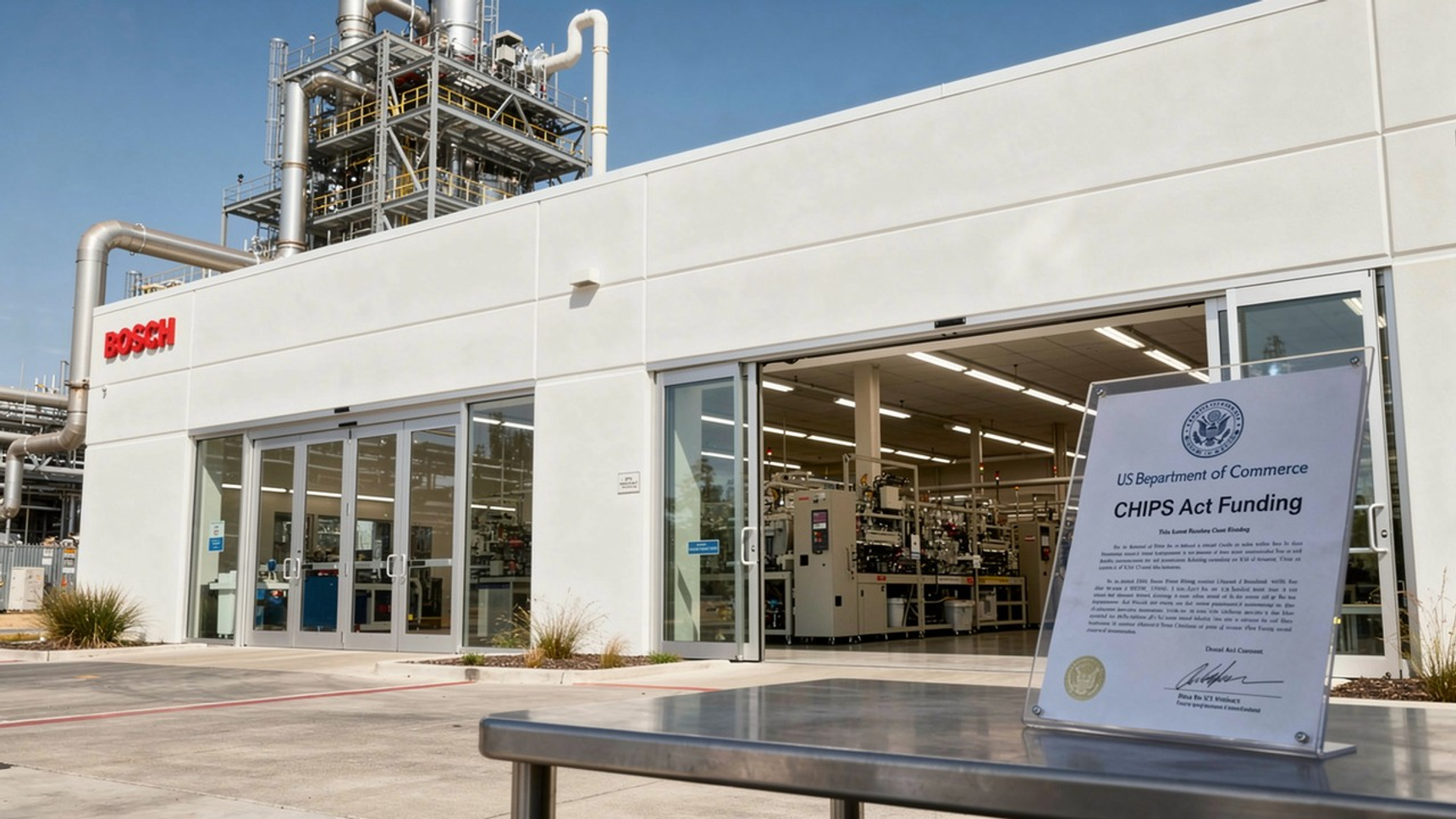
German automotive parts titan Bosch announced on the 13th that its first wholly-owned semiconductor factory in the United States, located in California, has officially commenced pilot production of silicon carbide (SiC) chips. The company has also reached a final agreement with the U.S. Department of Commerce to receive up to $225 million (approximately NT$7 billion) in federal subsidies. This move is seen as a significant milestone in the U.S. effort, driven by the Trump administration, to accelerate the reshoring of critical semiconductor supply chains.
Paul Thomas, President and CEO of Bosch North America, stated: “The start of pilot production and the agreement with the Department of Commerce represent a critical step in responding to our local customers’ long-standing demand for U.S.-based manufacturing.” The factory is expected to enter commercial volume production in the second half of this year, just three years after Bosch acquired the foundry from TSI Semiconductors in August 2023.
Under the plan, Bosch will invest up to $2 billion (approximately NT$64 billion) in total capital to completely renovate the existing facility in Roseville, California, transforming it into an advanced hub for SiC power semiconductor manufacturing. Secretary of Commerce Howard Lutnick noted: “The Trump administration is committed to building secure supply chains within the United States, ensuring the nation can continue to innovate and maintain competitive advantage in industries critical to economic and national security.”
SiC chips have become essential components for electric vehicles, industrial equipment, and data centers due to their superior tolerance for high voltage and high temperature, along with excellent energy conversion efficiency. Compared to traditional silicon-based chips, SiC can significantly extend EV driving range, accelerate charging speeds, and reduce system losses. As artificial intelligence (AI) applications drive surging energy consumption in data centers, the market outlook for high-efficiency SiC power components is drawing intense industry attention.
Bosch is deploying its third-generation SiC technology at the California fab, utilizing 200mm (8-inch) wafers for production. The company stated that compared to the previous generation, the new chips deliver up to a 20% performance improvement while featuring a smaller die size. Since launching its first-generation SiC chips in 2021, Bosch has cumulatively shipped over 60 million units to global customers, demonstrating formidable technical strength.
Notably, Bosch chose to revitalize an existing semiconductor facility rather than build from scratch, fully leveraging the site’s nearly four decades of chip manufacturing experience to significantly shorten the construction timeline. The Roseville facility currently employs over 300 workers, with room for expansion as production capacity ramps up. Bosch also announced that starting in 2026, it will invest over $100,000 annually (approximately NT$3.2 million) to support local STEM education programs, cultivating future semiconductor talent.
Bosch’s expansion is not limited to a single site. The company simultaneously unveiled a more ambitious North American blueprint, planning to invest up to $7.5 billion (approximately NT$240 billion) cumulatively across its U.S. operations by 2031, comprehensively strengthening its manufacturing and business footprint in North America.
In an interview with Reuters, Thomas specifically highlighted the impact of geopolitics and trade agreements on investment decisions. He pointed to the U.S.-Mexico-Canada Agreement (USMCA) as one factor driving Bosch to expand its U.S. semiconductor investments, emphasizing that automakers now prefer to partner with “geographically proximate companies that can provide stable, continuous supply.” Reflecting on the severe global automotive chip shortage during the COVID-19 pandemic, which exposed the risks of over-reliance on a handful of suppliers in Europe and Asia, automakers and suppliers are now aggressively pursuing localized production to mitigate the impact of high tariffs and geopolitical turmoil.
Liz Door, Ford’s supply chain chief, welcomed the move, stating: “We applaud suppliers taking action to localize production. A resilient supply chain is critical to the future of the automotive industry and advanced mobility technologies.”
Market analysts believe that Bosch securing federal subsidies and commencing pilot production not only marks a significant leap forward in U.S. self-sufficiency in the power semiconductor sector but also signals that, driven by dual demand from EVs and AI data centers, SiC chips are set to become the next strategic high ground in the global semiconductor race.