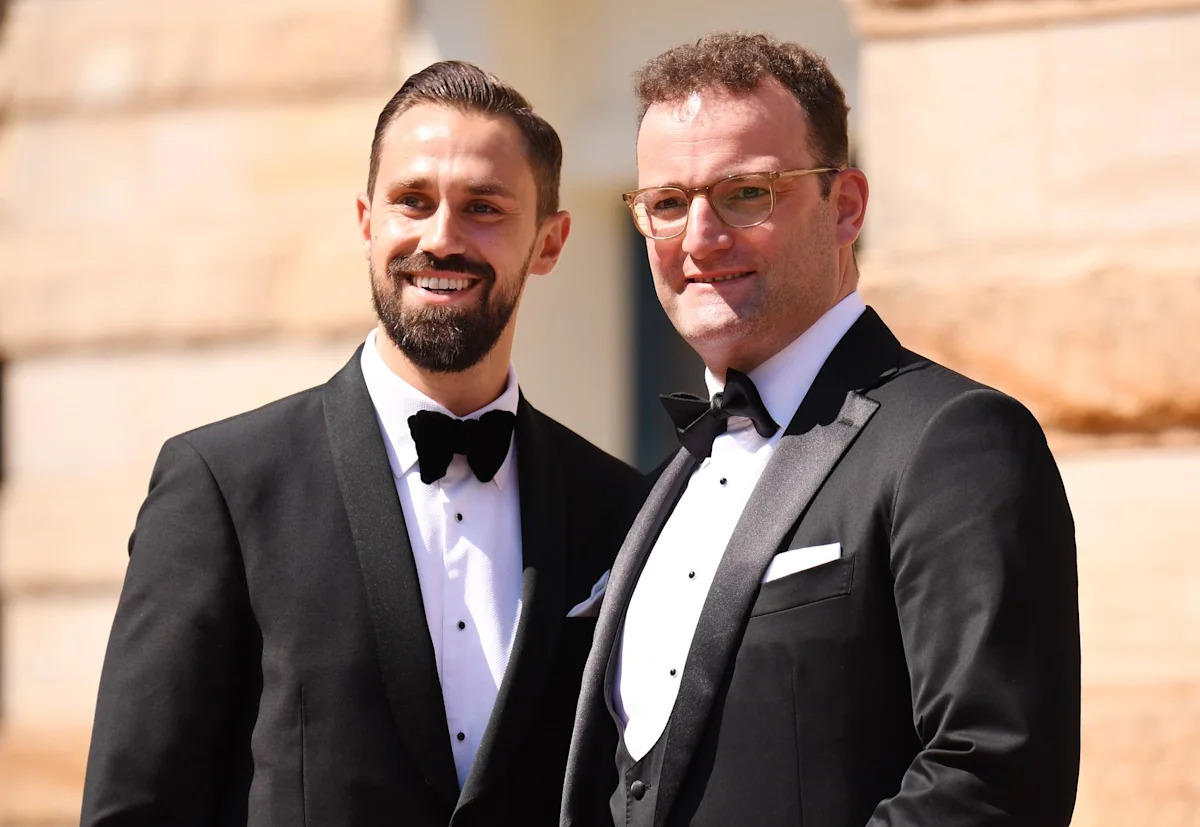
The head of the conservative parliamentary group in the Bundestag is under pressure following his revelation that he and his husband used a US surrogate mother, a practice that is illegal in Germany, to have a child.
After calls from his own party, the Christian Democratic Union (CDU), for him to resign, Jens Spahn said on Friday that his future is in the hands of his parliamentary group.
CDU leader Chancellor Friedrich Merz has said the CDU leadership would deal with the issue but has not offered an opinion as to whether Spahn’s personal decision is in line with CDU policies, which oppose surrogacy. Spahn heads the CDU/CSU parliamentary group, which also includes the Bavarian sister party, the Christian Social Union (CSU).
The CDU executive committee is to meet on Monday for a regular session and is expected to address the Spahn surrogacy. The parliamentary leader will attend the session, a spokeswoman for the CDU/CSU parliamentary group said. He hasn’t been a member of the executive committee since February, though usually attends as the CDU/CSU Bundestag leader.
Spahn says his fate is in the hands of party members
Spahn spoke from the United States in a Friday podcast with Bild tabloid deputy editor Paul Ronzheimer.
“I will of course discuss the question of what happens next with the parliamentary group when we see each other again in September,” the CDU politician said, when the faction’s next meeting is scheduled.
Asked whether he’d resign, Spahn repeated: “In the end, only the parliamentary group can decide how things go on.”
But he said days after becoming a father, “for me, and I realize this more and more with every hour, there is nothing more important than my family.”
Calls for resignation from the north
Spahn and his husband Daniel Funke announced on Wednesday that they had become parents. A surrogate mother in the US gave birth to the boy. There has been loud criticism in Germany because surrogacy is banned there – and because the CDU opposes legalizing it – as Spahn did in the past.
Critics speak of double standards
There has been a party uproar among some who see the CDU/CSU Bundestag leader as a hypocrite.
“Jens Spahn is no longer tenable as leader of the CDU/CSU parliamentary group and must resign,” Mecklenburg-Vorpommern CDU leader Daniel Peters told Bild.
By using a US surrogate to have a child, Spahn had “deliberately set himself above the law in force in Germany,” Peters said. Spahn was claiming the right to act differently as a private individual than he votes as a CDU office-holder.
“That is completely unacceptable,” Peters said.
Mechthild Heil, chairwoman of the group of women in the CDU/CSU parliamentary group, used sharp words in the Frankfurter Allgemeine Zeitung newspaper.
“Women must neither be bought for sex nor abused as incubators.” The CDU politician spoke of an “exploitative system between commissioning parents and surrogate mothers” and stressed: “I reject the buying of children and thus surrogacy.”
Long struggle
In the Bild podcast, Spahn said it wasn’t an easy decision.
“I struggled with myself for a long time, including on the issue of surrogacy. I was torn for a long time. But through that struggle and engaging with the issue, we decided on this path.”
As a Christian, he said there was on the one hand the “pure doctrine” and on the other “real life. And that sometimes it is not black and white and there are no easy decisions.”
What is banned in Germany is the brokering of surrogacy and the medical treatment as well as the implantation of an egg cell and the entire medical support of the process. “That is what is prohibited,” Spahn said. “Becoming parents or being a surrogate mother is not punishable.”
He said he was facing the political debate triggered by his fatherhood. “I just have to strike a balance,” he said. “It is and remains something very private. I want to protect my family.”
Spahn’s earlier stance on the issue
Spahn was health minister from 2018 to 2021. That meant the Embryo Protection Act was part of his portfolio.
In 2020, the ministry stated that no change was planned and said the rationale of the regulation barring surrogacy lay “primarily in safeguarding the child’s welfare.”
In 2015, GQ magazine quoted Spahn, then health policy spokesman for the CDU/CSU parliamentary group, as saying: “As a gay man and a Christian, I personally find it very difficult to come to terms with the idea of a rented womb. Accepting that I will not become a father in the natural way requires a great deal of humility. I do not know whether I can muster that.”
A political private decision
Along with Merz and Interior Minister Alexander Dobrindt, from Bavaria’s CSU, Spahn is one of Germany’s most powerful conservative politicians. After initial difficulties, he recently consolidated his position with a good showing in his re-election. He is also credited with having put together the recent reform package.
But things are heating up again. It is unclear whether someone so high in the CDU ranks can separate politics from the private. His decision to have a child with a surrogate cannot be reversed so his two options are: stay in office with his credibility significantly damaged or resign.
Has Spahn misjudged?
Spahn says he has a thick skin and he’s faced controversies before.
“It takes quite a lot to knock me down,” the CDU politician said some time ago in a podcast. He sat out the affair over mask purchases during the Covid-19 pandemic during his time as health minister. He once described the pressure then as one of the two most intense situations of his time in office. The other was the failed election of a Constitutional Court judge a year ago, when he underestimated resistance in his parliamentary group and plunged the coalition into crisis.
Now Spahn may have misjudged again. It is striking that initially no one from the CDU’s top ranks has jumped to his side.
Merz dodged a question about it during a Thursday press conference with the visiting Algerian president. He said he’d only been informed last Friday about the child and that he’d congratulated Spahn and his husband.
“He congratulated us,” Spahn told the podcast. “He was initially personally happy for us. But of course we also talked about the fact that this is not an easy starting point.”
On Friday, Merz again faced questions at a press conference with French President Emmanuel Macron. Merz said he was aware that this issue moved many people in Germany on a human, legal, social and ethical level.
But he offered no opinion, only saying that there is “a clear legal situation in Germany” and he doesn’t see that changing but it will be discussed at the next meeting.