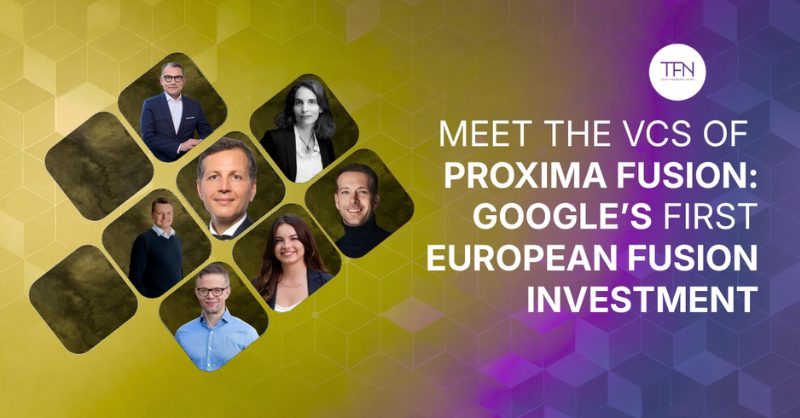
When Google backed Proxima Fusion’s €411 million round, it marked the search giant’s first investment in a European fusion company. But the investors who backed the company say that is not the story. The financing structure behind the money is.
Proxima Fusion finished the round with a €2.4 billion valuation, making it Europe’s best-funded fusion company. XTX Ventures and East X Ventures led the investment, while RWE and Google joined as strategic investors, along with KfW Capital, SPRIND, Burda Principal Investments, and SKion.
Previous investors such as Plural, UVC Partners, Balderton, Cherry Ventures, DST Global Partners, Brevan Howard Macro Venture, Lightspeed, DTCF, redalpine, Leitmotif, Elaia, CDP Venture Capital, Bayern Kapital, and the EIC Fund also participated.
The round caps a period of rapid capital accumulation. In June 2025, Proxima closed a €130 million Series A led by Cherry Ventures and Balderton Capital, and three months later, extended it to €200 million, with CDP Venture Capital joining.
Since spinning out from the Max Planck Institute for Plasma Physics in 2023, Proxima has raised over €650 million, including €95 million in public grants.
The mechanism behind the money
This round was different from a typical growth round as it was set up to unlock public funding. In February, the Free State of Bavaria agreed to provide up to €400 million in public funding to Proxima, RWE, and the Max Planck Institute for Plasma Physics, but only if Proxima first raised the same amount from private investors.
Proxima met this goal in three months, with the €411 million round going beyond the target.
Jörg Goschin, chief executive of KfW Capital, the German state development bank, says the structure acts as a bridge over the “valley of death” between publicly funded research and market-ready growth. He points out that this is different from a subsidy.
“Our co-investment alongside private lead investors serves as a powerful de-risking signal — it validates Proxima’s business case and crowds in additional private capital,” Goschin says.
Cristina Doumitrachko, associate at DTCF, which invested alongside sister platform HTGF, one of Proxima’s earliest backers, noted that the Bavaria commitment shifted investor focus.
“This is no longer a question of whether the project finds backing. It’s a question of execution,” she says.
Why the venture money followed
Public support explains the structure. Yet, it does not explain why venture firms without a state mandate returned through five consecutive rounds.
Benjamin Erhart, partner at UVC Partners and Proxima board member who co-led its 2023 pre-seed round, said underwriting Proxima required abandoning the firm’s usual risk model.
“With Proxima, we had to underwrite scientific and engineering risk against a capital plan measured in hundreds of millions of euros, years before any commercial product existed,” he shares.
Harald Nieder, general partner at redalpine, which led the seed round, points to several external validations that have strengthened the firm’s commitment. For example, MIT fusion researcher Dennis Whyte called Proxima’s Stellaris design paper the most important development in fusion technology since the tokamak breakthrough ten years ago.
“Our conviction continues to deepen at each stage,” Nieder notes.
Anne-Sophie Carrese, managing partner at Elaia, which joined the 2025 round, says the team’s execution matters more than theory.
“We’ve been very impressed by the execution of the management team since our first investment, that we are standing by our conviction in their vision for the future of energy by continuing to partner with Proxima in this recent fundraising round,” she says.
Filip Dames, founding partner at Cherry Ventures, which co-led the Series A and joined this round, links the technical case to government support. He points out that Proxima is building its Alpha demonstrator at a former nuclear fission site in Gundremmingen, using the existing grid connection rather than building new infrastructure.
“When government tailwind and a two-and-a-half-year head start on the technology line up like that, it’s an easy re-up,” Dames concludes.
CDP Venture Capital, Italy’s state-backed venture arm, adds a similar logic from outside Germany. It joined Proxima at the €200 million Series A extension and returned for this round.
Alessandro Scortecci, the fund’s Direct Investments Director, tied the investment to industrial access as much as returns: Proxima has committed to opening an R&D centre in Italy, and CDP has already connected the company to Suprema, a portfolio company that makes the high-temperature superconducting tape used in Proxima’s magnets.
“Energy costs significantly impact a company’s cost of production, hampering competitiveness and growth” across Italy and Europe’s manufacturing base, Scortecci said, calling commercial fusion “the most important enabler of the global economic transformation we’re living in.”
The new money’s read
Burda Principal Investments, a first-time strategic investor in this round and typically a media and consumer technology firm, sees its involvement as part of a larger plan to support capital-intensive technologies. This includes companies like green steel producer Stegra and sustainable materials firms Planet A Foods and Uluu.
“For us, this is less an infrastructure play and more a technology breakthrough in the making,” the firm stated, anticipating that larger infrastructure investments will follow once the technology overcomes its remaining challenges.
Google, RWE, XTX Ventures and East X Ventures did not respond to requests for comment.
What comes next
The financing meets Proxima’s current needs, but it raises a question: Will Germany’s approach, which requires state commitment matched by private capital, independent technical milestones, and support from a development bank investing on commercial terms, become a model for others or stay unique?
Nieder and Doumitrachko both described it this way: It was not a subsidy that made Proxima’s numbers work, but a structure that allowed private investors to take on risks they otherwise could not. That question, how Europe turns public research into private capital formation, sits at the centre of the continent’s deeptech debate.
The model still has open variables. Germany’s portion of the Bavaria memorandum depends on roughly €1.2 billion in federal funding that has not yet been committed. Proxima’s next hardware milestone, which is completing its Stellarator Model Coil in 2027, will test the technical side. Whether Berlin commits the federal portion this year will test the financial side.
The answer will show whether this is a blueprint for European deep tech or a one-off made possible only by the specific alignment of Bavaria, RWE, and the Max Planck Institute.