While dazzling on-pitch battles have captured World Cup viewers across the globe this summer, the world’s biggest sportswear brands are competing fiercely off the field to woo spectators and sell gear to valuable and growing markets in North America and abroad.
Nike and Adidas, the world’s two marquee sportswear companies, teed up the 48-team tournament as a significant opportunity to further their footholds in soccer. Both invested heavily.
The stakes are high. Nike, Oregon’s largest homegrown company, is looking to mount a comeback after years of lagging sales and earnings. Adidas, with a North American headquarters in Portland, is historically ascendant in soccer and is looking to build on recent sales momentum. Both companies are betting that sales bursts spurred by the first North American World Cup since 1994 will expand the overall market and translate to revenue growth for years to come.
“The engagement around this tournament has been unprecedented, which is great because it creates more touch points for consumers to fall in love with the game,” said Camilo Andrade, general manager of soccer and a global vice president at Nike. “It’s what we do to sustain the momentum, because the momentum is definitely here.”
Chris Murphy, a two-decade Adidas veteran and its senior vice president of brand marketing in North America, put a finer point on it: “You cannot overstate how important this World Cup is to us as a company.”
Since the last American World Cup, the once-faraway sport of soccer has exploded in viewing popularity and participation in the United States. The fanbase has grown considerably, particularly among the key youth demographic where both companies are seeking to build loyalty. Global stars like Lionel Messi, Sam Kerr and Thomas Müller fill rosters in U.S. men’s and women’s professional leagues, stoking passion for the game and its related paraphernalia.
 Argentina players toss teammate Lionel Messi — an Adidas athlete who plays in Major League Soccer — into the air as they celebrate a round-of-16 win over Egypt on July 7, 2026. Messi, who wears custom Adidas cleats, is a powerhouse name signed to the brand.AP Photo/Jacob Kupferman
The World Cup, as the companies are acutely aware, is the most widely watched sporting event in the world, reaching billions of fans.
“There are so many more brands out there. Consumers just don’t pay attention in the way they used to,” said Ian Parkman, a marketing professor at the University of Portland. “The World Cup becomes one of these massive opportunity moments to cut through all that and say something about your brand.”
For both companies, it provides a unique marketing platform and a surfeit of viral opportunities. For Nike, in particular, it’s a chance to turn the page on recent woes.
“The stakes are higher for Nike,” said Poonam Goyal, a senior e-commerce and retail analyst at Bloomberg Intelligence. “They have a bigger point to prove, especially to investors.”
Last month, Nike reported flat annual sales, with some signs of progress, as second-year CEO Elliott Hill continues to push a turnaround plan after an extended period of decline. North American sales were a bright spot, climbing 3% to $4.8 billion in the quarter.
“We’re not treating the tournament as a single moment,” Hill said on the earnings call. “We’re using it to reshape our business, telling a connected story over time, engaging different communities in relevant ways and building momentum that carries well beyond the tournament.”
The U.S., it turns out, is the biggest foreign market for Europe’s four largest soccer leagues. At the 2022 World Cup, the American viewing market accounted for 15% of total rights spending, according to The Economist. Both companies are looking to cement their brands in the buoyant market by channeling cultural ties to the sport.
But the swoosh won’t appear in the final, as both Argentina and Spain (and their respective Adidas-signed stars, Messi and 19-year-old sensation Lamine Yamal) are outfitted in Adidas jerseys, guaranteeing the brand’s visibility no matter who wins.
Heading into the summer, Adidas and Nike poured tens of millions of dollars into the tournament. Adidas, a longtime official FIFA partner, entered the tournament on a high. CEO Bjørn Gulden, himself a former professional soccer player, was fresh off a quarterly earnings call in which the company reported 14% revenue growth.
Adidas pays an estimated $150-200 million per cycle for FIFA partnership rights, according to Sports Business Journal. It sponsored 14 World Cup teams, and its three-stripe logo appears on the tournament’s official “Trionda” ball. Nike wasn’t far behind, sponsoring 12 teams. But in keeping with its guerilla marketing ethos, it eschewed the big deal with FIFA and went all in on player endorsements and a cinematic ad campaign.
“Both Adidas and Nike showed us early on through their marketing campaigns that what they were trying to do was show the fans: ‘Hey, we get soccer like you do. We’re steeped in it,’” said Matt Powell, a senior advisor at BCE consulting.
Adidas’ “Backyard Legends” campaign features Timothée Chalamet, Bad Bunny and a cast of big-name stars — Messi, French superstar Zinedine Zidane and U.S. women’s Trinity Rodman — playing street soccer in New York City.
“It’s a global ad, it’s meant for a global audience,” Murphy said. “But it is very much rooted in North American culture.”
Adidas channeled the design of past World Cup winners for some of its jerseys, including those of Germany and Argentina. The company reintroduced its alternate Trefoil logo for the first time since the 90s and outfitted stars with custom versions of classic cleats.
 Colombia’s Luis Diaz, sponsored by Adidas and wearing a bright-yellow jersey by the German company, clutches onto the Adidas-made match ball during a group stage game against Portugal on June 27, 2026. Adidas spent heavy to put its logo all over the tournament.AP Photo/Rebecca Blackwell
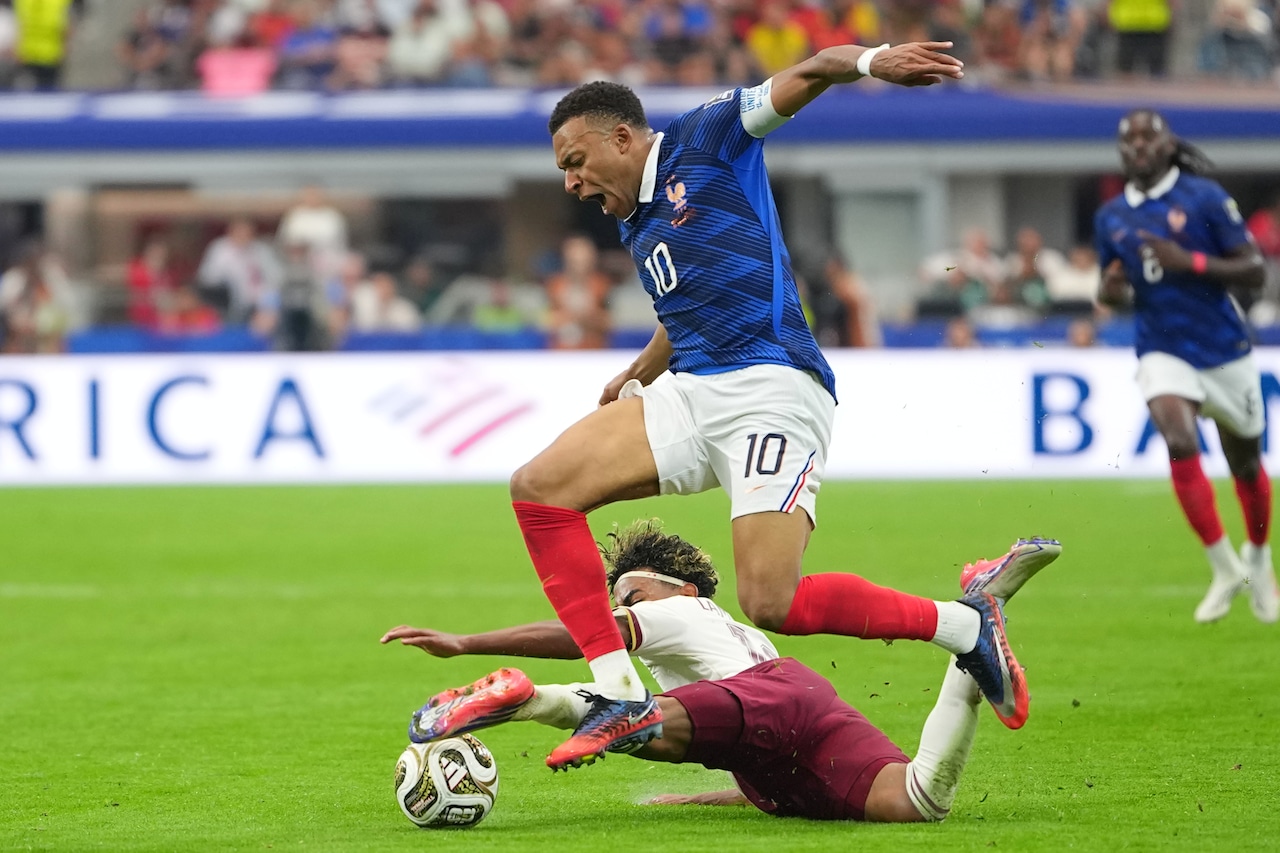
Not to be outdone, Nike’s “Rip the Script” campaign featured over 30 soccer stars, actors and youth footballers “ditching the playbook.” In the ad, LeBron James, Travis Scott, Kim Kardashian and Jason Sudeikis’ Ted Lasso spectate as France’s Kylian Mbappe and other Nike-sponsored athletes spark a hectic pick-up soccer game on a Hollywood set.
Nike also made an effort to include its lifestyle brands in the tournament’s football frenzy. Brazil’s team was part of a collaboration with the company’s iconic Jordan brand, and the Drake-Nike collab, Nocta, made gear for Canada’s team.
“It’s definitely a concerted effort by both brands to merge performance and lifestyle products,” said Tom Nikic, a senior analyst at Needham & Company.
If YouTube impressions are the metric that counts, Nike is winning. Its “Rip the Script” video has almost 80 million views and nearly 500,000 likes on YouTube as of Friday, while Adidas’ “Backyard Legends” scored 8.4 million views and nearly 300,000 likes.
“But at the end of the day, those impressions need to convert,” Goyal said.
While Adidas leaned on its heritage in the sport and the teams it sponsored, Parkman said, Nike’s approach centered on its individual stars and their personalities.
“I don’t know if Nike really changed the way that consumers think about them, and this was an opportunity to do that,” he said.
Nike signee Erling Haaland, Norway’s Viking striker, became a breakout star and social media phenom this summer as he rowed his way through the tournament in Cactus Jack cleats. The Nike-sponsored U.S. men’s team also attracted unprecedented attention on home turf until its red card controversy and subsequent flameout against Belgium. Nike reportedly underestimated demand and sold out of some U.S. and Norway jerseys early.
 In an all-Nike display, Norway’s Erling Haaland powers his way through a pair of Brazilian defenders during the round of 16 on July 5, 2026. Both Haaland, who won over the internet, and Brazil, which at one point wore a jersey made by Nike’s Jordan brand, were focal points for the Oregon company’s marketing campaign.Andrew Mills | NJ.com
Adidas embraced storefronts and live events, including a celebrity-filled pop-up in New York City and watch parties hosted by Major League Soccer clubs, including the Portland Timbers at Pioneer Courthouse Square. Nike did, too, hosting Toma street football tournaments in a handful of cities and viewing events — including watch parties in Portland presented by Prost! and Tursi Soccer.
“Our job was to make sure that we created a universe that could actually invite people in different ways and that could promote engagement differently,” Andrade said.
A mid-tournament report from Telsey Advisory Group and other market research suggest Adidas capitalized the most on World Cup merchandise sales. The company said it has sold four times as many jerseys and double the number of balls compared to World Cup 2022, and expects its event-related sales totals to hit around $1.7 billion.
Pre-tournament, Nike said it sold 2.5 times as many national team kits as it did in the same period before the 2022 World Cup. While its logo won’t appear in the final, Nike outfitted six of the teams that made it into the tournament’s round of 16, versus five for Adidas. Nike also continues to tout the fact that it will replace its Bavarian competitor as Germany’s jersey producer next year.
Looking ahead, executives at both companies see the World Cup as a starting point to further momentum within the sport.
 Two young viewers — one in a Nike-made United States men’s jersey, the other in an Adidas Portland Timbers kit — among the 20,000 gathered at Providence Park to watch the U.S. play Belgium in the round of 16 on July 6, 2026. For Nike and Adidas, the growing American soccer audience is key.Mark Graves/The Oregonian
Both are deeply invested in the American soccer market. Nike makes jerseys for the National Women’s Soccer League, while Adidas has an exclusive kit deal with MLS. Both are banking that the sport’s growth will translate to more customers, youth players and casual fans looking to purchase apparel and cleats.
“All this great fandom that the World Cup generates, we’re ready to transition that right into viewership for MLS,” Murphy said.
Next year, the women’s World Cup will go to Brazil. Rumors are swirling around another U.S.-hosted Copa America in 2028, while the 2028 Olympics will also be held in the states. Then, it’s another women’s World Cup in North America in 2031.
“We’re seeing not just a moment,” Andrade said, “but a decade that will help us accelerate.”