
BERLIN, Germany (AP) — The suspect in the deadly Berlin Pride attack that left one person dead and 29 injured was shot and killed by police during a confrontation in a suburb of the city, authorities said Sunday evening.
Abdul Ballout, a 21-year-old German citizen with Lebanese roots, was killed following a search that lasted nearly 24 hours after the attack in downtown Berlin. Prosecutors said he had previously sought to join the militant Islamic State group.
He is suspected of driving a van into a crowd the night before near Berlin’s Pride festival, killing one person and injuring several people before apparently stabbing others with a machete in what authorities believe was an Islamic extremist terror attack.
Ballout was tracked down around 6 p.m. Sunday at a garden in Spandau, a Berlin suburb, the city’s police department wrote on X. They said he apparently ran toward officers with a sharp instrument, and police fired at least one shot. He died at the scene.
“Everything we see here points to us dealing with an Islamic terror attack,” Interior Minister Alexander Dobrindt said before the suspect was found and killed.
Get The Times of Israel’s Daily Edition
by email and never miss our top stories
By signing up, you agree to the terms
Dobrindt put the total number of wounded at 29. The attack occurred a few hundred yards from a party near the Brandenburg Gate that was supposed to close out the city’s Pride festival.
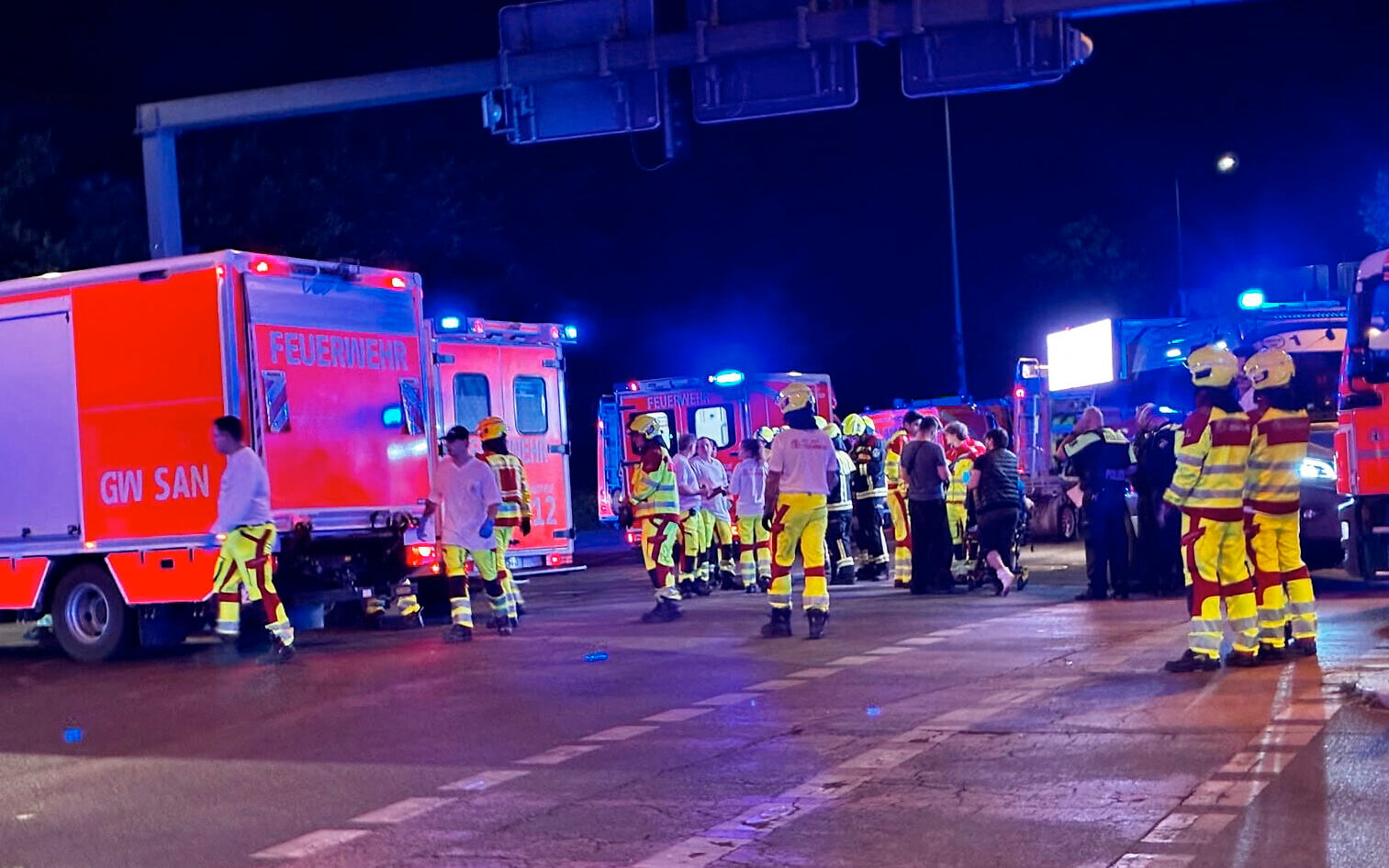
Police and security personnel work near the scene where several people were injured in a potential car-ramming on the sideline of the Christopher Street Day (CSD) parade in Berlin, Germany, on July 25, 2026. (Antoine LAMBROSCHINI/AFP)
Dobrindt said the suspect had come to authorities’ attention in the past because of numerous previous crimes, of which he did not give details, and also because of “radicalization and belonging to the Islamist scene” in the German capital.
Suspect was previously arrested for ISIS support
He said Ballout was born in Germany, and that his mother was naturalized in 2002 — three years before he was born.
Dobrindt said the suspect had been convicted in Berlin in the past, though he did not specify for what. He said that he had been given a suspended sentence of 1 year and 10 months.
Ballout traveled to Lebanon in 2025 with the goal of going to Syria to join the Islamic State group, Berlin prosecutors said Sunday.
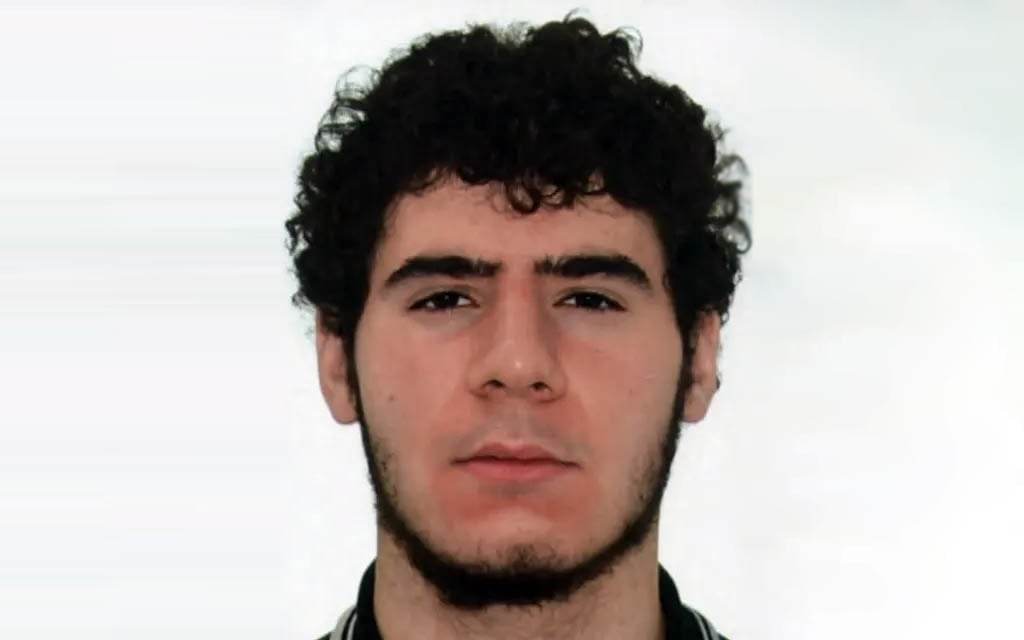
A photo released by Berlin police shows Abdul Ballout, the 21-year-old suspect in a deadly attack near the Berlin Pride Festival on July 25, 2026. (Berlin Police)
There, he made contact with several people who were presumed members of the militant group — or at least he believed them to be, prosecutors said. He was arrested in Lebanon last year and sentenced by a military court to three months’ imprisonment for offenses including incitement to religious and sectarian conflict.
He returned to Germany after completing his sentence, where he was arrested at the Berlin airport.
In May, a juvenile court in Berlin convicted Ballout of preparing a serious act of violence endangering the state, as well as publishing Islamic State propaganda on his Instagram account and other charges, prosecutors said.
The court handed down a suspended sentence of 1 year and 10 months in youth custody, which Berlin prosecutors had appealed.
The court said it took Ballout’s months of pre-trial detention in Germany and Lebanon into account. It also said it considered that Ballout had confessed to the crimes, appeared to distance himself from the militant group and no actual threat had ever materialized.
He was released from detention pending the appeal.
Berlin event is one of Europe’s largest Pride celebrations
According to police, a white van drove into the Tiergarten park around 10 p.m., and hit several people before colliding with a tree. The closing party at the Pride festival, known as Christopher Street Day, was ongoing at the time next to the Brandenburg Gate, a short distance away. The party followed a parade with some 80 trucks that had made their way through downtown Berlin earlier in the day.
The attack did not occur at the festival, along its route or at the closing party. Rather, the violence took place nearby on a track in the Tiergarten park. The van drove into a crowd that was likely a mix of festivalgoers and other locals or visitors.
Police said a woman was killed. Berlin’s fire service said that three people sustained life-threatening injuries and another eight were seriously injured.
The Pride event next to the Brandenburg Gate was called off around 10:15 p.m., and a band’s performance on stage was interrupted. People were urged to go home and to avoid taking the route through the park.
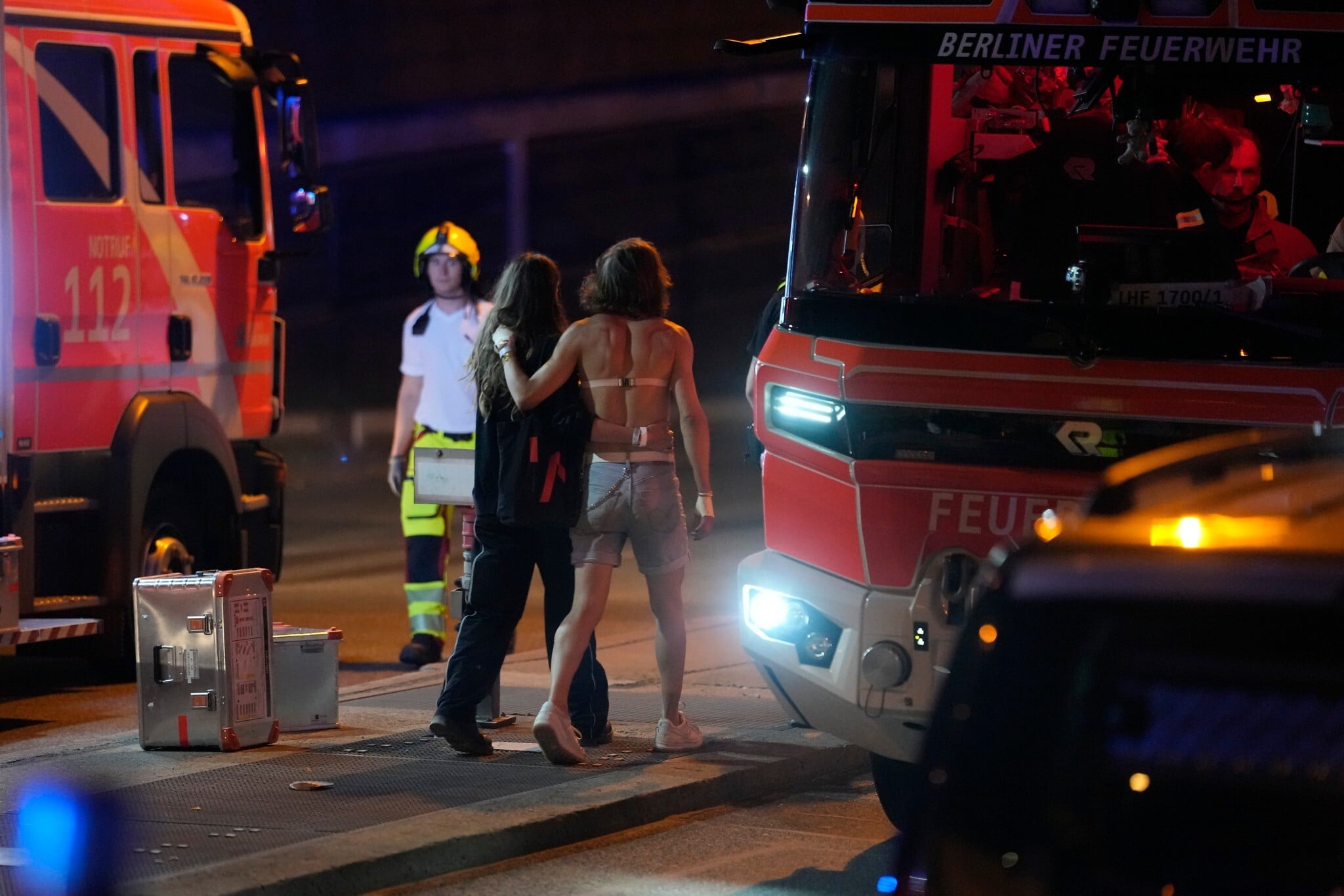
Two people walk together past emergency personnel in Berlin, early July 26, 2026, following the cancellation of Christopher Street Day festivities. (AP Photo/Markus Schreiber)
On Sunday afternoon, hundreds of mourners gathered at a memorial at the iconic gate. They hugged each other and laid down flowers, candles, rainbow flags and homemade signs, including a cardboard one that said: “The only thing more powerful than hate is love.”
Hundreds of thousands had come to Berlin to celebrate on Saturday, though it is unclear how many were still at the festival by late evening. It is one of Europe’s largest LGBTQ+ celebrations.
The van, with its battered front resting against a tree, could still be seen at the scene Sunday morning.
“We are simply stunned by what happened,” said Andre Lehmann, a top official with the main national LGBTQ+ association, LSVD+. “This suspected attack hits the heart of the queer community.”
Chancellor Friedrich Merz vowed that law enforcement would find the suspect.
“I would like to say this to Christopher Street Day participants here in Berlin but also across Germany: Don’t let yourselves, let us not let ourselves, be intimidated,” he said. “These acts have only one purpose: They aim to divide our society. They want to take away from us the most important thing we have: namely, our openness and our freedom.”
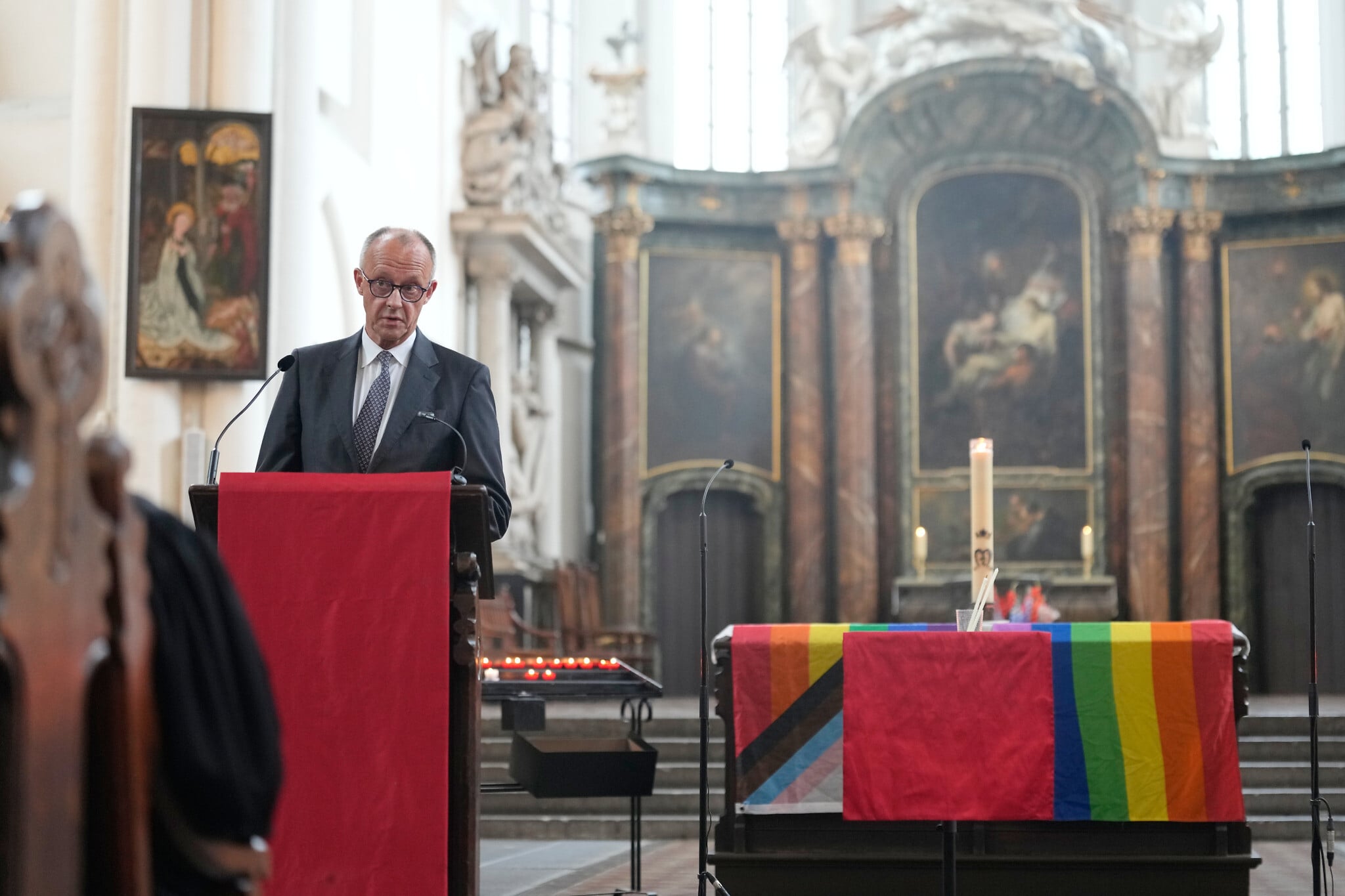
Chancellor Friedrich Merz speaks at a vigil for victims in the Pride March attack at St. Marien Church in Berlin, Germany, July 26, 2026. (AP Photo/Markus Schreiber)
Dobrindt said he expected security measures at other major events in Germany, including Pride events elsewhere, to be reviewed and if necessary significantly strengthened.
He pointed to concern about possible copycat crimes, adding that “this is not typical of such situations, but it also can’t be ruled out.”
Berlin has seen Islamic extremist attacks before. In December, 2016, a rejected asylum seeker from Tunisia plowed a hijacked truck into a Christmas market, killing 13 people and injuring dozens. He was killed days later in a shootout in Italy.
In February last year, a Spanish tourist was stabbed and seriously wounded at Berlin’s Holocaust Memorial. A Syrian man was convicted in March and sentenced to 13 years in prison.
Saturday’s violence “is suspected to be an Islamist terror attack on our way of living together, on our liberal democracy, on our openness and our freedom,” Wegner said.
We can’t do this work alone.

The war with Iran has been draining for all of us in Israel. But when I heard about a high casualty incident – ballistic missile impacts in Arad and Dimona that left nearly 200 people wounded – I drank a cup of coffee, packed a bag, and headed south.
There, I spoke with Shilgit, the head of an after-school program for underprivileged youth. Standing outside her destroyed center, Shilgit said it was a miracle that no children were hurt and spoke about the community coming together in the hours since.
As a Times of Israel reporter, I’m committed to telling stories of resilience like Shilgit’s. But my colleagues and I can’t do this alone. If you value work like this, please consider joining our reader support group, The Times of Israel Community. Your financial support is essential to keep real human reporting like this going.
— Stav Levaton, military reporter