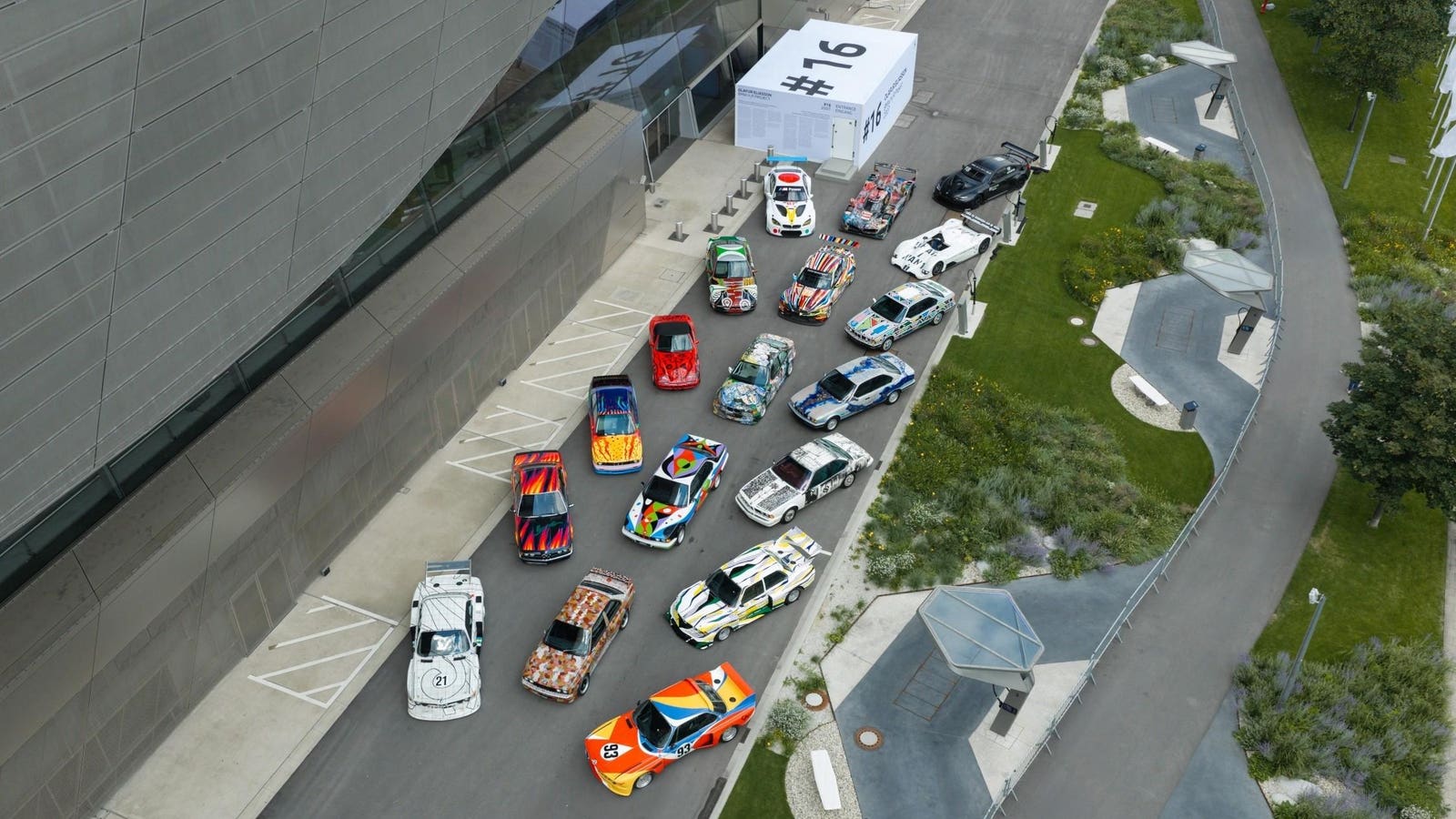
BMW Art Car Collection in front of BMW Welt in Munich
Photo courtesy of BMW AG
The story of the BMW Art Cars has been told many times, but never quite like this. More than 50 years after a painted racing car first thundered onto the grid at the famous 24 Hours of Le Mans race in northwestern France, every one of BMW’s 20 Art Cars—from legendary American sculptor Alexander Calder’s pioneering 3.0 CSL to Ethiopian-American abstract painter Julie Mehretu’s M Hybrid V8—are united for the first time under one roof at BMW Welt in Munich. On view through Aug. 31, the event is the largest and most significant exhibition in the collection’s history.
The groundbreaking show concludes the BMW Art Car World Tour, which has traveled to more than 60 venues across over 30 countries on five continents since March 2025, attracting upwards of 2 million visitors and underscoring the collection’s status as one of the defining combinations of contemporary art, motorsport and industrial design. Yet the exhibition is about far more than seeing celebrated masterpieces by the likes of Frank Stella, Roy Lichtenstein, Andy Warhol, Robert Rauschenberg, David Hockney, Esther Mahlangu, Jenny Holzer, Jeff Koons and Cao Fei side by side. It also brings together remarkable stories: of Hervé Poulain, a French auctioneer and amateur race car driver with an improbable idea, Jochen Neerpasch, a visionary BMW motorsport director willing to embrace it, and generations of artists who transformed automobiles into cultural icons.
BMW Art Car #3 by Roy Lichtenstein, BMW Art Car #1 by Alexander Calder and BMW Art Car #2 by Frank Stella at the BMW Art Cars exhibition at BMW Welt in Munich
Photo courtesy of BMW AG; Alexander Calder, BMW Art Car © 2026 Calder Foundation, New York / Artists Rights Society (ARS), New York; Roy Lichtenstein, BMW Art Car © Estate of Roy Lichtenstein / VG Bild-Kunst, Bonn 2026; Frank Stella, BMW Art Car © VG Bild-Kunst, Bonn 2026 (07/2026)
“The first BMW Art Car project in 1975 was not a strategic planned marketing project. It just happened by accident,” recalls Jochen Neerpasch, co-founder and former director of BMW Motorsport, who received a call from then BMW rally driver Jean Todt presenting him with Poulain’s idea. Neerpasch immediately recognized that Calder’s involvement could turn a racing machine into a rolling sculpture, in the same way as the artist’s kinetic mobiles, and create a “happening” that united “art, technology and speed”. Calder himself said, “Why must art be static? The next step in sculpture is motion.”
That spirit of fearless experimentation continues to resonate through the collection, from Warhol’s electrifying 28-minute performance painting and Lichtenstein’s Pop Art meditation on endurance racing to Hockney’s playful deconstruction of the automobile that allows the interior to be seen and Olafur Eliasson’s rarely exhibited hydrogen-powered H2R Project wrapped in a complex skin of steel mesh, shiny metal plates and multiple layers of ice that’s presented in a freezer, which challenged the very definition of what a BMW Art Car could be.
BMW Art Car #16 by Olafur Eliasson
Photo courtesy of Studio Olafur Eliasson and BMW Group
As Thomas Girst, Global Head of BMW Group Cultural Engagement, explains, the BMW Art Car collection’s enduring significance lies not simply in the caliber of its artists, but in the extraordinary collaborations that have continually pushed the boundaries between art, engineering and innovation—ensuring that this once-in-a-lifetime reunion ranks among the most important cultural events of 2026. I sit down with Girst as he reflects on the visionaries, masterpieces and moments that transformed painted racing cars into one of the world’s longest-lasting art and automotive partnerships.
This summer, all 20 BMW Art Cars are gathered under one roof for the first time. Among the artists—from Alexander Calder and Andy Warhol to Julie Mehretu—which collaborations surprised you the most?
It’s surprising to see that anything can happen when it comes to a BMW Art Car. Andy Warhol was a great surprise because he painted the car, which some consider to be the most valuable car on planet earth. He was always about wanting to turn into a machine. He called his studio in New York “The Factory”. He wanted to get rid of the hand. That’s why he invented the silkscreen process as a work of art. Then he was confronted with an industrial design object, and, all of a sudden, he created this choreography, dancing around the car, painting the car, signing the car onto the wet paint with his fingers, becoming a human again vis-à-vis the machine that he actually always said he aspired to be. Olafur Eliasson was a surprise and it wasn’t an easy sell within the company because the first thing he did was to rip out the BMW logo from the H2R hydrogen car to turn it into something else completely. Julie Mehretu was a surprise because she was eager to also return something to the continent of Africa in which she was born, so she not only created a BMW Art Car, but on top of it, came up with the African Film and Media Arts Collective with workshops around the African continent about documentary filmmaking. So it’s all about honoring the artist’s vision and making true whatever it is that they have on their minds, far exceeding the car itself from time to time. That is definitely the biggest surprise—that there’s no limit to artistic excellence.
BMW Art Car #12 by Esther Mahlangu, BMW 525i, 1991
Photo courtesy of BMW AG
Luxury brands increasingly collaborate with artists, yet very few partnerships remain culturally relevant after half a century. Why have the BMW Art Cars endured?
I absolutely agree with your assessment that much of those partnerships of luxury brands end up on the side of bling-bling and not on the side of meaning, which is very important. I would argue that luxury really has to do with the time that we are able to devote to a subject matter that is of interest to us, and that, as the sociologist Hartmut Rosa defined, creates a resonance—a resonance with another human being, a resonance with a work of art. That is what makes living worthwhile. That is what adds depth and meaning to life. If collaborations between luxury brands and the arts can achieve that, that is something great because it opens up a discourse and a dialog for everybody who is interested in looking, who is interested in delving into something that shows how great human beings can create amazing works of art that resonate if we put our heads together and if we don’t bash our heads in.
So what has prevented the BMW Art Cars from becoming mere marketing objects?
BMW Art Cars are always a great collaboration: a co-creation of sorts between the artist and his or her vision and our engineers, designers, mechanics, those in the pit stop, the race car drivers and everything else. It brings out the best in everyone. And I think that is what has prevented the BMW Art Cars from becoming mere marketing objects. It’s also about that they’re not there to support the launch of a new model, that they’re not there to be churned out every year. Sometimes there are nine years between one Art Car and the next, and I think that adds some trustworthiness to the whole trajectory of the BMW Art Cars, with 20 BMW Art Cars having been created in 50 years.
American artist Alexander Calder with Hervé Poulain, a French auctioneer and amateur race car driver
Photo courtesy of BMW AG
Looking back, how important was the original vision of Hervé Poulain and Jochen Neerpasch?
There’s the idea of the BMW Art Car nucleus that wasn’t born out of PR and marketing people putting their heads together, thinking how can we introduce the brand BMW to the arts. It came out of the true passion and love of two men, Hervé Poulain and Jochen Neerpasch, our motorsports director and founder, who put their heads together at the racetrack of Le Mans, thinking of what they could do together by having a car painted that would then race within the BMW fleet.
So it was about the love for racing and the love for contemporary art, and I’m so happy that Jochen Neerpasch said yes to Hervé Poulain’s idea and suggestion over 50 years ago. Nobody thought that the BMW Art Car series would evolve around this amazing initial idea. The 3.0 CSL by Alexander Calder was supposed to be a one-off, but as it was cheered on by the crowds, parents, children and everybody else on the racetrack, we thought we had something and we continued—obviously the next year already with Frank Stella, then with Roy Lichtenstein, then with Andy Warhol.
Fifty years on, what do the BMW Art Cars ultimately represent?
We have a responsibility looking into the future of not watering down what I would refer to as a sub-brand of BMW. It still makes everybody happy to look at these BMW Art Cars, to look at these great achievements of artistic and engineering excellence. I think what is important is that it’s not only about arts and culture; it’s about engineering, mechanics, racing, art, design, lifestyle—all of this coming together with the BMW Art Cars at the intersection of exactly those different realms of human achievement, which makes them stand out, which makes them make a difference. I do think that is what ultimately turns them into something of value, if not monetary value, then value in terms of true meaning, in terms of seeing the object of the car through the art and seeing the art through the car, something that will resonate in centuries.