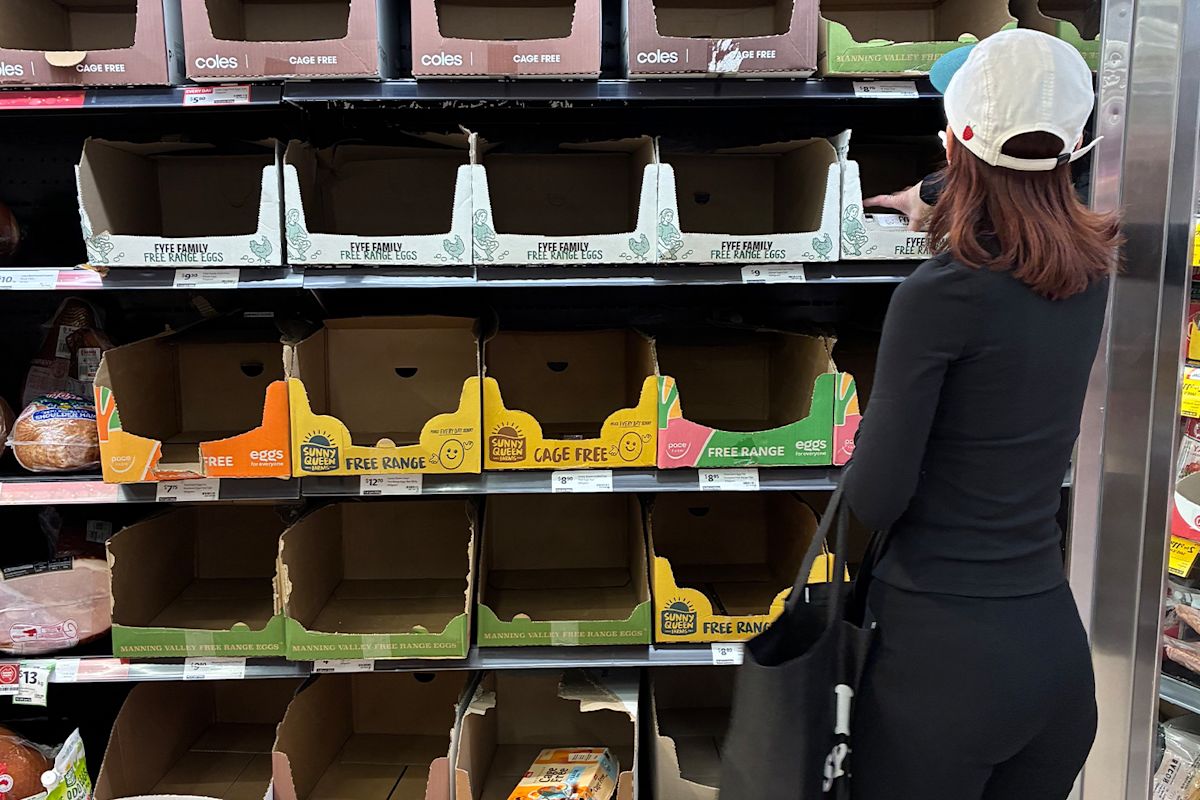
Aussie egg farmers say they’re “prepared” for the spread of H5 bird flu, because they’ve been “closely watching” how overseas markets have reacted to the virus.
But one industry leader warns some supermarket chains could still be vulnerable to supply disruptions.
The Victorian Farmers Federation Egg Group President, Brian Ahmed, looks to recent history, when outbreaks of the H7 strain of the virus in 2024 and 2025 left shelves empty at Coles, Woolworths and Aldi, and purchase limits were imposed.
But at the same time, many smaller grocery stores continued to maintain supply.
A major reason for the disparity in 2025 was that livestock at the sprawling farms supplying the major supermarkets became infected, and operations were shut down.
That year, an estimated 2.4 million chickens were culled to stop the spread of the virus, and during the months it took to raise new hens to replace them, eggs were hard to find.
Have you reported a sick or dead bird to the disease hotline? Contact newsroomau@yahoonews.com

While Woolworths struggled to supply customers with eggs throughout all of 2025, smaller retailers had full shelves.
(Yahoo News Australia)
Ahmed notes that the scarcity of eggs led to higher prices, and he claims that major retailers were unwilling to pay more.
“So the farmer was sending the eggs elsewhere, where he’d get a better price,” he said.
H5 has been confirmed in NSW, Western Australia, South Australia, Queensland and Victoria, and it has spread from migratory birds to native species.
In South Australia, there have been mass deaths of greater-crested terns, but no detections in poultry.
When the virus was first detected in Western Australia in June, chicken meat supplier Inghams heightened biosecurity controls around its farms.
And Ahmed has done the same, restricting access to his property and warning staff about the risks of keeping chickens.
Coles takes action ahead of H5 virus threat
Yahoo News asked the major supermarket chains what measures they had taken to protect their supply chains from bird-flu-related disruptions since the H7 outbreak.
Woolworths declined to comment. Aldi confirmed it was monitoring the situation but declined to respond.
Coles was more forthcoming in its response, verifying it had worked with existing and new egg suppliers to strengthen and diversify its supply network and contingency planning.
“We work with a large number of egg suppliers across Australia and our team have been working hard to strengthen and diversify our supply network following the outbreaks experienced in recent years,” a spokesperson from the company said.
“We are monitoring the evolving situation and are well prepared for any impacts, but at this stage, there is no concern relating to the supply of eggs for customers.”
Warning that free-range mega farms are ‘high-risk’
In Australia, close to 50 per cent of eggs stocked by supermarkets are free-range, making it the most popular egg category.
Many consumers make this choice because they believe hens should be outdoors rather than locked away in barns or cages. And Australia has mandated a phase-out of traditional “battery” cages by 2036 due to welfare concerns about the housing system.

Australia has several egg production systems, including barn (pictured).
(Brian Ahmed)
Free-range systems can vary in stocking density from around 30 to 10,000 hens per hectare.
(Brian Ahmed)
Hens in cage systems have zero interaction with the outdoors.
(Brian Ahmed)
Ahmed, a cage-egg farmer, is concerned that the supermarkets are particularly vulnerable because they source their eggs from large free-range farms.
When chickens are outdoors, the likelihood of them coming into contact with wild birds infected with H5 increases.
To reduce the risk, the Australian Competition and Consumer Commission (ACCC) has declared that free-range producers will be able to bring their hens indoors to protect them from H5, on government advice.
But on a large scale, Ahmed believes farming hens outdoors is both “high-risk” to hen welfare and to the supply chain.
“When you have a small farm running 3,000 birds, and it’s impacted with the disease, it’s not going to impact the supply chain,” he said.
“But when you’re running 500,000 to 1 million birds on a farm, and the virus hits, you’re definitely going to see an impact on supply.”
RELATED:
He believes free-range systems “are needed”, but they don’t suit mass production.
“The reason these farms are vulnerable is that they’re trying to produce free-range eggs on a volume scale, and the system was never designed for that,” he said.
“That’s why cages were designed back in the 60s. We had disease issues then, and we solved the problem by locking up the birds in sheds and cages.
“It’s how we best control disease.”
You can also follow us on Facebook, Instagram, TikTok, X and YouTube.